What is a 360 Performance Review?
A 360 performance review is a multi-source employee evaluation that measures a person’s skills, competencies, behaviours, and workplace impact against agreed competencies, using feedback from colleagues at every level of the organisation. The process is also known as 360-degree feedback or multi-rater feedback. Input comes from supervisors, peers, direct reports, and the employee’s own self-assessment. In client-facing roles, clients or customers may also contribute.
Unlike other performance management techniques, a 360 review offers a multi-dimensional evaluation that focuses on highlighting strengths and areas for improvement from different angles.
How Do 360 Reviews Work?
Who Participates in a 360 Performance Review?

While most performance reviews involve a manager analysing an employee’s role, 360-degree reviews gather feedback from within and outside an employee’s direct hierarchy.
- Supervisors provide insights into performance from a managerial perspective.
- Peers offer observations on teamwork, collaboration, and interpersonal skills.
- Subordinates share feedback on leadership, management style, and support methods.
- Employee self-assessment encourages self-reflection and personal growth.
- Clients/Customers. In client-facing roles, clients or customers can provide an external view of customer service and professional interactions.
However, not all feedback will hold the same weight. A study by the Chartered Institute of Personnel and Development (CIPD) suggests looking specifically for sources that have expertise or visibility of job performance and can accurately measure it.
How Can You Collect Feedback?
- Anonymous Surveys. Anonymous surveys produce more honest feedback because reviewers can’t be identified. This helps organisations easily gather unbiased opinions.
- Structured Questionnaires. Structured questionnaires keep evaluations consistent across every reviewer. Each questionnaire uses predefined questions tailored to specific competencies or behaviours.
- Interviews and Focus Groups. Interviews and focus groups capture the context behind performance that surveys can’t. Their qualitative insights support a nuanced understanding of performance and more constructive feedback.
360 Performance Review Template
Improve your performance management process with our comprehensive 360 Performance Review Form. Designed to help you gather valuable feedback from multiple perspectives, this tool will focus reviews around identifying strengths and areas for improvement. Kickstart your journey towards insightful evaluations for better employee development and organisational success.
Download our free 360 Performance Review Form today.
1. Traditional
The primary objective of a traditional 360 performance review is to provide a well-rounded view of an employee’s performance, identify skill gaps, and pinpoint high-performance areas. The traditional approach is widely used for annual performance evaluations and is essential for understanding an employee’s overall contributions towards company goals.
2. Developmental
Developmental 360 Reviews are designed specifically for personal and professional growth rather than performance appraisal. These reviews focus on identifying developmental needs and opportunities for workplace skills enhancement. Feedback is typically collected from peers and mentors, and the results are used to create individualised development and training plans aimed at fostering continuous learning and growth.
3. Leadership
Leadership 360 Reviews target individuals in managerial or executive roles. The aim is to assess leadership qualities and effectiveness. Feedback is collected from subordinates, peers, and senior leadership to provide insights into leadership style, impact, and areas for leadership development.
This type of review is crucial for succession planning and leadership development programs.
4. Team-Based
Team-based 360 Reviews focus on evaluating the dynamics and performance of an entire team. Feedback is gathered from team members and sometimes other teams or departments. The goal is to identify strengths and weaknesses within a team, improve collaboration, and enhance overall performance. Team-based performance reviews are particularly beneficial for project teams and cross-functional departments.
5. Project-Based

Project-based 360 Reviews assess performance related to specific tasks. Feedback is collected from project team members, stakeholders, and even clients. The review focuses on project management skills, teamwork, and the successful completion of relevant objectives within a given timeframe. Since project teams often involve cross-departmental collaboration, these performance reviews work well for analysing the performance of temporary teams or for post-project evaluations.
6. Customised
Customised 360 Reviews are tailored to meet specific organisational goals or individual roles. These reviews can be adapted to focus on particular competencies, behaviours, or performance metrics relevant to your strategic objectives. Customised reviews provide highly relevant feedback that aligns with specific business needs and personal development goals.
7. Employee Training
Employee Training 360 Reviews are training evaluations that analyse the effectiveness of employee training programs and the development of skills. Feedback is collected from trainees, trainers, peers, and managers to assess the impact of training on performance and identify any gaps in the training program. This type of review helps organisations enhance their training initiatives and ensure they meet the developmental needs of employees.
4 Benefits of 360-Degree Reviews
1. Enhancing Employee Development
Multi-source feedback improves employee development by revealing gaps that single-manager reviews miss. By receiving input from multiple parties, you gain a well-rounded understanding of overall performance from different perspectives. This holistic approach helps create tailored employee development plans that address specific needs and result in more effective upskilling and professional growth.
2. Promoting Self-Awareness and Personal Growth
Employees who receive 360 feedback gain a more accurate view of their own performance. Diverse sources offer employees valuable insights into how others perceive their behaviour and performance. This awareness encourages self-reflection and helps identify blind spots that might hinder performance. This can serve as great motivation to become proactive in seeking opportunities for personal and professional development.
3. Fostering a Feedback Culture
360 reviews build a culture of open, honest communication across the organisation. They normalise the practice of giving and receiving helpful feedback which can see issues being addressed quickly rather than escalating. Also, it creates an environment of trust and transparency, where employees feel valued and supported in their development journey.
4. Improving Team Dynamics and Collaboration

4. Improving Team Dynamics and Collaboration
Teams build stronger working relationships when colleagues at every level give feedback. The feedback highlights how well employees work together, communicate, and support each other in achieving team goals. When team members understand each other’s strengths and areas for improvement, they can collaborate more effectively. This can lead to a more productive and harmonious work environment.
How to Implement 360 Reviews: Step-by-Step Guide
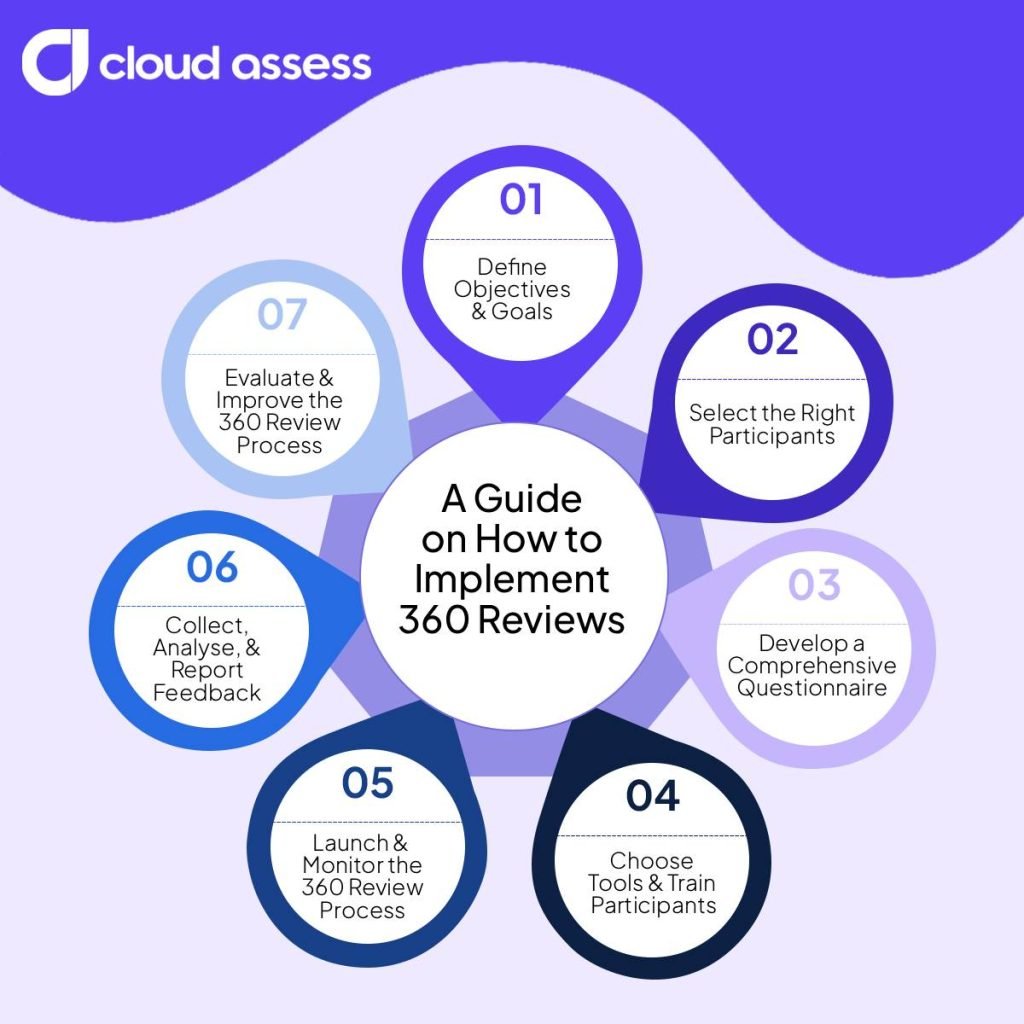
1. Define Objectives and Goals
Determine what you aim to achieve. This could be enhancing employee development, improving team dynamics, or identifying leadership potential. Use SMART criteria (Specific, Measurable, Achievable, Relevant, Time-bound) and ensure these objectives align with the broader organisational goals to drive meaningful outcomes.
2. Select the Right Participants
Carefully select participants to ensure a comprehensive review. Include a mix of peers, direct reports, supervisors, and even external stakeholders to provide diverse perspectives. Ensure that participants understand the importance of their role in the process.
3. Develop a Comprehensive Questionnaire
Craft a well-rounded questionnaire that addresses various competencies and behaviours for relevant roles. Use a mix of quantitative rating scales and qualitative (open-ended) questions to gather detailed performance feedback.
4. Choose Tools and Train Participants
Companies that effectively use performance management tools are 150% more likely to financially outperform their industry peers. So, select reliable tools and platforms to facilitate the 360 review process. Train participants on how to use them effectively and provide guidance on giving positive feedback. Ensure the tools you choose are secure and easy to use.
5. Launch and Monitor the 360 Review Process
Initiate the review process with clear instructions and deadlines. Monitor progress to ensure timely completion and address any technical or procedural issues that arise. Maintain open communication channels for support.
6. Collect, Analyse, and Report Feedback
Gather the completed surveys and analyse the data to identify trends and key insights. Use both statistical analysis for quantitative data and thematic analysis for qualitative responses. Compile comprehensive reports for each reviewer, highlighting strengths and areas for improvement.
7. Evaluate and Improve the 360 Review Process
After the reviews are complete, evaluate the effectiveness of the process. Gather feedback from participants about their experience and where it can be adjusted Use these insights to refine future 360 reviews.
For example, you can conduct a follow-up survey to understand participant satisfaction and gather suggestions for improvement. However, do try to avoid survey fatigue. Sending out too many survey requests can add to employees’ workloads, making them reluctant to participate.
Example 360 Performance Review Questions and Scoring Rubric
For Employees
1. Character and Behaviour
- How consistently does the employee follow safe work procedures, even under time pressure?
- How proactive is the employee in reporting hazards and near misses?
- How does the employee respond to feedback on their work or safety practices?
- How committed is the employee to keeping their licences and competencies current?
2. Interpersonal Skills
- How clearly does the employee communicate during shift handovers?
- How well does the employee work with the crew to complete tasks safely?
- How does the employee handle disagreements on site or on the ward?
- How does the employee show respect towards colleagues, patients, or customers?
3. Leadership Skills and Organisational Alignment
- How well does the employee demonstrate the technical skills required for their role?
- How readily does the employee suggest improvements to work processes?
- How does the employee uphold the organisation’s safety and quality standards day to day?
- How willing is the employee to guide newer team members?
For Supervisors and Team Leaders
1. Character and Behaviour
- How consistently does your supervisor model safe work practices?
- How does your supervisor take responsibility when incidents or mistakes occur?
- How does your supervisor support you in building your skills and competencies?
2. Interpersonal Skills
- How clearly does your supervisor explain tasks, risks, and changes before each shift?
- How does your supervisor resolve conflicts within the crew or team?
- How does your supervisor recognise good work and safe behaviour?
- How well does your supervisor listen and act on concerns you raise?
3. Leadership Skills and Organisational Alignment
- Do you feel comfortable raising safety concerns with your supervisor?
- Is the feedback your supervisor provides useful and actionable?
- Do you understand how your supervisor’s targets link to wider site goals?
Scoring Responses
A scoring rubric gives every reviewer the same definition of each rating. Without one, a “3” from one reviewer can mean something different from another’s.
Example rubric: How proactive is the employee in reporting hazards and near misses?
- 4 (Exemplary): Reports every hazard straight away and suggests practical controls.
- 3 (Proficient): Reports hazards and near misses within the agreed timeframe.
- 2 (Developing): Reports most hazards, but sometimes needs prompting.
- 1 (Needs improvement): Rarely reports hazards or near misses without being asked.
To build your own rubric:
- Scale. Use four points to avoid a neutral middle score.
- Descriptors. Describe each score with observable behaviours rather than personality traits.
- Role fit. Tailor descriptors to the specific role, site, or ward.
- Timing. Share the rubric with reviewers before the review opens.
Challenges and How to Overcome Them
Potential Biases and Anonymity Concerns
With so many parties being included in 360 degree feedback, participants might be influenced by personal relationships, recent interactions, or organisational politics, leading to biased feedback. Also, if participants are not assured of anonymity, they may hesitate to provide honest feedback, fearing repercussions. This is especially the case when reviewing a direct supervisor or those in higher positions.
Solution: Use surveys and tools to collect anonymous feedback, ensuring that reviewers feel safe to share their honest opinions without fear of identification.
Time-Consuming Process
Implementing a 360 Performance Review process can be time-consuming for both the HR team and the participants. It involves designing the questionnaire, collecting peer feedback, analysing the data, and then providing helpful feedback to employees. This can be challenging for both large organisations and small businesses with limited resources.
Solution: Finding the right review software can reduce administrative strain by automating data collection and analysis, reducing manual effort and saving time.
Handling Negative Feedback
Criticism can be difficult to receive and deliver. It can make employees feel demotivated or defensive. Similarly, managers might find it challenging to communicate negative feedback constructively without causing resentment or accusations of unfairness or bias.
Solution: Improving communication skills can see managers giving feedback empathetically, using specific examples and actionable suggestions for improvement.
Ensuring Actionable Insights
Feedback from 360 reviews can sometimes be too vague or general, making it difficult to extract actionable insights. Employees need specific, practical advice on how to improve their performance.
Solution: Customising your 360 performance review template can help you gather detailed feedback on specific behaviours and competencies, avoiding broad, generic questions.
Choosing the Right 360 Review Tool or Software
The successful implementation of 360 performance reviews involves careful planning. Finding a review tool that integrates well with your existing performance management framework can save you time and effort and ensure consistency when it comes to reviews. This is why it’s important to choose software that not only meets your technical requirements but also supports your organisational goals.
Tools like Cloud Assess offer a wide range of features to help organisations simplify the review process. These include:
- Customisable templates to tailor questions for specific roles and competencies.
- A User-friendly interface for both administrators and participants.
- Reporting and analytics capabilities to analyse feedback effectively.
- Anonymity options to ensure respondent anonymity, fostering honest performance feedback.
- Integration with your existing HR and performance management systems.
Want to see the difference that Cloud Assess can have on your review process? Sign up for a Explore Pricing of the employee training platform.