Humanforce is a trusted solution for effective workforce management. The platform unifies HR, payroll, talent, and financial well-being tools. It’s widely used in industries with shift-based and frontline teams, where efficiency and compliance are critical.
But managing a workforce also involves ensuring employees hold the right qualifications. It’s also about making sure they have the skills to work safely and meet compliance requirements on a continuous basis.
That’s where Cloud Assess comes in. The training and assessment platform helps organisations deliver flexible learning. It also supports skill development and simplifies compliance. It’s especially effective in high-risk and deskless environments.
Juggling two systems might seem like a challenge. However, integrating Humanforce with Cloud Assess removes friction.
In this article, we explore how the Humanforce and Cloud Assess integration bridges the gap between workforce operations and employee development.

Why the Humanforce Integration with Cloud Assess is a Game-Changer
When workforce tools operate in silos, essential data becomes fragmented and decision-making suffers. The integration of Humanforce with Cloud Assess eliminates these barriers. It brings workforce management and workforce capability into one seamless system. This enables businesses to optimise operations while developing a skilled, agile workforce.
Connecting your learning management system (LMS) with your workforce management solution helps you manage various workforce elements in one place. These include employee qualifications, training progress, and compliance. This integration ensures leaders have a complete view of their teams. It makes it easier to support continuous professional development and plan for future workforce needs.
The skills matrix within Cloud Assess adds another layer of value. It supports skills mapping and planning. It also provides a visual representation of abilities company-wide. This helps organisations assign employees to roles where they’ll have the greatest impact. It also helps organisations identify skill gaps at a glance and design targeted training programs that close those gaps. Beyond filling immediate needs, this also helps with succession planning. Companies can identify potential future leaders and equip them with the tools to succeed.
Ultimately, this integration supports a more dynamic and adaptable workforce. Instead of assigning tasks based on job titles, businesses can align responsibilities with real skills. The result is a workforce that is more empowered, more engaged, and better prepared to deliver results.
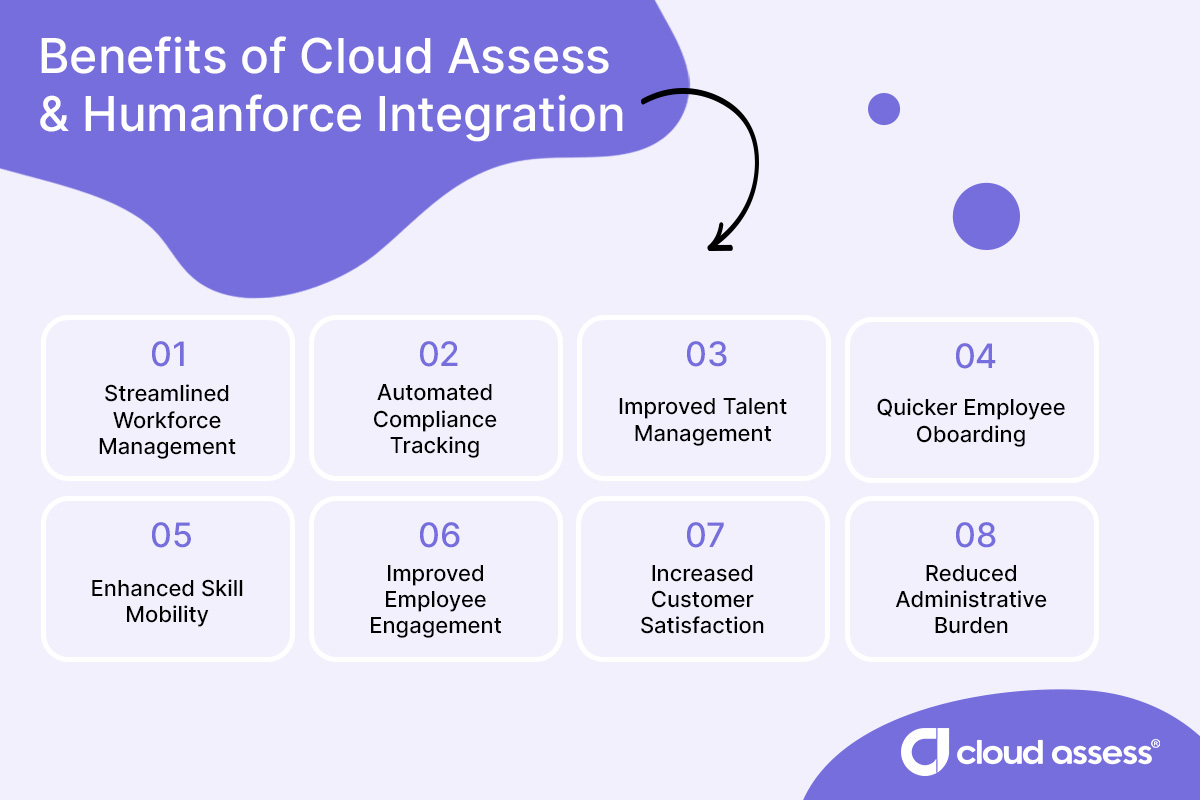
Benefits of Cloud Assess & Humanforce Integration
Streamlined Workforce Management
Cloud Assess and Humanforce working together allows for more efficient, data-driven and strategic workforce planning. Managers can oversee onboarding, talent planning, payroll, and training in one place. This reduces duplication, strengthens compliance, and improves oversight across both operations and capability. It also helps teams stay focused on delivering outcomes rather than navigating multiple systems. The result is a smoother, more connected management process.
Reduced Administrative Burden
Linking HR, workforce management, and training in a single ecosystem reduces administrative tasks. Managers no longer need to transfer data or manage updates across different platforms manually. This frees HR and operations employees to focus on strategic initiatives rather than paperwork. The outcome is greater efficiency and reduced operational costs.
Automated Compliance Tracking
Compliance is easier to maintain when reporting is automated across both platforms. The integration tracks certifications, licences, and training records in real-time. This reduces the risk of missed requirements. Leaders can generate reports quickly, ensuring they always have accurate data at their fingertips. This proactive approach safeguards the organisation and simplifies audits.
Improved Talent Management
Talent management is more effective when you can attract candidates and hire with confidence. The integration makes it easier to match skills to roles, ensuring the right people are placed in the right positions. Connecting workforce data with training progress gives leaders deeper insights into employee potential. This supports internal recruiting, encouraging employees to upskill and reskill into available roles. However, it also helps to identify gaps where external hiring may be a better option. Together, this creates a pipeline of talent that can grow with the business.
Quicker Employee Onboarding
The integration allows organisations to onboard faster. It connects training programs directly to workforce requirements. New hires can access role-specific learning immediately, helping them become productive sooner. Managers gain visibility into progress, ensuring no step is missed in the onboarding journey. This streamlined employee onboarding process reduces downtime and accelerates time-to-performance.
Enhanced Skill Mobility

With a clear view of workforce skills, companies can leverage skill mobility across their workforce. Teams can be assigned more effectively across projects and roles. Managers can pinpoint employees who will perform well in specific tasks. They can make data-driven decisions based on assessments and competencies. This creates a more agile workforce, where skills, not just job titles, drive decisions. Over time, it also builds career pathways for employees looking to expand their roles.
Improved Employee Engagement
Employee engagement increases when performance, training, and workforce planning are connected. The integration helps employees see how their work links to company culture. They can also understand how their roles and expertise support the organisation’s mission and vision. This connection fosters stronger commitment and motivation. In turn, businesses benefit from higher employee retention and a more engaged workforce.