Working in the modern workplace can often feel chaotic. Decisions must be made on the spot, leaving little time for thoughtful consideration. It’s easy to settle into routines that work ‘well enough,’ even if they could be significantly improved with a moment of reflection.
Schön’s Reflective Practice provides a flexible framework for accessing and refining professional knowledge that shapes your decision-making. It allows you to evaluate your actions, adjust your routines, and shift from relying on instinct to leveraging informed insights.
In this article, we explore the history, principles, and components of Schön’s reflective practice, its benefits, and how to apply it to your workflow. We’ll also share real-world examples of its use across different settings and offer tips for incorporating it into your daily routines.

What is Schön’s Reflective Practice?
Schön’s Reflective Practice, also known as the Schön Reflective Model, is a framework for using experience, learning, and practice to actively improve professional performance.
It emphasises using knowledge in action, reflection in action, and reflection on action to draw on experience and implicit knowledge when adapting to new situations. This process fosters a deeper understanding of one’s actions, allowing professionals to make informed, data-driven decisions and refine their methods in real time.
Schön’s process bridges the gap between theory and practice, encouraging professional learning and dynamic problem-solving. These essential elements help professionals in sectors like education, healthcare, social work, and leadership think critically and adapt quickly to changing scenarios.
History
Donald Schön introduced his reflective practice theory in his 1983 book, The Reflective Practitioner. The book stemmed from his efforts to understand the complexities of professional planning and decision-making. To address this, Schön examined how professionals think, communicate, and interact across various sectors, uncovering the processes that contribute to professional excellence.
However, Schön’s Reflective Practitioner wasn’t the first theory to address reflective practice. Theorists like John Dewey, Kurt Lewin, Jean Piaget, Terry Borton, and David A Kolb explored the role of reflection in their experiential learning theories. The concept can even be traced back to ancient philosophies, including Buddhist teachings and the writings of Roman philosophers like Marcus Aurelius.
Components of the Schön Reflective Model

- Knowledge in Action is the foundation of information and skills honed through years of training that people apply instinctively. This tacit knowledge shapes decision-making and guides daily tasks and routines. Taking the time to recognise your thought patterns and the knowledge you rely on can help you tap into these insights more deliberately. This heightened awareness enables confident, data-driven decisions, reducing reliance on instinct alone.
- Reflection in Action is the process of ‘thinking on your feet’. It involves assessing and adapting your actions and decisions in real time as a situation unfolds. Asking questions like, ‘Is this the best course of action?’ or ‘Could there be a more effective approach?’, allows for active problem-solving. This practice enhances self-awareness, promotes a more deliberate and thoughtful approach, and allows for quick yet informed decision-making.
- Reflection on Action involves examining decisions after they’ve occurred and evaluating their effectiveness and appropriateness. This process examines the ‘why’ and ‘how’ behind decisions, inviting professionals to consider the steps they took and their outcomes. Insights gained from this step can guide future strategies, fostering continuous personal and professional growth.
Reflective Practice Principles
While the components of Schön’s Reflective Practice explain how the process works, it’s also important to look at the principles behind his framework. These provide a better understanding of the importance of each component, while also helping you apply the practice in different settings and scenarios.

- Problem Framing. Identifying and defining key challenges within a situation. This requires questioning assumptions and exploring different perspectives by evaluating knowledge in action and practising reflection in action. This process ensures you gain a thorough understanding of the issue at hand.
- Action. Applying knowledge and experience to implement solutions or strategies in response to challenges.
- Reflection. Critically analysing actions to uncover patterns, learn from experience, and identify areas for improvement. It can occur after a situation, or during the process to inform future decisions. This is what distinguishes reflection on action from reflection in action.
- Reframing. Reinterpreting a problem or situation to gain new insights. Often undertaken during reflection on action, this encourages innovative solutions and a deeper understanding of the challenges involved.
- Contextual Learning. Considering the specific environment and circumstances in which actions and learning occur. It recognises that effective solutions are often tailored, rather than one-size-fits-all.
- Continuous Improvement. A commitment to ongoing learning and development. It involves using insights gained from reflection to enhance workplace skills, refine processes, and improve outcomes over time.

Benefits of Adopting the Schön Reflective Model
Develops Emotional Intelligence
Self-reflection is a cornerstone of emotional intelligence, helping individuals understand their emotional responses and triggers. Schön’s reflective practice encourages evaluating the impact of your emotions and the feelings of those around you when navigating delicate situations. This improves communication, collaboration and risk assessment, allowing for more informed decision-making.
Focus on Continuous Professional Development
The Schön reflective model promotes continuous learning and growth. Analysing your thought processes and reviewing current and past challenges enables you tomake more informed, data-driven decisions rather than relying solely on instinct.
Beyond that, where your instincts have proved correct, reflective practice helps uncover their underlying logic. This can boost confidence in your abilities and support long-term and continuous professional development.
Develops New Soft Skills and Technical Skills
Reflective thinking helps you focus on specific workforce skills you want to develop by encouraging deliberate evaluation of your actions and routines. This process allows you to identify skill gaps and strengths that can be enhanced further.
Schön’s model supports purposeful skill development in technical skills related to your role and power skills like communication, teamwork, and problem-solving. This ensures alignment between your career goals and workplace needs.
Identifies Opportunities and Areas for Improvement
Beyond skill gaps, Schön’s reflective practice helps to uncover inefficiencies, missed opportunities, or untapped potential in your current routines. Regular reflection can highlight specific areas for optimisation and innovation. This provides an opportunity for continuous refinement, leading to better results.
Helps to Overcome Career Stagnation
Unproductive and ineffective routines can impact organisational processes and job satisfaction, resulting in a sense of career stagnation. Reflection is a powerful tool for identifying barriers to growth by assessing your challenges, accomplishments and skill sets. This awareness can help you set actionable goals, build up new competencies, and find the motivation to progress your career.
Boosts Adaptability
Practising reflection in action can help you respond effectively to changing circumstances. Analysing your actions and decisions in real time will help you shift priorities and strategies as needed. This can improve your change management, helping you handle the complexities of evolving workplace dynamics and organisational goals with professionalism.
How to Apply Schön’s Reflective Practice

1. Recognise the Problem
Start by identifying the core issues or challenges within a situation and approaching each one systematically. Look at the context behind the scenario to better understand what needs to be addressed. This avoids relying on assumptions and ensures your actions and strategies are well-suited to the specific situation.
2. Think on Your Feet
Assess your actions and decisions as the scenario unfolds. This involves reflection in action. Asking questions like ‘Is my approach working?’ and ‘What adjustments can I make?’ will help you adapt and respond effectively in real-time, without delaying progress.
3. Analyse and Evaluate
Once the situation has been handled, it’s important to take the time to review the decisions that were made and their outcomes. This involves reflection on action. Identify the reasoning behind the actions that were taken, and think about what could have been improved. Ask questions like, ‘Is this the result I expected?’ and, ‘What could I have done differently?’ Reflecting with the benefit of hindsight allows you to gather valuable evidence and insights to guide future decisions.
4. Reassess and Reframe
Use insights from your analysis to revisit your initial assumptions and explore new perspectives. Reframing challenges can reveal innovative solutions or alternative approaches, helping you become more mindful of different viewpoints during future decision-making.
5. Develop a Plan of Action
Based on your reflections, create a clear plan to apply what you’ve learned. Ensure you include what went well alongside areas for improvement. Incorporating these insights into your routines will help you handle future challenges with refined strategies and greater confidence.
Real-World Examples of Schön’s Reflective Practice in Action

Education and Teaching Example
A teacher notices that students aren’t participating or engaging in a group activity. Using reflection in action, he considers two options:
- Change the groups to ensure each has one active participant to encourage others to share their views.
- Change the activity itself to accommodate different learning styles.
After the lesson, he reflects on his choice and uses training feedback to analyse why the activity didn’t go as planned. He incorporates the experience and feedback into his future lesson plans as part of contextual learning. This helps him design future activities that encourage better collaboration and meet students’ unique learning styles.
Healthcare and Nursing Example
During rounds, a nurse notices that a patient isn’t responding to treatment as expected. He uses reflection in action to adjust his approach, asking additional questions that could inform a different diagnosis, and performing a thorough assessment.
Afterwards, he reflects on action by reviewing the steps taken in the initial diagnosis and reframes the scenario based on the patient’s reaction to treatment. He consults with colleagues to better understand symptoms he might have overlooked. This process helps him refine his diagnostic and communication skills, ensuring more effective responses to similar cases in the future.
Business and Leadership Example
A project manager realises her team is falling behind schedule on a tight deadline. Using reflection in action, she recognises that priorities have been misaligned. She considers two options:
- Push the project forward to allow more time for all tasks to be completed.
- Reallocate resources to address the most urgent deliverables.
After the project wraps up, she considers what she could have done differently to avoid the delays. Using reflection on action, she recognises that clear communication, more thorough planning, and better task delegation will set clearer expectations. These adjustments help her implement continuous improvements that lead to better workflows and time management for future projects.
Tips for Implementing Schön’s Reflective Practice
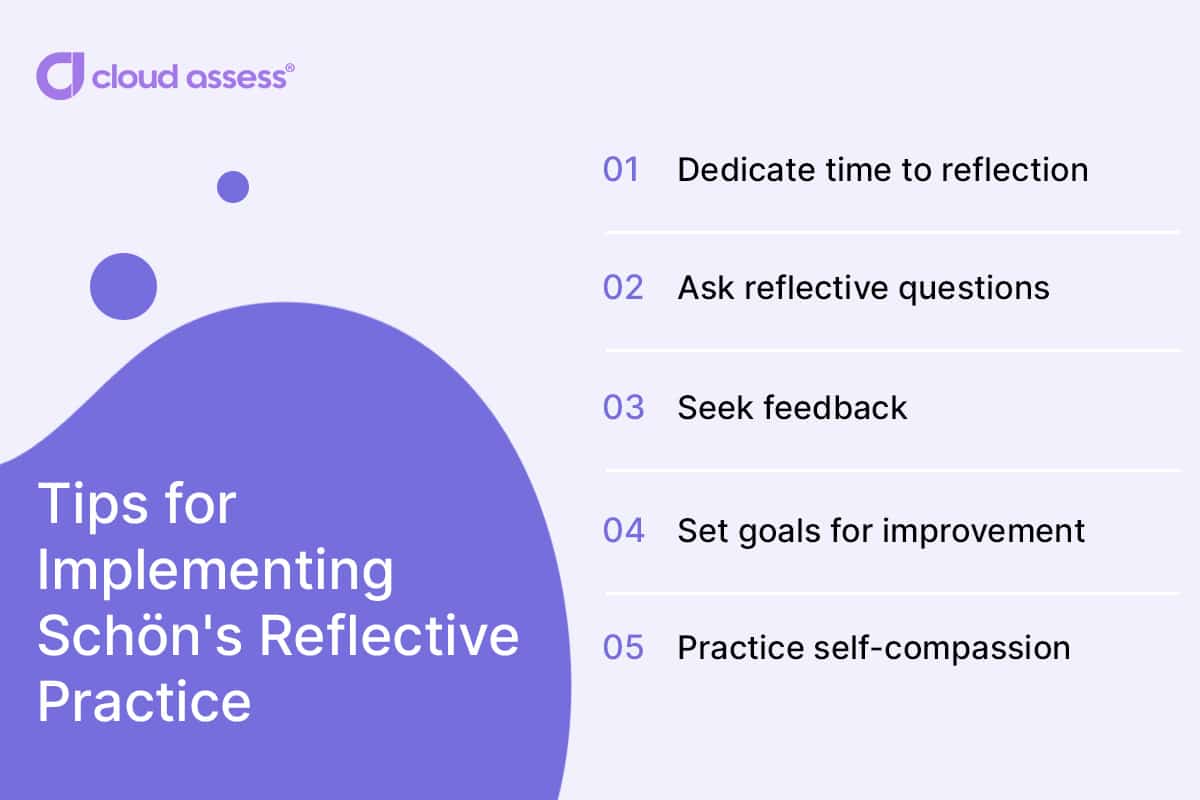
- Dedicate time to reflection. Make reflection a regular part of your routine, not as an afterthought. Set aside dedicated time daily or weekly to incorporate reflective thinking into your processes. Consistency will help you internalise the practice and make it more effective.
- Ask reflective questions. There are questions that you can ask at each stage of Schön’s reflective model. For example, asking ‘What do I already know?’ can help you recognise knowledge in action. Asking ‘What other factors should I consider’ during reflection in action can help you consider other solutions in the moment. Asking ‘What can I do differently in future’ will make reflection on action more insightful.
- Seek feedback. Reflection doesn’t have to be a solo activity. Engage in reflective conversations with mentors, colleagues, or trusted friends to gain different perspectives. Feedback from others can provide valuable insights and enhance your reflective process.
- Set goals for improvement. Use the insights gained from reflection to actively improve your work. Make notes of the lessons you’ve learned and create a plan for incorporating them into your routines. Setting clear and actionable goals will help you foster continuous learning and growth.
- Practice self-compassion. Reflection isn’t just about identifying areas for improvement—it’s also about recognising and celebrating successes. Schön’s reflective practice should encourage thoughtfulness, not self-criticism. Take time to acknowledge your achievements, growth, and instances where you’ve successfully applied past experiences to improve outcomes.
Schön’s Reflective Practice vs Other Learning Models
Schön’s reflective practice is most effective when considered alongside other learning theories and models. Incorporating it into a broader training plan that draws from multiple approaches can support personal development while aligning organisational goals with employee growth.
- Kolb’s Learning Cycle – Both models emphasise learning from experience and reflection as central to skill development.
- Vygotsky Scaffolding Theory – Schön’s reflective practice supports self-directed learning within a scaffolded environment.
- Cognitive Learning Theory – Schön’s reflective practice aligns with cognitive learning theories from Jean Piaget, Albert Bandura, and others that focus on internal mental processes and metacognition.
- Honey and Mumford Learning Styles – Schön’s reflective practice fits well into Honey and Mumford’s Reflector learning style. It also accommodates others’ learning styles through action-based problem-solving.
- Malcolm Knowles Adult Learning Theory – Schön’s model complements Knowles’ principles of andragogy, or adult learning. It ties in particularly well with his views on self-directed and experiential learning.
- Gibbs’s Reflective Cycle – Gibbs’ cycle offers a structured framework for reflection that complements Schön’s more flexible approach.