Reflection is essential to effective learning, helping organisations and educational institutions foster growth and improve outcomes. Gibbs’ Reflective Cycle offers a structured framework to guide this process, breaking reflection into clear, actionable stages. This model supports meaningful learning, purposeful decision-making, and continuous improvement by encouraging deeper analysis of experiences and their outcomes.
Widely used across various sectors, Gibbs’ Reflective Cycle is a valuable tool for optimising teaching and learning methods and enhancing overall performance.
What is Gibbs’ Reflective Cycle?
Gibbs’ Reflective Cycle is a systematic framework designed to help individuals engage in reflective learning by breaking down experiences into actionable steps. Developed by educational theorist Graham Gibbs in 1988, this model was first introduced in his seminal book, Learning by Doing: A Guide to Teaching and Learning Methods. It has since become a cornerstone in reflective practice across various disciplines.
The cycle consists of six stages that promote deep analysis and understanding of experiences. Facilitating structured self-reflection enables individuals to extract meaningful insights, refine their skills, and plan for future improvements. Gibbs’ model is particularly useful in experiential learning, where practical experiences form the basis for developing knowledge and strategies.
Initially tailored for educational settings, Gibbs’ Reflective Cycle has been widely adopted in sectors such as healthcare, social work, and business management. Its adaptability and simplicity make it accessible to learners and professionals alike. This model fosters a culture of continuous improvement by encouraging introspection, critical thinking, and strategic planning.
The Six Stages of Gibbs’ Reflective Cycle
Gibbs’ Reflective Cycle divides reflection into six distinct stages, providing a structured approach for analysing experiences. Each step builds on the last, promoting a logical progression from understanding events to planning actionable improvements. This systematic framework ensures that lessons are thoroughly examined and effectively applied to future situations.
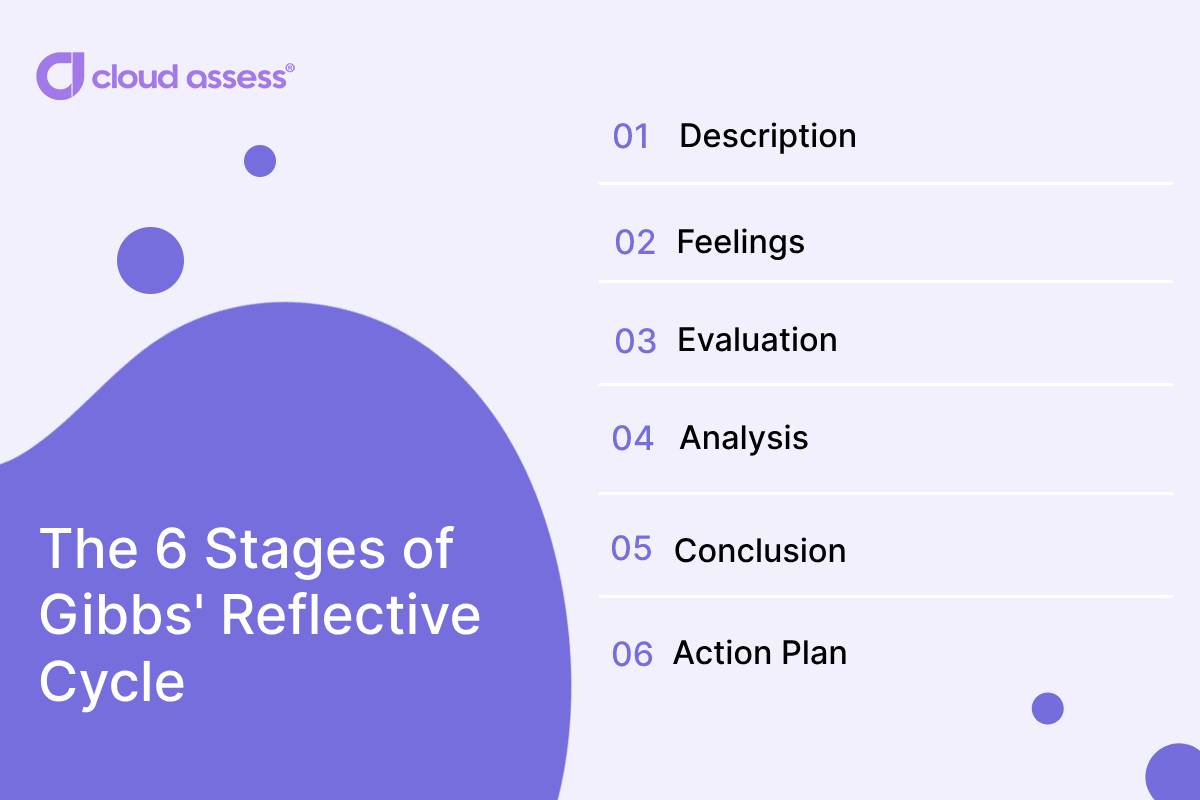
1. Description
The first stage involves creating an objective account of the experience by documenting what occurred in detail. This step emphasises recording facts without interpretation or judgment, forming a foundation for meaningful reflection. Specificity is key to ensuring clarity and precision. Key questions include:
- What happened during the event?
- Who participated?
- What were the results or outcomes?
2. Feelings
This stage explores the emotional response to the experience, encouraging critical reflection on feelings during and after the event. Recognising emotions without judgment helps uncover how they influence actions or decisions and can be used to improve overall emotional intelligence. Questions to consider:
- What were my feelings during the event?
- How did I feel afterwards?
- How might others have felt in this situation?
3. Evaluation
The evaluation stage involves critically assessing the experience to identify strengths and weaknesses in your approach. By examining both successes and challenges, this step fosters a balanced understanding of what worked and what could be improved. Questions to ask include:
- What aspects of the experience were successful?
- What challenges or difficulties arose?
- What areas require improvement?

4. Analysis
The analysis stage focuses on uncovering the underlying reasons behind why the situation unfolded as it did, examining factors such as patterns, causes, and contributing influences. This step deepens understanding of how actions, decisions, or external factors shaped the experience and its outcome. Key questions include:
- Why did the situation unfold as it did?
- What influenced my actions or decisions?
- Were there external factors that affected the event?
5. Conclusion
The conclusion stage emphasises extracting key lessons from the experience. It provides a chance to reflect on insights gained and plan how to approach similar situations differently in the future. Key questions include:
- What did I learn from this experience?
- What would I do differently next time?
- What skills or knowledge could help me improve?
6. Action Plan
The final stage focuses on turning reflection into actionable steps. This involves creating a plan to apply lessons learned and prepare for future challenges. It may include setting goals, building skills, or adopting new approaches. Key questions include:
- What steps will I take to apply what I’ve learned?
- How can I prepare for similar challenges?
- What resources or support will help me succeed?
Applications of Gibb’s Cycle Across Different Fields
In Educational Settings
Gibbs’ Reflective Cycle plays a pivotal role in promoting a culture of learning and improvement in education, benefiting both students and educators.
Enhancing Curriculum Design
Educators leverage the reflective cycle to assess the effectiveness of their teaching strategies and curriculum design. Analysing student outcomes and feedback reveals areas of success and those requiring refinement, paving the way for more impactful learning experiences.
Fostering Student Development
Students use the cycle to reflect on their academic experiences, such as assignments, projects, or assessments. This process helps them identify strengths, address challenges, and set clear, actionable goals for personal and academic growth.
Encouraging Peer Collaboration
The cycle also supports reflection in group activities, helping students analyse team dynamics and their contributions to shared tasks. This improves communication, teamwork, and problem-solving skills, fostering a more cohesive learning environment.

In Workplace Learning and Development
Organisations use Gibbs’ Reflective Cycle to foster employee growth, enhance personal and professional development, and improve operational processes.
Enhancing Employee Training
The reflective cycle offers employees a structured framework to assess training sessions, connect newly acquired skills to their roles, and identify areas for continued improvement.
Strengthening Performance Management
Managers and employees apply the cycle to evaluate performance outcomes, celebrate successful strategies, and address areas needing attention. This approach cultivates accountability and supports continuous professional development.
Improving Onboarding Experiences
New employees use the cycle to reflect on their onboarding journey, identifying knowledge gaps or areas needing clarification. This feedback helps organisations refine employee onboarding practices, ensuring smoother transitions for new hires.
For Business Strategy and Operations
Gibbs’ Reflective Cycle supports businesses in improving team collaboration, optimising workflows, and cultivating effective leadership.
Enhancing Team Collaboration
Teams use the cycle to reflect on their performance after projects or meetings, highlighting successes and areas for improvement. This process strengthens communication and fosters more cohesive teamwork.

Improving Operational Efficiency
By applying the reflective cycle, organisations can identify inefficiencies, pinpoint their root causes, and implement targeted solutions. Regular reflection ensures that processes evolve in response to shifting needs and priorities.
Developing Leadership Skills
Leaders reflect on power skills like decision-making, communication, and problem-solving using the cycle. This helps them identify growth opportunities, refine their leadership style, and maximise their organisational impact.
How to Implement Gibbs’ Reflective Cycle Effectively
Implementing Gibbs’ Reflective Cycle requires careful planning and practical strategies to ensure it becomes integral to personal or organisational learning. By embedding it into regular practices, providing support, and addressing barriers, individuals and teams can unlock its full potential.
Define Clear Objectives
Start by identifying the specific goals you hope to achieve through reflective practice. Objectives should align with broader priorities, such as improving critical thinking in education, enhancing employee performance in workplaces, or refining team workflows.
For example, an educator might aim to deepen students’ understanding of complex concepts, while a manager might focus on improving employee engagement or productivity. Setting measurable goals ensures that the reflective process is outcome-driven and meaningful.
Train Facilitators and Leaders
Facilitators and leaders play a key role in ensuring the cycle’s success. Invest in workshops or professional development programs that teach the six stages of Gibbs’ Reflective Cycle and provide practical tools for guiding others through the process.
For instance, facilitators can use real-world scenarios or interactive exercises to demonstrate each stage. Resources such as detailed guides, checklists, and reflection prompts help standardise the process and build confidence among leaders.
Create Structured Reflection Processes
Structured reflection ensures that individuals remain focused and do not feel overwhelmed. Provide templates or prompts tailored to the six stages, ensuring clarity and consistency. For example, during the “Feelings” stage, you might ask, “How did this situation make you feel, and how did those emotions influence your actions?”
Similarly, during the “Conclusion” stage, a prompt like “What are the key lessons from this experience, and how can they be applied to similar situations?” encourages actionable insights. Templates help participants organise their reflections systematically.

Embed Reflection into Learning and Workflows
For the reflective cycle to become a habit, it must be seamlessly integrated into existing routines within educational or workplace settings. Teachers can incorporate the cycle into classroom discussions, self-assessment tasks, or project reviews in education. Students might use the cycle as part of their journals or portfolio submissions, reflecting on their growth over time. In workplaces, reflective practices can enhance team debriefings, training evaluations, or performance reviews.
For instance, after completing a project, teams could collectively reflect on what went well, what challenges arose, and how future processes could be improved. Embedding reflection into workflows ensures that it becomes part of a continuous learning culture.
Provide Tools and Resources
Practical tools can simplify and enhance the reflective process. Digital journals or online platforms can help individuals document their reflections in real-time, making it easier to revisit their insights later. In organisations, performance management software might include reflective prompts to encourage employees to evaluate their work.
Visual aids, such as infographics or flowcharts outlining the six stages, are helpful in both educational and workplace contexts. These tools make the reflective cycle more accessible and encourage participation by offering a clear visual representation of the process.
Encourage Collaboration and Feedback
Reflection becomes more powerful when done collaboratively. Group discussions or feedback sessions provide opportunities to share diverse perspectives and learn from others’ experiences. For example, in a team setting, members might discuss what went well in a recent project and collectively brainstorm ways to address challenges.
Mentors, peers, or managers can provide constructive feedback to deepen the reflection process. This fosters a culture of shared learning and ensures that individual insights contribute to broader team or organisational growth.
Track and Measure Effectiveness
Regularly assess the impact of the reflective process to ensure it aligns with its intended goals. Use both qualitative and quantitative metrics. For instance, in an educational setting, track improvements in student engagement or learning outcomes, while in a workplace, monitor increases in employee satisfaction or operational efficiency.
Collecting participant feedback can also reveal how the process is perceived and where adjustments may be needed. For example, if employees find the reflection process too time-consuming, explore ways to streamline it without compromising its effectiveness.
Address Barriers to Engagement
Common obstacles, such as time constraints or resistance to reflective practices, can hinder the effectiveness of Gibbs’ Reflective Cycle. To overcome these challenges, create a safe, supportive environment that encourages openness and honesty. Confidential discussions, for example, can help participants feel more comfortable sharing their thoughts.
Provide examples of success stories to illustrate the tangible benefits of reflective practice. Whether it’s a student improving their problem-solving skills or a team enhancing its collaboration, relatable examples make the value of reflection more evident.
3 Examples of Gibbs Reflective Cycle
1. An RTO Manager Reflecting on a Marketing Campaign

- Description: An RTO manager reflects on a marketing campaign for a short course that increased inquiries but resulted in low enrolments.
- Feelings: Initially optimistic, the manager felt disappointed by the underwhelming results.
- Evaluation: The campaign boosted website traffic but revealed issues with communication, unclear course details, and poor timing.
- Analysis: On examination, the manager finds that a lack of clarity on the website and insufficient promotion contributed to the campaign’s failure.
- Conclusion: They conclude that future campaigns should have improved course descriptions, promote offers more prominently, and align timing with audience availability.
- Action Plan: The manager plans to clarify the course page, schedule campaigns outside peak holiday seasons, and highlight offers more effectively across platforms.
2. Leadership Training: A Manager Reflecting on Team Feedback

- Description: A manager reflects on feedback from their team, highlighting a lack of clarity in task assignments during a recent project.
- Feelings: The manager felt defensive initially but later understood the value of constructive criticism.
- Evaluation: Clear communication of project goals was identified as a strength, but task delegation and follow-ups needed improvement.
- Analysis: The manager recognises that unclear instructions led to misunderstandings and missed deadlines.
- Conclusion: They conclude that improved delegation skills and better follow-up processes are essential to avoiding similar issues.
- Action Plan: The manager plans to use collaborative tools for task tracking and schedule regular check-ins to ensure team alignment.
3. A Student Reflecting on Group Work

- Description: A student reflects on their contribution to a group project that received mixed feedback from peers and the instructor.
- Feelings: The student felt proud of their research but disappointed about the team’s lack of cohesion.
- Evaluation: While the research was well-executed, weak coordination among team members led to a fragmented final presentation.
- Analysis: A lack of regular communication and unclear role assignments were key factors affecting the group’s performance.
- Conclusion: The student realises the importance of collaborative planning and shared responsibility in group tasks.
- Action Plan: For future projects, the student plans to set clear roles, establish regular meetings, and encourage open communication among team members.
Challenges and Limitations of Gibbs’ Reflective Cycle
Oversimplification of Complex Experiences
The structured stages may oversimplify multifaceted situations, particularly those involving interwoven emotions or complex dynamics. This can result in shallow reflection or overlooked insights.
Solution. Combine Gibbs’ Cycle with other frameworks, such as Kolb’s Experiential Learning Cycle or Schön’s Reflective Practice, to gain a more comprehensive perspective on complex scenarios.
Time Constraints in Implementation
Reflection can be time-consuming, making it challenging to integrate into fast-paced environments. When rushed, participants may skip key stages, leading to incomplete insights.
Solution. Embed the reflective process into existing workflows, such as team debriefings or 360 performance reviews, to ensure it becomes a regular and sustainable practice.
Resistance to Reflective Practices
Some individuals view reflection as unnecessary or unproductive, especially in action-oriented settings. This resistance may hinder engagement and reduce the cycle’s effectiveness.
Solution. Share success stories and examples demonstrating the tangible benefits of reflection, such as improved team dynamics or decision-making. Foster a supportive and open environment to encourage participation.
Cultural and Contextual Barriers
The effectiveness of the cycle can vary across cultural contexts. Participants may hesitate to share honest reflections in hierarchical cultures, particularly in group settings.
Solution. Tailor reflective prompts to respect cultural sensitivities and encourage group reflections where individuals feel safer sharing collective insights rather than personal critiques.
The Impact of Reflection on Learning and Organisational Success
Reflection is an essential process that transforms experiences into valuable learning opportunities. This framework provides a practical method for processing events, deriving insights, and planning for the future. Reflection is an academic or professional tool that fosters continuous personal and professional growth and improvement. It ensures that lessons from the past shape better outcomes in the future.