Contractor training records are one of the most common weak points in an audit. The training usually happened, but the evidence often cannot be produced, verified, or tied to the work performed. The reason for this is structural. Contractor competency evidence is created by another organisation and held in another system. It covers workers who move between sites, employers, and jobs. Organisations typically inherit the record without controlling how it was made.
The result is a gap between organisational accountability and evidence. Auditors, regulators, and principal clients test that gap directly. They ask for proof from organisations, not from contractors.
That exposure is hard to see from the inside. Contractor registers, induction dashboards, and completion rates can all look healthy. The evidence behind them can still fail an audit.
In this blog, we’ll explore:
- What an audit actually tests in contractor training records
- Why contractor records fail differently to your own
- The twelve audit risks hiding in contractor training records
- Nine practices that close those gaps
- How Cloud Assess keeps contractor evidence audit-ready
What Audits Mean for Contractor Training Records
An audit of contractor training records is a test of organisational evidence, the proof that real compliance, not just paperwork, is protecting safety and quality on site. It checks whether the business engaging the contractor can produce documentation showing that a named worker was competent for a specific task, on a specific site, and on a specific date.
Auditors work backwards from the work performed. They select a task, a site, and a date, then request the record that supports it. The record either holds up or it does not.
Four elements have to line up:
- The person. The record identifies and verifies a specific individual.
- The task. The training or licence covers the actual work performed.
- The place. Site-specific requirements are covered, not just general training.
- The time. The evidence was valid on the day the work happened.
Where any one of those is missing, the record cannot support the work, and that becomes the finding against the engaging organisation. The worker may well have been competent. Competence and provable competence are assessed separately, and only the second one is auditable.
Volume offers no protection either. A contractor file can hold dozens of certificates and still fail on a single sampled task. Auditors are not checking for a complete set of paperwork. They are checking whether one line of evidence holds up.
Why Contractor Training Records Fail Differently
Records Belong to Other Organisations
Contractor competency evidence is created, owned, and retained by the contracting business. The engaging organisation holds a copy at best, often only for the duration of the engagement. That produces two exposures. Access is not guaranteed, because contracts end, systems are decommissioned, and labour hire providers change or cease trading. Nor does the contractor’s copy satisfy an audit of the engaging organisation, which is expected to hold what it needs to demonstrate its own compliance.
Workforces Move Faster Than the Records
Contractors cycle through sites, employers, and scopes of work at a pace record systems are not built for. A worker may be inducted Monday, demobilised Thursday, and re-engaged months later under a different subcontractor. Each movement is a point where evidence breaks. Site training expires against a site the worker has left. Currency lapses between engagements. Records created under one employer do not follow the worker to the next.
Competency is Asserted Rather Than Assessed
A certificate states a conclusion. It rarely states what the worker was assessed against, under what conditions, or by whom. The engaging organisation therefore inherits a judgement it had no part in making. It did not set the standard, choose the assessment method, or verify the assessor’s currency. At audit, that judgement is treated as the engaging organisation’s own, whether or not it was ever examined.
12 Audit Risks Hiding in Contractor Training Records
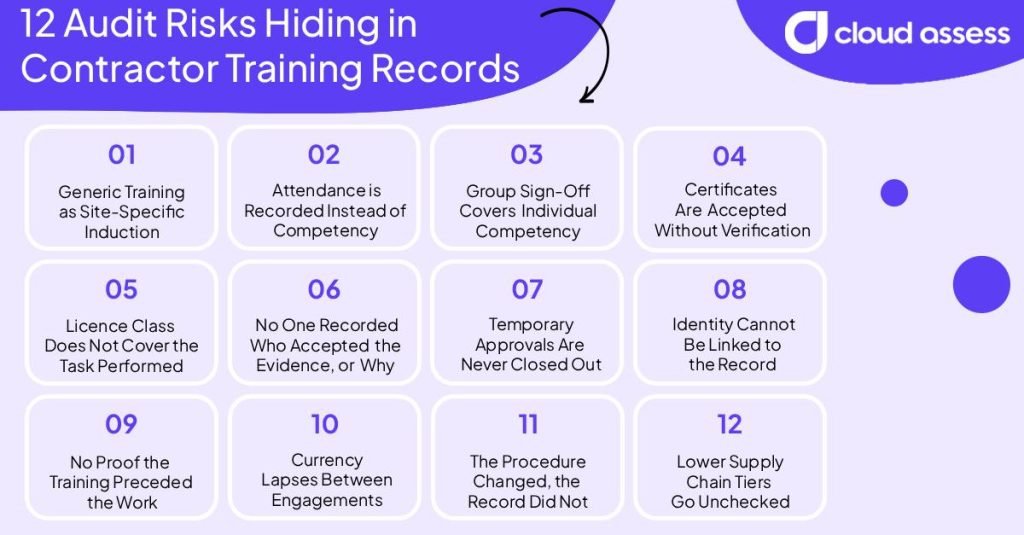
1. Generic Training is Treated as Site-Specific Induction
A worker arrives with a general safety card or an industry induction certificate. It is logged as their induction, and they are cleared to start. Those two things cover different ground. General training establishes baseline awareness. Site induction training covers the hazards, controls, and emergency arrangements of one location, including site-specific plant, exclusion zones, and permit systems.
The record fails because it names the wrong scope. An auditor sampling a task on your site asks for evidence of induction to that site. A general certificate does not reference it.
2. Attendance is Recorded Instead of Competency
A toolbox talk, briefing, or training session runs, and the attendance sheet becomes the record. The worker is marked as trained. Attendance shows exposure to information. Competency proves that the worker can perform the task to the required standard. This needs an assessment judgement against defined criteria.
The record fails because nothing in it demonstrates capability. An auditor asking how competence was determined receives a list of names and a date, with no assessment, no criteria, and no assessor.
3. Group Sign-Off Covers Individual Competency
A crew is briefed together and signed off together. One form, one supervisor signature, a list of workers underneath. Competency is held individually. Each worker either meets the standard for the task or does not, and that determination has to exist per person.
The record fails because it cannot be resolved to an individual. Where an auditor samples one worker from that crew, the group form shows they were present. It does not show what they were assessed on, or that they met it.
4. Certificates Are Accepted Without Verification

A certificate is provided at mobilisation, filed, and accepted at face value. Nothing checks whether it was issued as stated. Verification confirms three things:
- The issuing body exists and is authorised
- The certificate was genuinely issued to that person
- It remains current
The record fails because an unverified certificate proves only that a document was supplied. Where a certificate proves to be expired, altered, or issued by an unrecognised provider, the failure attributed at audit is the absence of a verification step, not the invalid certificate itself.
5. Licence Class Does Not Cover the Task Performed
A worker holds a valid, verified licence, and it is accepted as clearance for the work. The class of licence is never checked against the task. Licences are issued against defined classes. The class sets the boundary of what the holder has been assessed to do, covering equipment type, capacity, and configuration.
In Australia, that boundary is explicit. A basic rigging licence does not cover intermediate rigging, and a forklift licence does not cover a boom-type EWP. In the UK, where competence rather than a licence class is the legal test, the equivalent failure is a card scheme being treated as authorisation for whatever plant is on site.
The record fails because a valid licence is not necessarily a relevant one. Where the task sits outside the class held, the evidence covers different work from the work performed.
6. No One Recorded Who Accepted the Evidence, or Why
A certificate is reviewed at mobilisation and the worker is cleared. The file holds the certificate, but nothing about the decision to accept it. Accepting competency evidence is a judgement. Someone determined that the document was sufficient for the work. That determination has its own details, such as who made it, when, what they reviewed, and what they concluded.
The record fails because it holds the input and not the decision. When an auditor asks how the evidence was assessed, the organisation can produce the certificate. But it cannot show that anyone competent evaluated it, or on what basis.
7. Temporary Approvals Are Never Closed Out
A worker is cleared to start on a conditional basis. The certificate is in transit, the licence check is pending, or supervision is substituted until evidence arrives. Work begins, and the condition is never revisited. A temporary approval is a control with an expiry built into it. It holds only while the conditions it named remain in place, and it is discharged when the underlying evidence is produced.
The record fails because the approval outlives its conditions. What the file shows is a worker cleared subject to a check that has no completion. This puts every task performed since on evidence that was never meant to stand alone.
8. Identity Cannot Be Linked to the Record
A certificate names a worker and is filed against them. Nothing confirms that the person on site is the person the certificate was issued to. Competency attaches to an individual, so the evidence has to resolve to that individual. That needs a verified identifier carried consistently across the certificate, the site record, and the person presenting for work.
The record fails on common names, shortened names, and inconsistent spelling across systems. When an auditor asks which worker a certificate belongs to, a name alone cannot answer it. This makes shared cards or borrowed credentials impossible to rule out.
9. No Proof the Training Preceded the Work
Training and site records both exist, and both look complete. Neither carries a reliable date, or the dates are recorded to different levels of precision. Competency has to exist before the task is performed. That makes the sequence part of the evidence, not the context around it.
The record fails because it cannot establish order. A certificate can be dated to the month and the work to the day. Or the file can be backdated to the engagement rather than the assessment. This means the evidence cannot show the worker was competent at the time rather than shortly afterwards.
10. Currency Lapses Between Engagements
A worker was current when first engaged, and the record from that engagement stays on file. They return months later and are cleared against it. Currency is assessed at the point of work, not the point of onboarding. Refresher training intervals, licence renewals, and competency validity periods all continue running while the worker is off site.
The record fails because it was accurate when created and is being relied on outside that window. Nothing in the original evidence changes, which is why this one rarely gets noticed until an auditor checks the expiry against the work date.
11. The Procedure Changed, the Record Did Not
A safe work method statement is revised, a control is changed after an incident, or plant is replaced. Contractors trained under the previous version keep working, and their records still show them as trained. Training proves competency against a specific procedure at a specific version. When the procedure changes, the existing record becomes evidence of the superseded method.
The record fails because nothing links it back to what changed. Under Australian WHS law, duties are held concurrently. That means the organisation controlling the site carries its own obligation to re-establish competency regardless of what the contractor’s employer does. The UK regulation works the same way, with a duty to those not in your employment and a requirement for employers sharing a workplace to coordinate. In both cases, an auditor comparing the revision date to the training date finds a gap that belongs to the engaging organisation.
12. Lower Supply Chain Tiers Go Unchecked
Prequalification and evidence checks are applied rigorously to the contractor holding the contract. Their subcontractors, and anyone engaged below that, arrive on site under the tier one arrangement. Every worker performing work under your control falls within scope, regardless of how many contracts sit between them and you. Depth in the supply chain does not narrow what an auditor samples.
The record fails because assurance stops at the first tier while the work does not. A task can be sampled and performed by a tier three worker. But the evidence chain runs through parties the engaging organisation never assessed, often with no record that it ever asked.
9 Best Practices That Remove Risk From Contractor Training Records
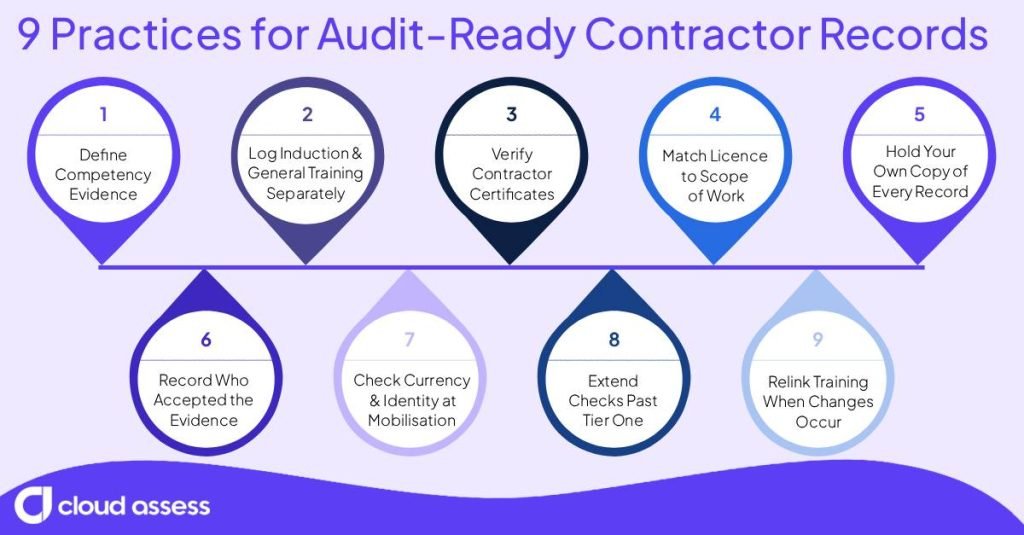
1. Define What Counts as Competency Evidence
Write down what you will accept as proof of competency before a contractor mobilises. Set it by task, not by worker or by contract. For each task, state the qualification, licence class, or assessment outcome required, plus any site-specific training. Then state what you will not accept on its own, such as an attendance record or a group sign-off.
This resolves risks 2 and 3 above, where attendance stands in for competency and group sign-off covers individuals. Both happen when nothing defines what the record should be. Keep the standard in one place, and make it the reference point for everyone clearing workers to start.
2. Separate Site Induction from General Training
Treat these as two records with two different jobs. General training establishes baseline knowledge. Site induction covers the hazards, controls, and arrangements of one location.
Log them separately, and make site induction a condition of site access rather than a box in the employee onboarding pack. Name the site on the record, and re-induct when a worker returns to a site after a period away or moves to a different one. A general safety card cannot prove induction to a site it does not name, so keeping the two records apart is what makes each one provable.
3. Verify Certificates Against the Issuing Body
Check every certificate with the organisation that issued it. Confirm the issuer is authorised, the document was issued to that person, and it remains current.
In Australia, that means checking statements of attainment against the issuing registered training organisation. It also means checking licences with the relevant state or territory regulator. In the UK, check card schemes against the scheme register and any statutory registration against the responsible body.
Record the outcome of the check alongside the certificate, including the date and who performed it. Verification you cannot evidence is indistinguishable from no verification at all.
4. Match Licence Class to Scope of Work
Check the class of licence against the specific task, not the general trade. A valid licence proves nothing if it covers different work. Build this into how you scope contractor work. When you define a task, define the licence class it requires, then check the class a worker holds against that requirement before they start.
This closes risk 5 above, where licence class does not cover the task performed. Rigging classes, EWP height thresholds, and plant capacity limits are the common failure points. This is because each one looks like a valid licence right up to the moment an auditor reads the class.
5. Hold Your Own Copy of Every Record

Take a copy of every piece of competency evidence you rely on, and hold it in your own system. Do not rely on the contractor’s records or a shared portal you do not control. Keep those copies after the engagement ends. Retention runs against the work performed, not the contract. That means records need to outlast the contractor relationship by years in most cases.
This closes the custody problem behind several risks. It ensures currency doesn’t lapse unnoticed between engagements. When a worker returns, your own history of what they held and when is the only record you can be certain still exists.
6. Record Who Accepted the Evidence
Capture the decision, not just the document. For each worker cleared to start, record who reviewed the evidence, what they reviewed, the date, and what they concluded. Make the reviewer a named individual with the authority and knowledge to make that call. A system-generated timestamp shows a file was uploaded. It does not show that anyone competent assessed it.
This helps you avoid the risk of not seeing who accepted the evidence or why. It also gives you somewhere to record conditional clearances, reducing the risk of temporary approvals quietly becoming permanent.
7. Tie Currency Checks and Identity Checks to Mobilisation
Run both checks at the point a worker starts work, not at the point they were first onboarded. Currency and identity both change between engagements. Currency lapses between engagements, and identity has to be reconfirmed each time, since you cannot assume the check performed at onboarding still applies. Onboarding records go stale without changing. Check expiry dates against the work dates, and confirm the person presenting is the person the evidence was issued to. Use a verified identifier that carries across your systems rather than a name.
Both failures are invisible in your own records, because nothing about a valid certificate changes when the worker or the date does. Mobilisation is the only point at which the check catches them.
8. Extend Checks Past Tier One
Apply the same evidence standard to every tier, not just the contractor holding your contract. Make that a contractual obligation, with the right to audit their subcontractor records. Ask for the names of every party engaged below tier one before work starts. Check evidence for the workers performing the highest risk tasks regardless of who employs them.
An auditor sampling a task does not stop at the first contract, so neither can your assurance. Depth in the supply chain is a reason to check further down, not a reason the check belongs to someone else.
9. Relink Training When Procedures or Incidents Change
Procedure changes should trigger a training review. When you revise a safe work method statement, change a control after an incident, or replace a plant, identify who was trained under the old version. Version your training records so they point to the procedure they were built on. Without that link, you cannot tell who needs re-briefing without checking every record by hand.
Then close the loop. Re-brief the affected workers, including contractors who have demobilised but are due to return. Ensure you record the date against the new version.
How Cloud Assess Helps You Maintain Audit-Ready Contractor Training Records
Cloud Assess is built for high-compliance workplace settings where training records have to be verifiable at a moment’s notice. It replaces fragmented paper and spreadsheet systems with a single instance covering every site and business unit, so permanent employees, contractors, and casual workers sit in one live view of capability.
Cloud Assess offers capabilities that help organisations keep contractor records audit-ready:
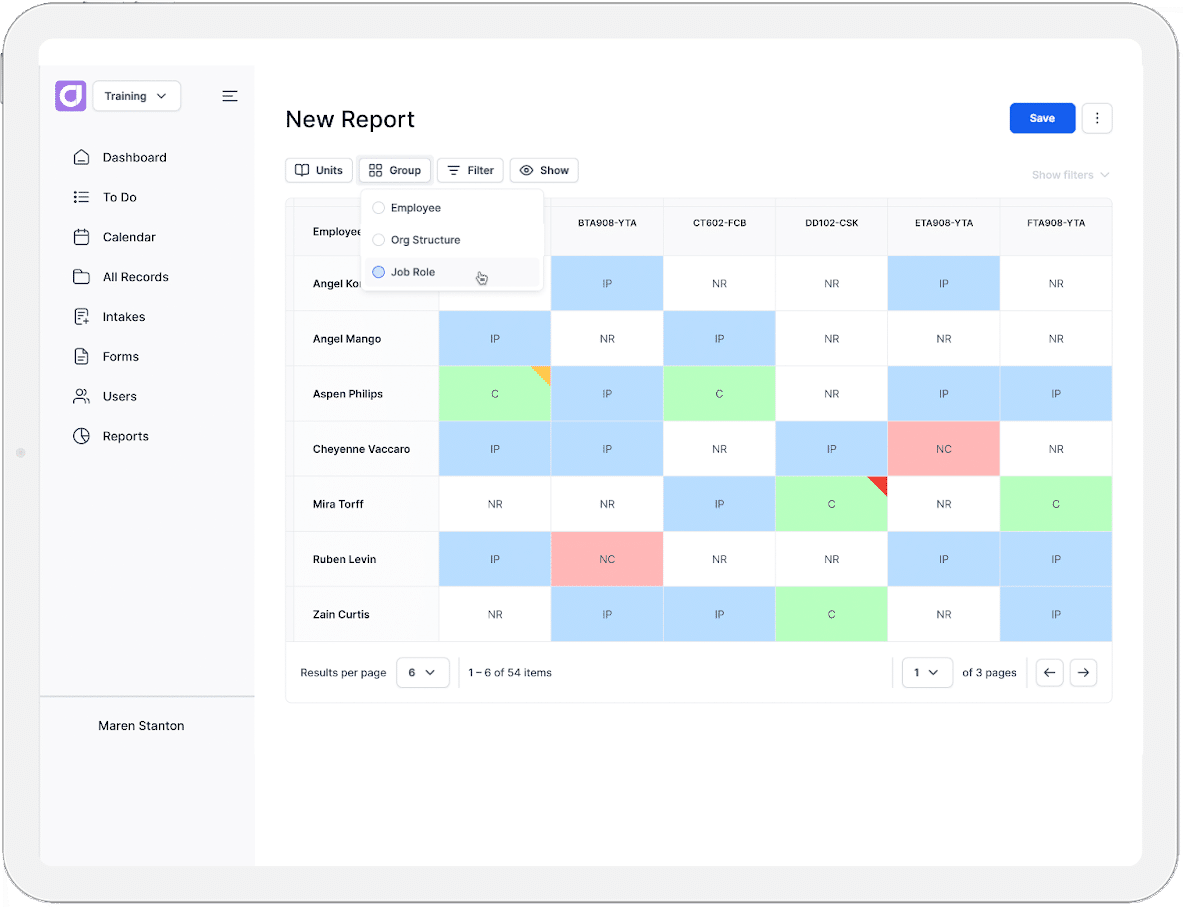
- Live Skills Matrix. A real-time, filterable grid that cross-references role profiles against personnel. This ensures skill and competency gaps and compliance status are visible instantly rather than assembled for an audit.
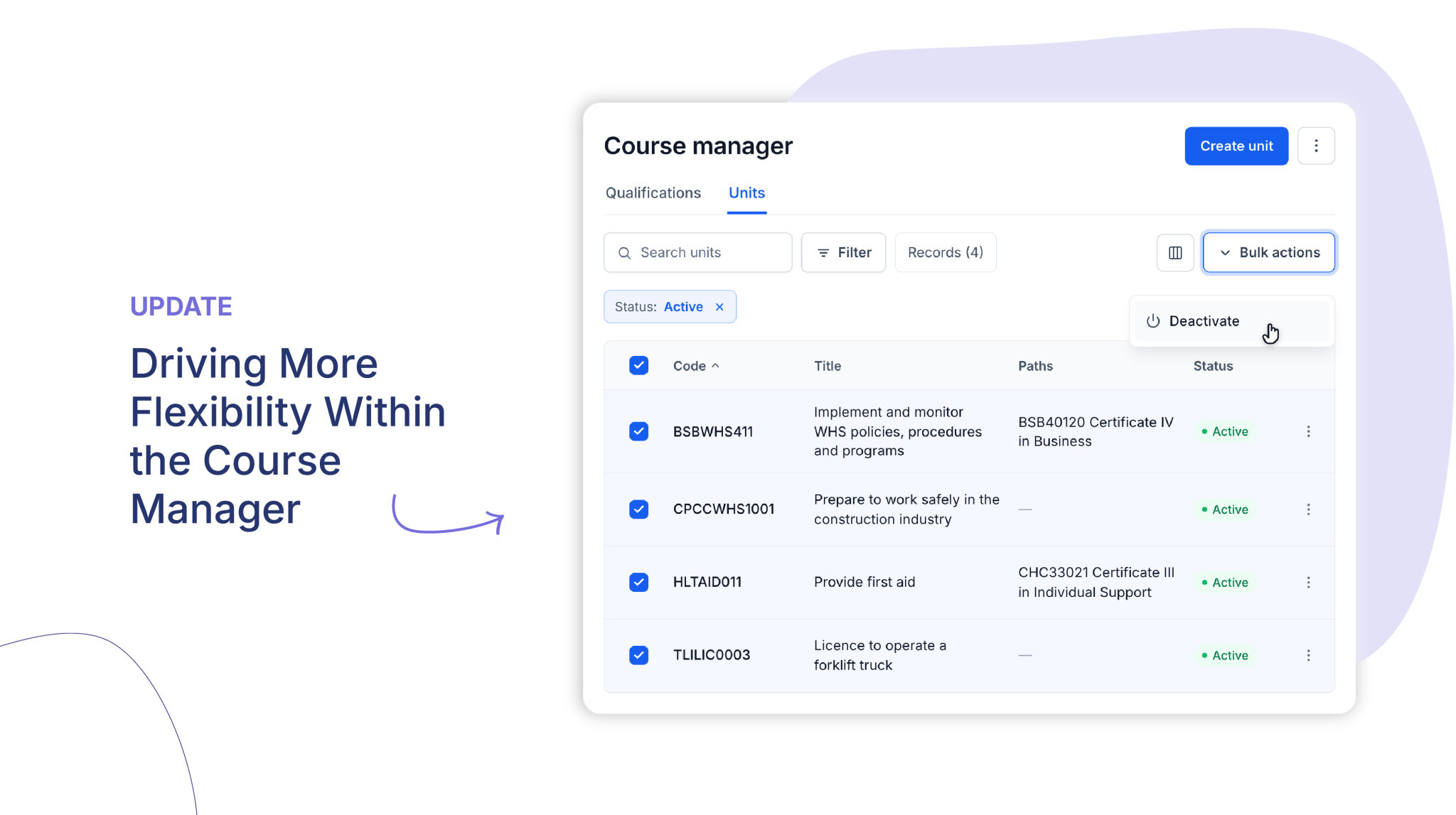
- Third-party user access. External parties, such as a subcontractor’s own supervisor or an auditor, can be given access to a defined subset of data without full access to your system. This lets them view and manage the records relevant to their own workers, while you retain control over everyone else’s..
- Verified evidence capture. Photo, video, and GPS-stamped evidence of competency captured on the job, in place of a completion tick. This is what separates a record of attendance from proof of competency.
- Offline capability. The learner app supports mobile and offline verification of competency for remote sites. It allows records to be captured without signal and synced once back in range.
- Automated expiry alerts. It offers custom triggers for certifications and licences. These escalate from the worker to managers or HR before a qualification expires. This is the control that stops currency lapsing between engagements.
- Activity revisions. When a procedure changes, a new revision of an assessment can be distributed to workers who already completed the previous version. That keeps training records tied to the current method rather than a superseded one.
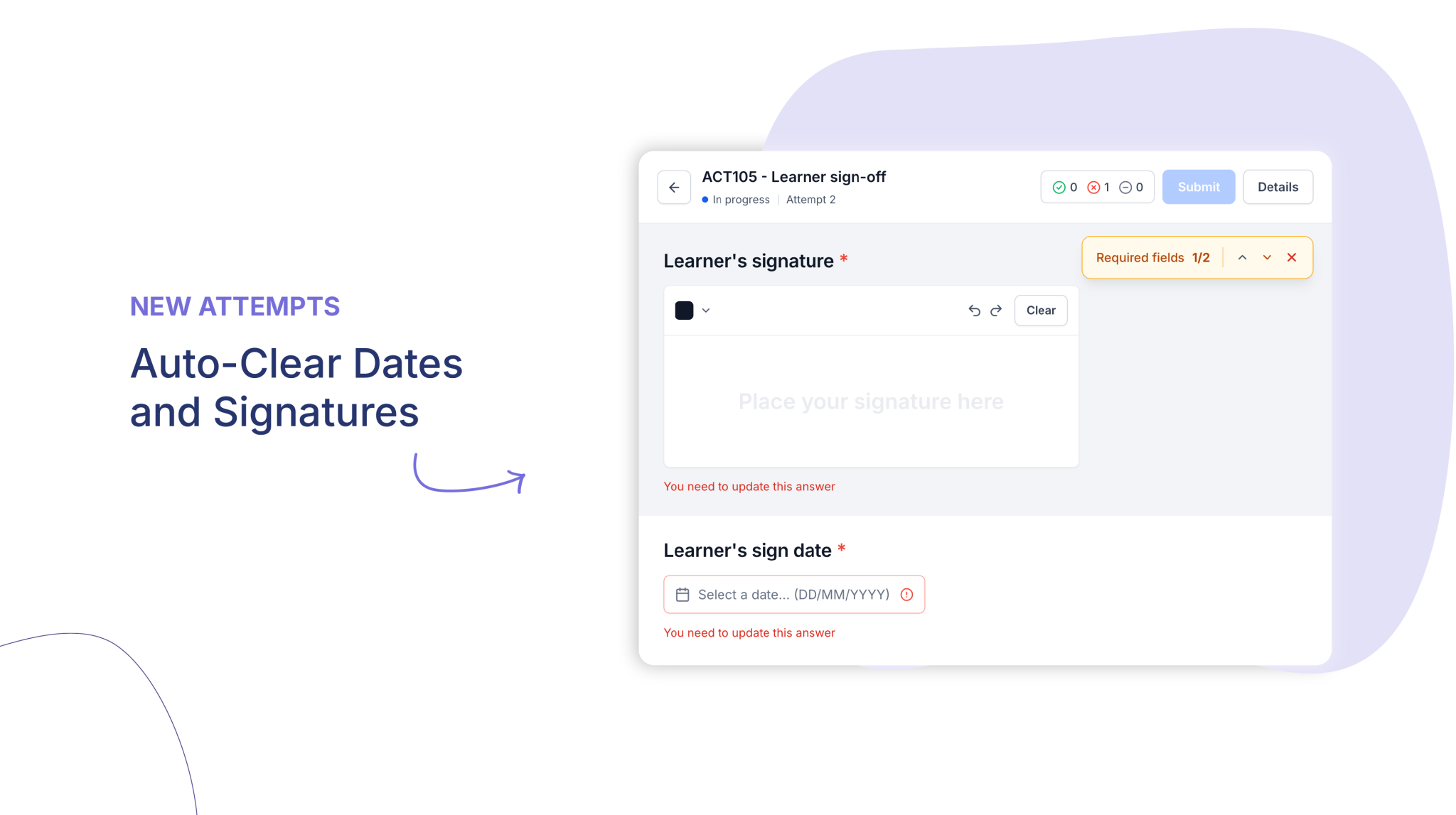
- Digital signatures and timelines. Digital signatures, backed by audio or video evidence, capture who accepted a piece of evidence and confirm it’s authentic. Timelines then build a visual audit trail of each record, covering approvals, conditions, and training history in sequence. Together, they show whether training preceded the work and whether conditional approvals were ever closed out.
- Native integrations. The platform can connect with existing HR systems and other business platforms. This helps ensure contractor data can seamlessly flow across systems without manual reconciliation.
Would your contractor records survive a sampled audit today? If your answer is no or unsure, that is a fixable problem. Book a demo and see how Cloud Assess works against your own records.