Cornerstone has introduced its latest unified platform, Cornerstone Galaxy. The platform brings together learning, skills, and talent capabilities. As part of this shift, several products no longer operate as standalone systems. They now sit within the Cornerstone Galaxy environment. Saba LMS is one such platform.
For many organisations, especially small and medium-sized enterprises, this raises practical questions. Is Saba still the same product? What does Cornerstone Galaxy actually represent? And how does this change affect organisations that need a focused, easy-to-manage learning system?
In this article, we’ll discuss:
- When and how Saba was acquired by Cornerstone
- What Cornerstone Galaxy is
- Why this change matters for small and medium-sized enterprises (SMEs)
When Cornerstone acquired Saba LMS
Cornerstone’s Acquisition of Saba
Saba LMS is no longer an independent product. Cornerstone OnDemand acquired Saba Software in 2020. The acquisition brought Saba’s learning and talent management products into the Cornerstone portfolio. At the time, Saba was well known for its cloud-based talent experience solutions. These included learning, performance, and development capabilities. Saba LMS was a core part of that offering.
What Happened to Saba LMS After the Acquisition
Saba LMS kept running, but its future now follows Cornerstone’s strategy. After the acquisition, Saba’s products became part of Cornerstone’s wider suite of people development software. Product direction, roadmap decisions, and long-term investment priorities moved to Cornerstone.
Saba LMS continued to operate. However, it no longer evolved as a standalone LMS with its own independent strategy. Its future became tied to Cornerstone’s broader platform and portfolio decisions.
Cornerstone continued to support existing Saba LMS customers. Organisations remained on the platform and continued to run training programs as before. Day-to-day administration and learner activity did not change immediately.
As Cornerstone’s broader platform strategy took shape, priorities shifted. Product investment and innovation increasingly focused on that direction.
What is Cornerstone Galaxy?
Cornerstone Galaxy Explained

Cornerstone Galaxy covers far more than learning management. Cornerstone Galaxy is Cornerstone’s unified workforce platform. It is built around a central AI layer that connects data across learning, skills, and talent systems.
The platform is organised into named solution areas:
- Cornerstone Learn: supports learning management, training delivery, and compliance
- Cornerstone Transform: focuses on skills intelligence, strategic workforce planning, and internal career mobility
- Cornerstone Elevate: supports employee growth, performance, and career development
Artificial intelligence sits at the centre of the platform. It analyses data across these solution areas. It generates recommendations and insights within learning, skills, and talent workflows.
All solution areas run on the same platform foundation. Data is shared across the system. Administration is centralised. The user experience is consistent.
How Is Cornerstone Galaxy Different From Saba LMS?
Saba LMS works as a contained learning management system. Learning setup, delivery, and reporting all happen within the LMS. Administration is handled within the learning system itself.
Cornerstone Galaxy works as a connected platform. Learning runs through Cornerstone Learn. It links to skills and talent systems through Transform and Elevate. Data and configuration extend beyond learning.
This affects how organisations manage the system. Saba LMS supports focused LMS ownership. Cornerstone Galaxy requires shared ownership across learning, HR, and talent teams.
What Cornerstone Galaxy means for existing Saba customers
Do Saba LMS Customers Need to Migrate?
Saba LMS customers are now expected to plan a move to Cornerstone Galaxy. For existing Saba LMS customers, the change is about the path forward.
Cornerstone now presents migration to Cornerstone Galaxy as the direction for Saba LMS customers. Continued use of Saba LMS sits alongside an expectation that organisations will plan for a transition.
This means Saba LMS should no longer be treated as a long-term, standalone solution. Planning for migration or replacement is now a practical requirement, even if no immediate action is needed. The real shift for existing customers is not functional. It is how learning systems are expected to fit into the wider organisation.
Can You Keep Using Saba LMS?
Day-to-day use of Saba LMS stays the same for now. Companies can continue using Saba LMS as they do today. They can deliver training, manage compliance reporting, and maintain existing learner records within the LMS.
The LMS remains operational and supported as part of current subscriptions. It continues to provide familiar training workflows and administration.
At the same time, Cornerstone’s own platform pages now present migration to Cornerstone Galaxy as the path forward for Saba LMS customers. This means:
- You will need to plan for a platform transition at some point
- You should assess whether migrating into Galaxy or considering Saba LMS alternatives is appropriate for your organisation’s needs
For many organisations, migration will be a practical requirement rather than an optional project. That does not mean you must act immediately, but planning is necessary to avoid future support and platform continuity issues.
Why Cornerstone Galaxy Can Be Challenging for SMEs
Typical LMS Needs for SMEs
Small and medium-sized enterprises typically use an LMS for a narrow set of needs. The focus is on getting people trained quickly and meeting compliance requirements.
Common LMS requirements for SMEs include:
- New employee onboarding
- Compliance management and mandatory training
- Simple administration and reporting
- Fast implementation with low ongoing overhead
For many SMEs, the LMS is a supporting system rather than a strategic platform. Ease of use and speed to value matter more than platform breadth.
Is Cornerstone Galaxy Too Complex for SMEs?

- The value of the platform depends on how much of it is actively used. Galaxy is designed to deliver value when learning, skills, and talent capabilities are used together. For SMEs that only use learning for onboarding and compliance, much of the platform’s capability may not be activated. In these cases, the additional scope does not translate into better learning outcomes.
- Broader capability does not always improve training effectiveness. Access to skills intelligence, strategic workforce planning, and talent tools can be powerful. However, when these capabilities are not part of an organisation’s learning strategy, they do not improve day-to-day training delivery. A simpler system may support training goals just as effectively.
- Effort and cost increase faster than realised benefit. Broader platforms require more configuration, governance, and ongoing management. If only a limited set of features is used, the effort required to run the platform can outweigh the benefits gained. This can reduce overall return on investment for smaller organisations.
- Budget constraints can limit long-term sustainability. Galaxy is priced and packaged for organisations that plan to use a wide range of its capabilities. Some SMEs may struggle to justify or sustain this level of investment over time. This is especially true when their learning needs remain relatively stable.
How This Shift Changes the LMS Decision for SMEs
Broader Platforms Raise the Bar for Organisational Readiness
The move toward workforce platforms changes what an LMS decision involves. Platforms like Cornerstone Galaxy assume defined ownership across learning, HR, and talent functions. They also assume the ability to govern data, configuration, and processes across multiple areas. For SMEs, organisational readiness becomes a deciding factor, not just feature fit.
Platform Scope Changes the Risk Profile of the Decision
Choosing a broader platform is a bigger commitment with higher stakes. As employee LMS platforms expand in scope, the consequences of complexity increase. More capability brings more configuration, more dependencies, and more long-term operational responsibility. This shifts the LMS decision from a tooling choice to an operational commitment. If the platform outpaces the organisation, cost and adoption risk are higher.
Value is Determined by Alignment, Not Capability Volume
A platform delivers value when its scope matches how the organisation works. The shift also changes how value should be assessed. Broader platforms deliver value when multiple capabilities are actively used together. When learning remains the primary use case, simpler systems can achieve comparable or better outcomes. In SME contexts, alignment between platform scope and organisational reality matters most. Access to advanced features is less important.
How You Should Approach The Decision
For Existing Saba LMS Customers
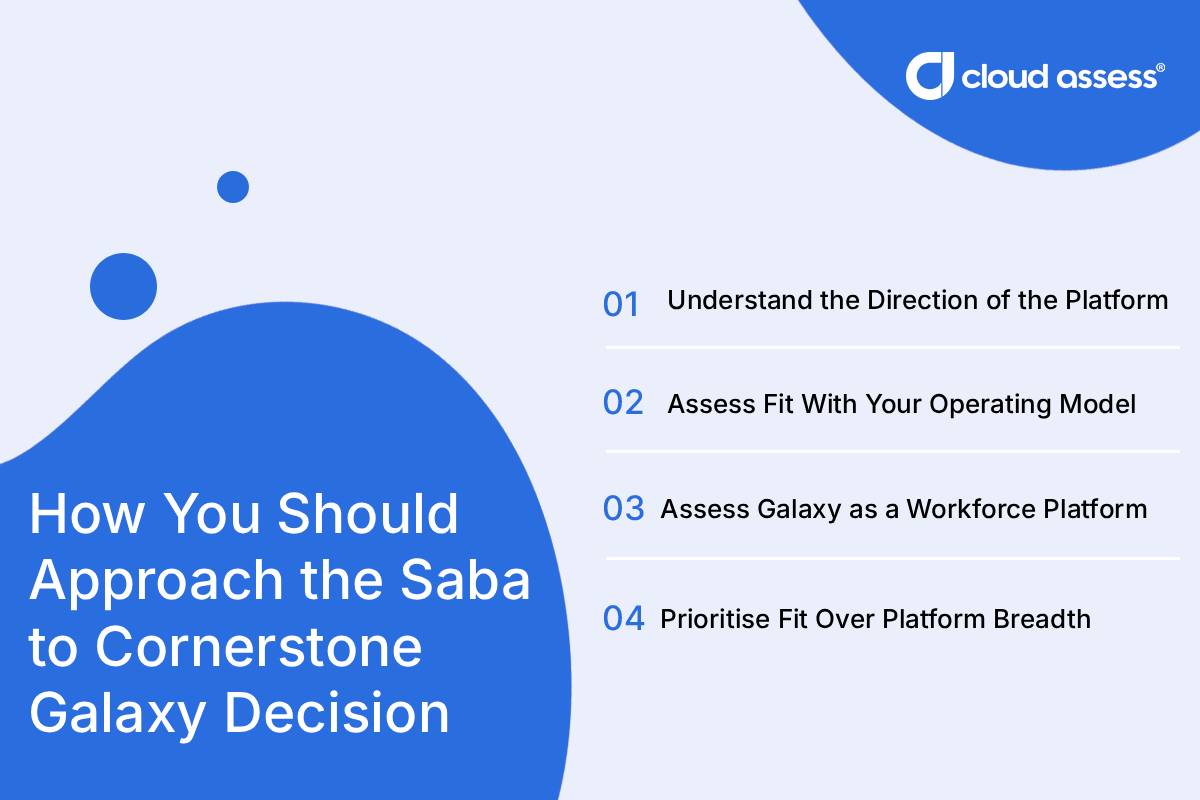
Understand the Direction of the Platform
Your next step depends on how well Galaxy matches your learning needs. If you are already using Saba LMS, the key question is alignment. You need to assess your organisation’s learning use. Then determine whether the Cornerstone Galaxy direction matches it. Some SMEs may continue operating effectively within the LMS layer during a transition period. Others may find the broader platform misaligned with their scale, resources, or priorities.
Assess Whether Migration Aligns With Your Operating Model
Migration only pays off if your team can absorb the extra scope. Migration should be evaluated against how learning is owned and managed today. Consider whether your organisation has the capacity to govern a broader platform. If you have a small team managing learning, the additional scope may introduce friction rather than value. Fit matters more than access to features.
For SMEs Evaluating LMS Options
Assess Galaxy as a Workforce Platform, Not Just an LMS
Judge Galaxy on everything it commits you to, not only its learning features. Cornerstone Galaxy should be assessed as an enterprise workforce platform, not simply as an LMS. This means evaluating the full scope of what you are committing to, including governance, configuration, and long-term cost. Compare Galaxy to focused LMS platforms using the same criteria. This helps avoid mismatched expectations. Feature volume alone is not a reliable indicator of suitability.
Prioritise Fit Over Platform Breadth
For most SMEs, a simpler platform that fits will serve them better than a broader one. When choosing a learning system, prioritise ease of administration. Also prioritise reporting clarity and realistic time to value. A platform that aligns with how your organisation works today is more likely to succeed. Broader capability only delivers value when the organisation is ready to support it. For many SMEs, focus and simplicity remain decisive factors.
Galaxy Isn’t the Problem, Fit Is
The transition from Saba LMS to Cornerstone Galaxy reflects a broader shift in the digital learning platforms market. Learning systems are no longer positioned as standalone tools. They are increasingly part of wider workforce and talent ecosystems.
For SMEs, this shift changes the nature of the LMS decision. The question is no longer whether a platform offers enough features. It is whether the organisation is ready to support the scope, governance, and cost that come with a broader platform model.
Cornerstone Galaxy is not inherently unsuitable for smaller organisations. Some organisations have the scale, maturity, and appetite to use its full capabilities. For them, it can support more connected learning and talent strategies. For others, the same breadth can introduce unnecessary complexity without improving training outcomes.
For existing Saba LMS customers, the priority is clarity. Understanding the direction of the platform supports deliberate planning. Organisations are less likely to react impulsively. For SMEs evaluating Saba LMS alternatives more broadly, the same principle applies.
In today’s market, the most effective learning systems are not defined by how much they can do, but by how well they fit the organisation using them.