The Hidden Cost Of ‘Trained’ Versus ‘Competent’
Every operator in mining, construction, rail or heavy engineering has had the same uncomfortable moment. An incident review reveals a worker who, on paper, was fully qualified. The training matrix was green. The induction was current. The ticket was valid. And yet, the task was not performed safely.
This is the trained-versus-competent gap. It exists because the systems organisations rely on to manage workforce capability were built to evidence inputs, not outcomes.
The Four Signals That The Gap Is Hurting You
Audit Anxiety
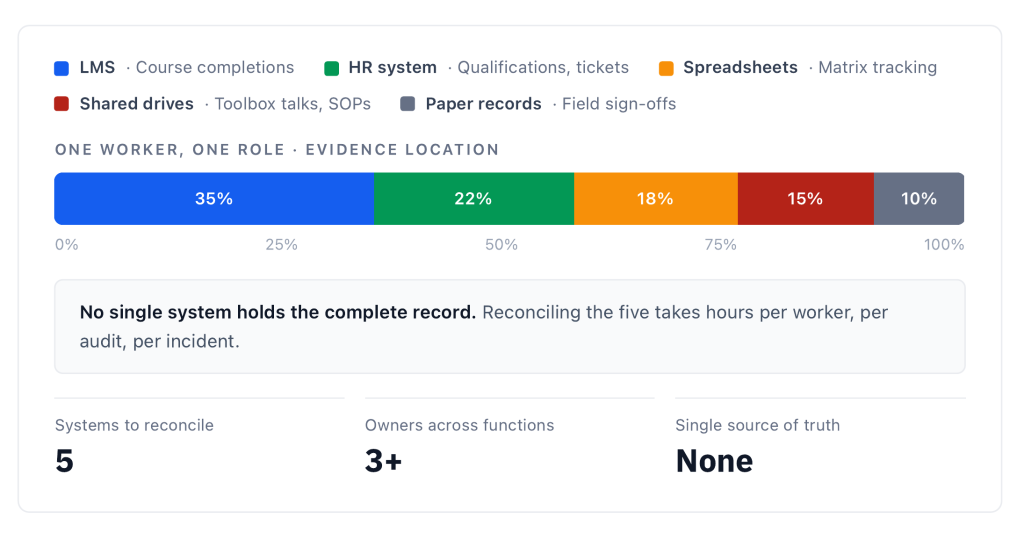
Preparing for an external audit, an Incident Cause Analysis Method (ICAM) investigation or a client compliance review takes weeks, because evidence is fragmented across the LMS, HR systems, spreadsheets, shared drives and paper records. By contrast, organisations with a single, connected competency platform can prepare in hours, not weeks. Queensland Rail can now present a complete training trail for any of its 1,500-plus drivers and crew in seconds.
Site Delays
Work stops because supervisors cannot quickly confirm who is competent to perform a task. Shutdowns and high-tempo periods amplify the cost. With real-time competency visibility, supervisors can confirm the right person for the right task instantly. Access Mining is able to give supervisors live visibility of who is competent, who needs supervision and who can work independently, eliminating the delays that come with manual checks.
Re-Work and Double Handling
The same competency information lives in three places and none of them agree. Before adopting a closed-loop platform, Access Mining’s trainers were manually entering hundreds of competencies each week across paper and spreadsheets; Komatsu held three training streams across pen, paper, SharePoint and Excel before consolidating.
Incidents That Should Have Been Preventable
A post-incident review reveals that the worker had completed the course but had never had their skill verified in the field. When competency is confirmed through observed, evidence-based assessment rather than course completion alone, that risk is eliminated. Castlereagh Coal moved from paper-based records to assessor-verified field evidence, giving the organisation defensible proof that every worker had been assessed, not just trained.
What Australian WHS Regulations Require for Competency Evidence
Under the model Work Health and Safety Act, a Person Conducting a Business or Undertaking (PCBU) must ensure workers are competent, not merely trained. The distinction is not academic, and the regulatory environment around frontline competency is tightening on three fronts.
- Queensland, live since 10 June 2025. The Practising Certificate Scheme is now mandatory for Certificate of Competency and Notice holders in statutory mining positions. CPD must be tracked, evidenced and current.
- NSW, from 1 July 2026. Approved Codes of Practice become legally binding. PCBUs must comply with or demonstrate an equal-or-higher standard. “Considering” the code is no longer sufficient.
- NSW, passed February 2026, pending proclamation. The Work Health and Safety Amendment (Digital Work Systems) Act 2026 makes employers accountable for safety risks created by algorithms and other digital systems that direct work. The first state-level law of its kind in Australia.
Site operators carry these duties whether or not they hold an RTO scope.
Why The LMS Was Never Designed For Frontline Competency
The LMS emerged in the late 1990s as a way for corporate L&D teams to deliver and track eLearning. The unit of measurement was the course. The unit of proof was the completion record. The user was a knowledge worker sitting at a desktop computer.
Two decades later, the same architecture is being asked to manage the competency of a haul truck operator on night shift, a rigger on a remote wind farm, or a train driver completing a pre-departure inspection. The mismatch is structural, not cosmetic.
Where The Traditional LMS Falls Short For Frontline Work
The Skills Matrix Workaround, And Why It Is Only Half The Answer
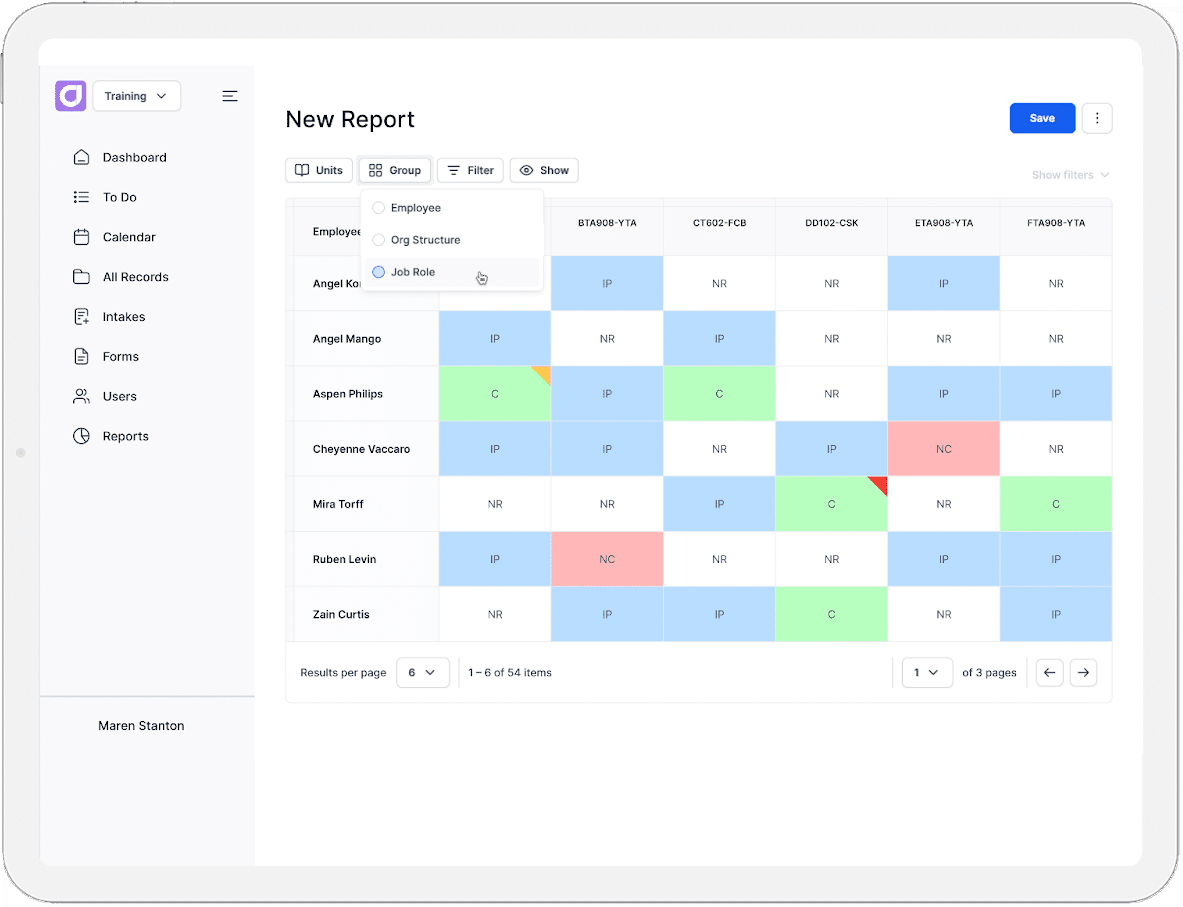
When the LMS cannot show competency by role, site or task, organisations build a spreadsheet. Names down one side, skills across the top. Colour-coded cells. A tab per site. A version that lives on a shared drive, or, more honestly, on the trainer’s laptop.
It works, until it doesn’t. A skills matrix in a spreadsheet has four predictable failure modes.
- It goes stale. The moment a worker completes new training, the matrix is wrong. Manual reconciliation lags by weeks.
- It cannot be trusted as evidence. A green cell in a spreadsheet is not defensible in an audit or an investigation.
- It does not action gaps. Identifying that thirty operators need a refresher is one thing. Enrolling them, delivering the training, capturing the assessment and updating the record is another.
- It does not scale. What works for a single crew breaks under the weight of multi-site, multi-contractor operations.
The market response has been the rise of dedicated skills matrix software. Tools such as AG5, SkillStation and Workforce.com offer visualisation, gap analytics and audit-ready reporting. They are a step forward from spreadsheets. But they share a common limitation: they are tracking tools, not capability platforms. Most explicitly position themselves as complementary to your existing LMS, which means the original integration problem has not been solved. It has been formalised.
A Revealing Position From The Category Itself
Pure-play skills matrix vendors openly position their products as a layer that sits above and beside the LMS. The implication is honest. Tracking competency and developing it are two different jobs, and the market has built two different categories of tools to do them.
The Four Broken Approaches
Most organisations in high-risk industries are running one of four configurations. Each has predictable strengths and predictable failure points.
Approach 1: The LMS-Only Stack
A single LMS, often inherited from a corporate HR or L&D rollout. Training delivery is solid. Competency, credentials and skills matrix reporting are either absent or bolted on with custom fields. Examples include traditional corporate LMS products and the L&D modules of broader Human Capital Management (HCM) suites such as SAP SuccessFactors or Workday Learning.
Strength: Training delivery, completion tracking, content libraries.
Failure point: No native concept of role-based competency, no skills matrix, no field assessment, no defensible evidence of capability. For Compliance leaders, the absence of an auditable, end-to-end evidence trail is not a reporting inconvenience. It is a liability.
Approach 2: The Spreadsheet Matrix
The LMS sits in one place. A trainer or HSE coordinator maintains the skills matrix in Excel or Google Sheets. Many sites still operate this way, often in parallel with a digital LMS.
Strength: Flexible, cheap, familiar.
Failure point: Out of date the moment it is opened. Cannot be trusted as audit evidence. Does not connect to training delivery.
Approach 3: The Enterprise Compliance Platform
Workforce compliance and contractor management platforms such as Ideagen Damstra, MyPass Global, Rapid Global and Cited. These are mature, enterprise-grade systems that focus on site access, contractor verification, credential management and induction delivery. Competency is typically a module within a much larger suite.
Strength: Strong on contractor onboarding, credential verification, site access control and document management.
Failure point: Limited native capability for delivering training, conducting practical assessment in the field, or capturing observation-based evidence. Often slow and expensive to implement. Competency reporting is improving but is rarely the core of the product.
Approach 4: The Pure-Play Skills Matrix Tool
Dedicated skills matrix and competency tracking software such as AG5, SkillStation, Xapify and Workforce.com’s skills module. Excellent at visualisation, gap analytics and audit reporting.
Strength: Best-in-class skills matrix UI. Strong role and location filtering. Fast to deploy.
Failure point: Tracks competency. Does not develop it. Requires a separate LMS for training delivery and rarely supports practical, evidence-based assessment in the field.
What None Of The Four Approaches Does
Identify a competency gap, enrol the worker into the right training (online or practical), capture defensible evidence of the assessment in the field, and update the matrix in real time. All in one platform. All from a mobile device. All while offline.
What Closed-Loop Competency Management Looks Like
The category that high-risk industries actually need is not LMS, and it is not skills matrix software. It is closed-loop competency management. A platform that brings four capabilities together and treats them as a single workflow, not four integrations.
1. A Live, Role And Location-Aware Skills Matrix
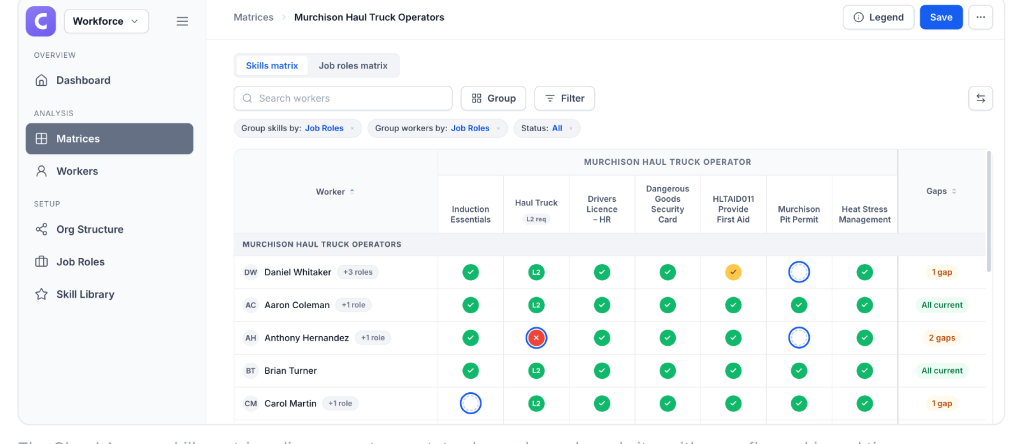
Competency requirements are mapped to roles and to sites, not to individuals in isolation. A boilermaker on Project A may need a different competency profile to the same role on Project B. The matrix reflects this without manual rebuilding. The matrix updates the moment an assessment is completed or a credential expires. No manual reconciliation. No lag.
2. Gap Identification and Intelligent Enrolment
When the matrix reveals a gap, the platform enrols the worker into the right combination of online training, practical training and assessment. The workflow runs without a separate import, export or spreadsheet. When a gap is identified, the platform determines whether it requires online training, a practical assessment, or both, based on the competency framework mapped to that role.
3. Practical Assessment With Defensible Evidence
Competency is verified in the field. The assessor captures photo, video and signed evidence on a mobile device. The record is timestamped, attributable to a qualified assessor, and linked to the specific unit of competency or skill. This is the part that pure-play matrix tools and most LMS products simply cannot do. Regulators and investigators look for three things: who verified the competency, when, and on what evidence. A timestamped photo or video, attributed to a qualified assessor and linked to a specific unit of competency, answers all three.
4. Offline-First Mobile Use
Frontline work happens underground, in tunnels, on remote sites and in low-coverage corridors. Evidence capture and assessment must work when there is no signal, and sync the moment a device reconnects. Evidence captured underground or in a no-coverage zone is stored locally on the device. The moment connectivity is restored, it syncs automatically. Nothing is lost.
How Cloud Assess Helps Close Frontline Competency Gaps
Cloud Assess has spent more than a decade helping training organisations and enterprises in high-risk industries solve one specific problem: how to prove, defensibly, that a worker is competent. Customers including Castlereagh Coal, Glencore, Komatsu, Roy Hill, Access Mining and Lion have used the platform to digitise the field assessment process and capture evidence that holds up under audit.
The new Cloud Assess offering extends that heritage into a fully closed-loop competency platform purpose-built for frontline workforces in mining, construction, engineering, rail and transport.
What Cloud Assess offers:
- Skills and competency matrix. Our platform enables you to map role, site and location-based requirements with live gap analytics across the workforce.
- Integrated training delivery. With built-in course delivery, you can run online courses, practical training programmes and blended pathways inside the same platform. No switching between systems.
- Practical assessment and Verification of Competency. The platform enables assessors to capture photo, video and digital signature evidence on mobile and offline, verified against the specific unit of competency being assessed.
- Credential and ticket management. Cloud Assess tracks expiries, automates reminders and produces audit-ready reporting across all credentials and tickets, without manual oversight.
- Open integrations. Our open integrations connect natively to enterprise HR and L&D systems including SAP SuccessFactors, so your existing investment is preserved.
This is not a new LMS, and it is not a skills matrix overlay. It is the first platform purpose-built to close the loop between identifying a competency gap and proving, in the field, that it has been closed.
Proven In 90 Days: An Australian Implementation Path
Closing the trained-versus-competent gap is not a multi-year programme. Four Australian operators in mining, rail and construction have made the transition inside 90 days. Their results, drawn from published case studies, set the benchmark for what is achievable when a closed-loop platform replaces fragmented systems.
From Spreadsheet Chaos To Closed-Loop Competency
A proven three-phase path, used by Cloud Assess customers across Australian high-risk industries.
Phase 1, days 1 to 30: Set the Foundation
Map roles to required competencies. Digitise assessments. Consolidate evidence sources into one platform.
Castlereagh Coal: Live within hours of platform review.
Phase 2, days 31 to 60: Capture in the Field
Supervisors verify competency on site using mobile and offline tools. Photo and video evidence replaces paper.
Castlereagh Coal & Access Mining: 300 assessments digitised in two weeks. 100% offline-capable underground.
Phase 3, days 61 to 90: Close The loop
Real-time competency matrix live. Expiries auto-tracked. One source of truth across roles, sites, and audits.
Castlereagh Coal & Queensland Rail: Audit-ready in two months. Zero concerns raised. Complete trail in seconds.
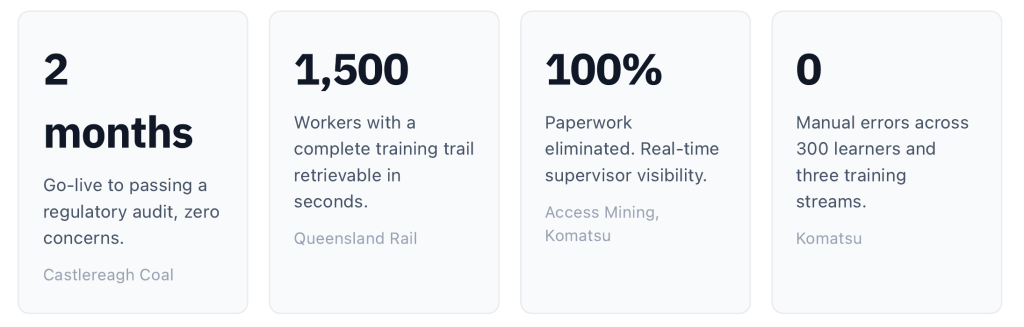
- 2 months. Go-live to passing a regulatory audit, zero concerns. (Castlereagh Coal)
- 1,500. Workers with a complete training trail retrievable in seconds. (Queensland Rail)
- 100%. Paperwork eliminated. Real-time supervisor visibility. (Access Mining, Komatsu)
- 0. Manual errors across 300 learners and three training streams. (Komatsu)