Understanding a concept is one thing, applying it with confidence is another. This is where hands-on training proves its value. It’s the difference between knowing what to do and being able to do it well.
This approach to learning connects theory with action. It prepares people not just to pass assessments, but to perform tasks, make decisions, and solve problems in real contexts. From classrooms to construction sites, hands-on training brings learning to life.
Here’s what we’ll cover:
- What hands-on training is
- How it differs from on-the-job training
- The benefits it comes with
- The different ways hands-on training can be delivered
- Examples of how it’s used in real industries
- How to design effective hands-on learning experiences
- Challenges in implementing hands-on training
What is Hands-On Training?
Hands-on training is a learning method where people build skills by doing the tasks they need to learn. Instead of listening to a lecture or reading about a process, learners get directly involved. They use tools, work with equipment, or perform job-related activities. This practical approach helps them understand how things work in real settings.
It focuses on learning by doing, often in environments that simulate real-world conditions. This gives learners the chance to apply knowledge, make decisions, and receive immediate feedback as they go. Learners take part in hands-on training. They might use machinery. They might run service drills or complete task-based scenarios. This type of training turns knowledge into capability. Learners apply what they know. They build the skills they need through direct practice.
Hands-On Training vs On-the-Job Training
Hands-on training takes place in a controlled environment designed for learning. This could be a training centre, a classroom with specialised equipment, or a virtual simulation. The focus is on building competencies before learners enter the workplace. Trainers provide guidance throughout the process. Learners also have the freedom to make mistakes without real-world consequences.
On-the-job training, on the other hand, happens in the actual work environment. Learners perform real tasks under supervision as part of their job responsibilities. While this offers immediate exposure to work conditions, it can be less structured. It may also lack dedicated time for skill development or feedback.
In short, hands-on training prepares students before they start the job. On-the-job training continues that development once they’re already in it.
Benefits of Hands-On Training
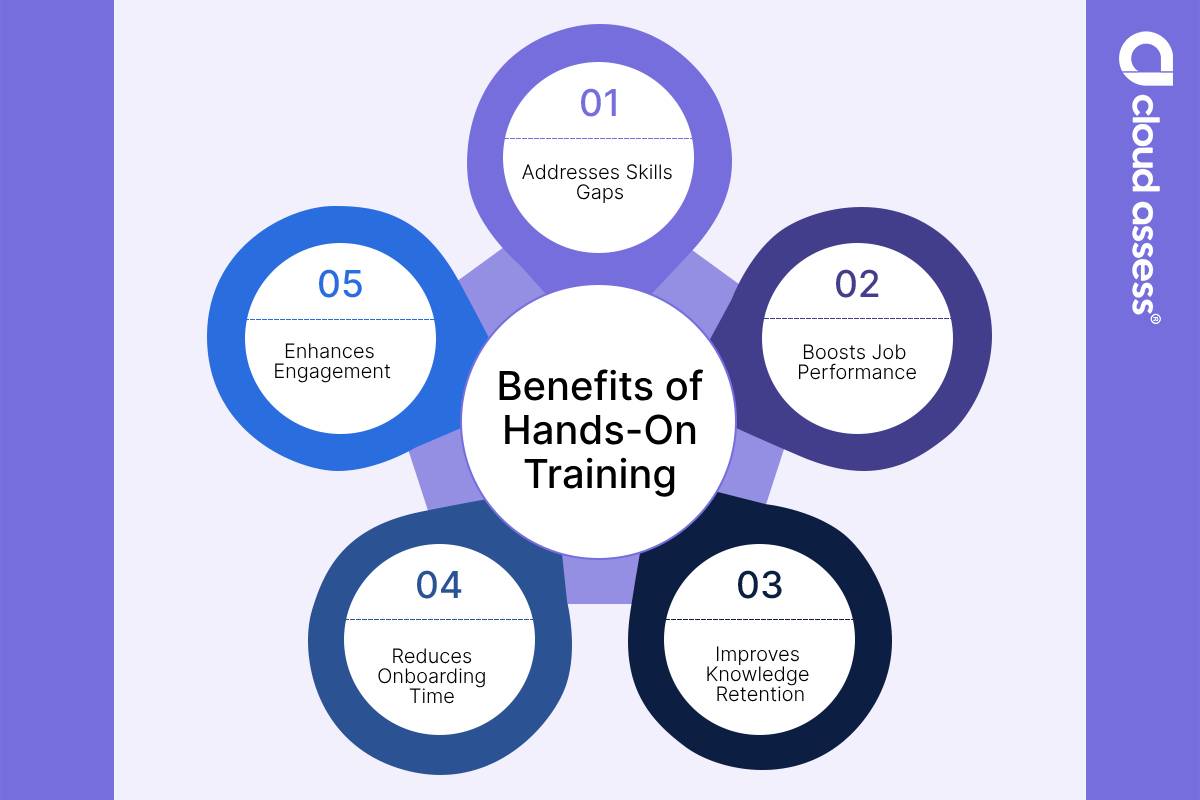
Addresses Skills Gaps
Many students complete traditional training. But they still do not know how to perform the tasks required in their roles. Hands-on training targets specific workplace skills. It helps close the gap between theory and real-world application. This enables organisations to develop a workforce that is both capable and confident.
Boosts Job Performance
Learners practise tasks in a controlled environment. They build skills, capabilities, and competencies that translate to the workplace. This increases confidence. It reduces hesitation. It also drives stronger job performance from the start of their careers.
Improves Knowledge Retention
Hands-on training supports better knowledge retention. It allows students to apply what they’ve learned immediately. Active participation strengthens understanding and recall. This means students can complete tasks more accurately and independently over time.
Reduces Onboarding Time
Professionals who have completed practical training require less time to settle into their roles. They need less supervision, make fewer errors, and contribute to productivity sooner. This shortens the employee onboarding process and eases the workload on managers, team leads, and broader teams.
Enhances Engagement
Learners are more engaged when they take an active role in their training. Hands-on methods encourage curiosity, participation, and real-world problem-solving. This makes the learning experience more meaningful and memorable. It can also help improve employee engagement once learners transition into the workplace. They arrive with a stronger connection to the tasks and responsibilities ahead.
Types of Hands-On Training
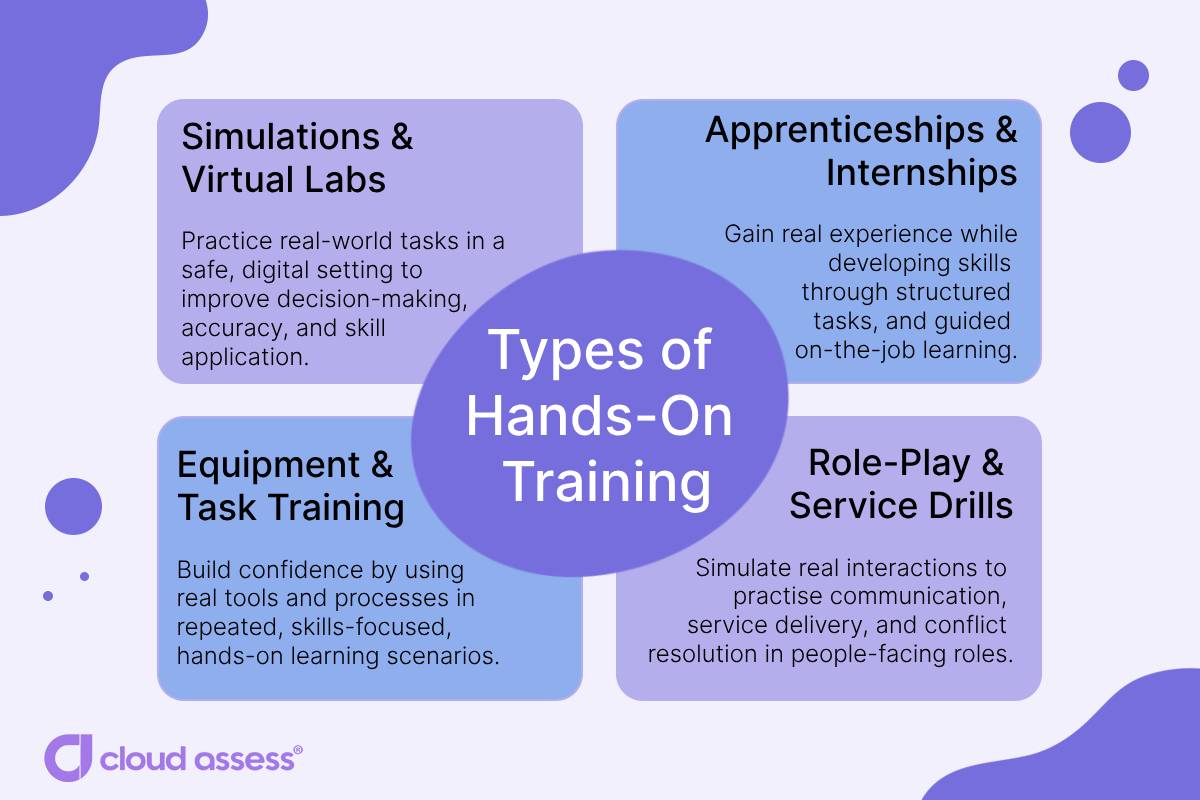
Simulations and Virtual Labs
Simulations recreate job-like scenarios in a digital or controlled setting. They allow trainees to make decisions. It lets them see the results of their actions, and repeat tasks without real-world consequences. This method is especially useful in industries like healthcare, aviation, and IT. These are environments where safety, accuracy, and decision-making are critical.
Apprenticeships and Internships
While apprenticeships and internships are often viewed as examples of on-the-job training. But they can also be hands-on when they include structured, skills-based training. In these cases, participants aren’t just performing day-to-day work. They’re actively developing specific job skills through guided practice, coaching, and feedback. This real-world experience and focus on skill development makes them hands-on learning opportunities.
Equipment Operation and Task-Based Scenarios
Participants take part in hands-on training. They gain direct experience with the tools, systems, or processes they will use in the workplace. They might operate machinery, assemble components, or use industry-specific software. The goal is to build task confidence through repeated, skills-based learning. Students get the chance to refine techniques. They also improve their accuracy in a safe, instructional setting.
Role-Play and Service Delivery Drills
Some roles involve people-facing tasks. This is common in industries like retail or hospitality. Role-play scenarios allow trainees to practise customer interactions. They also practise conflict resolution and communication strategies. These exercises are a form of structured, skills-based training. They help participants prepare for real conversations and service situations. Learners simulate these situations beforehand. This helps them build both competence and confidence.
Examples of Hands-On Training Applications by Industry

- Hospitality: In this sector, students are trained through role-play exercises and mock service setups. They might practise front desk procedures, food service, or housekeeping tasks. Trainees gain experience in realistic settings that mirror hotel or restaurant operations. This helps them deliver consistent, high-quality service from their first day on the job.
- Healthcare: Hands-on training is critical for developing clinical and procedural skills. Medical and nursing students often practise in simulation labs. They use mannequins or virtual patients before treating real people. This allows them to perform procedures, respond to emergencies, and make decisions in a safe learning environment.
- Construction: Hands-on training involves working with tools, materials, and site equipment. This happens in controlled training areas. Trainees learn tasks such as bricklaying. They also practise setting up and dismantling scaffolding. They may operate machinery under supervision. This helps them build practical skills. It also ensures they follow safety protocols before entering active worksites.
- Retail: Training often includes simulated customer service scenarios. It also includes point-of-sale system practice and inventory handling exercises. These sessions help trainees learn how to manage customer queries. They also learn how to handle payments and work efficiently in fast-paced environments. This improves both service quality and accuracy.
- Manufacturing: This sector relies heavily on hands-on learning. Trainees learn equipment operation, quality control processes, and assembly techniques. They work directly with machinery. They also use simulation tools and digital twins. These are virtual models of production equipment. Trainees practise tasks using these tools before entering production lines. This reduces the risk of errors. It also ensures operational efficiency.
How to Deliver Effective Hands-On Training
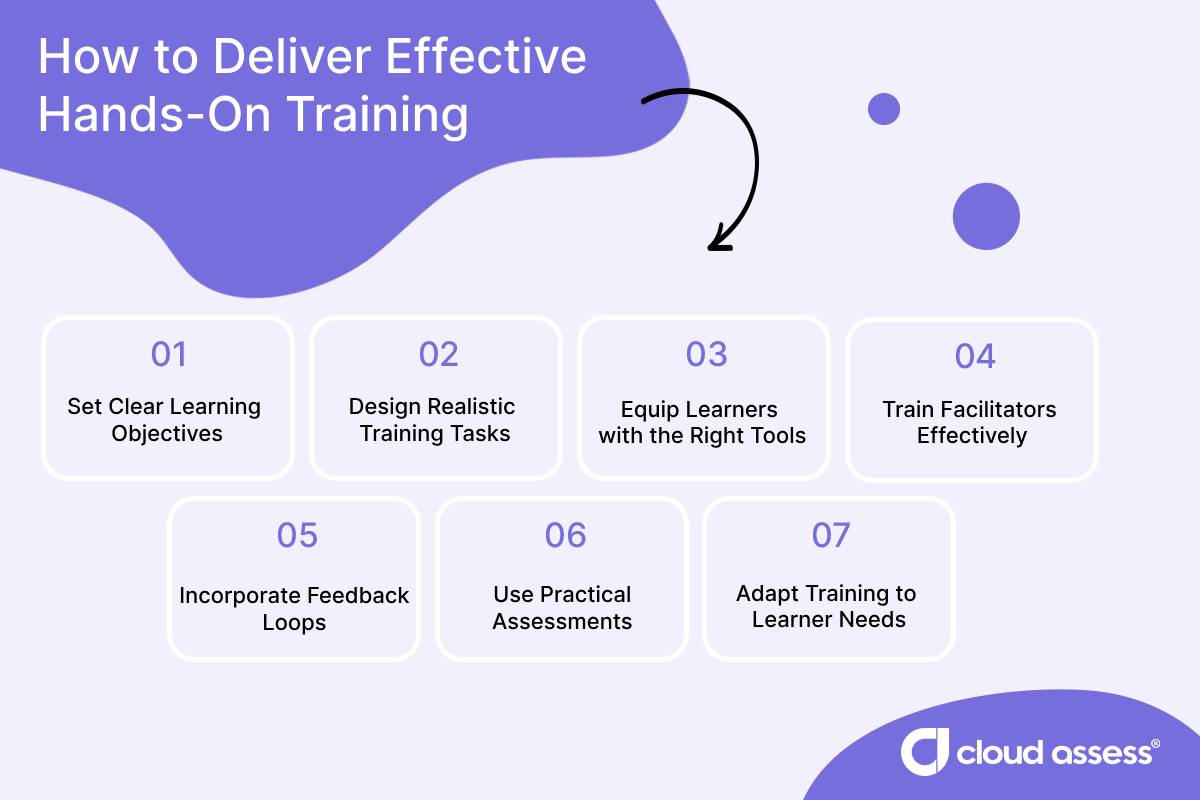
1. Define Clear Learning Objectives
Hands-on training must begin with a clear understanding of what learners need to do by the end of the session. These objectives should go beyond theory. They should describe observable, job-relevant actions. Examples include “assemble a mechanical component safely” or “respond to a customer query using a service protocol”.
Clarity here informs everything that follows, from task design to assessment. When learning goals are vague, the training becomes harder to structure and the outcomes less measurable. Strong objectives also help students track their own progress and understand the purpose behind each task.
Tip: Structure objectives using the format: Action + Condition + Standard. For example, “Complete a stocktake using digital inventory software. Do this within a 5-minute time limit, with zero discrepancies.”
2. Design Realistic Training Tasks
The closer your training scenario mirrors the actual job, the more useful and memorable it becomes. Generic or overly simplified tasks can lead to disengagement. They can also cause confusion when learners transition to the real environment. Build your training around real workflows, customer interactions, and technical procedures. Focus on the tasks learners are likely to encounter.
This could involve simulating production runs, service setups, or system troubleshooting. It’s not only about giving them tasks, it’s about placing them in context so they develop judgment, adaptability, and situational awareness.
Example: Instead of “practise using the till,” set up a full customer service interaction. A return with missing tags, time pressure, and the need to escalate the issue using store protocols.
3. Equip Learners with the Right Tools
For hands-on learning to be effective, students must work with the same or similar tools they will encounter in the workplace. This might include industry-specific equipment. Examples are diagnostic devices, manufacturing machinery, or service tools. In digital environments, this could mean access to platforms such as point-of-sale systems. It could also include customer management software. Or simulation tools that mirror real workflows.
The training space itself also matters. A well-designed learning environment supports focus. It replicates real conditions. It also allows for safe, supervised practice. When learners can interact with the tools they will use on the job, whether physical or digital, they build confidence. They reduce error rates. They also adapt more quickly to actual work demands.
Example: A trainee in healthcare might practise using a blood pressure monitor. They might also use an electronic medical record system. A retail learner could use mock tills and inventory software to simulate a store environment.
4. Train Facilitators Effectively

Instructors are the bridge between the learning content and the learner’s skill development. Beyond demonstrating tasks, they must observe and diagnose learning gaps. They also need to adapt their coaching in real time. Their ability to facilitate, correct, and motivate often makes the difference. It separates someone who can simply repeat a task from someone who understands how and why it is done that way.
Equip instructors with digital observation tools, lesson guides, and peer collaboration forums. Train them to give clear instructions. They should also learn to spot errors early. Teach them to deliver feedback that is supportive but specific.
Tip: Use tablets to annotate learner performance on the spot. You can also use mobile apps that guide instructors through structured task observations.
5. Incorporate Feedback Loops
Feedback is not just a final checkpoint. It should be continuous and embedded throughout the training. Learners should receive timely, actionable insights into their performance. This can happen during a demonstration. It can also take place after a trial run or during a task reflection session.
Use video replays, digital review tools, or structured reflection prompts. These tools help learners understand their own habits and thought processes. Feedback should not only highlight what went wrong. It should also explain how to correct it. Learners should understand why the correction matters in the real context.
Practical Application: In a warehouse training session, record a trainee’s picking process. Play it back to show how their body position affects speed and safety. Let them reflect on the footage before their next attempt.
6. Evaluate with Practical Assessments
Evaluation should reflect the real demands of the job. Practical assessments are most effective when they ask students to complete full tasks. The tasks should not be fragments. The conditions should mirror the workplace. Think performance over theory. The goal is not to “explain the steps,” but to “carry out the process accurately within standard tolerances.”
Assessments should also allow for reflection, correction, and repeat attempts. This reinforces learning. It ensures competency rather than one-off performance. Use observation checklists, outcome-based rubrics, or recorded task completions for review.
Example: Instead of a multiple-choice quiz on food safety, have the learner set up a food prep station. Ask them to select the correct personal protective equipment. They should also explain why each step matters. All of this should be observed against a standard checklist.
7. Adapt Training to Learner Needs
Catering to different types of learning styles is essential. Not everyone learns the same way. Not everyone learns at the same speed. Flexibility is key to effective training. Some individuals absorb information best through visual aids. Others respond better to verbal explanations. Some learners prefer physical activity or a combination of methods.
To support varied preferences, combine demonstrations (visual) with verbal walkthroughs (auditory). Add written guides (reading/writing) and hands-on activities (kinaesthetic). This approach makes your training more inclusive. It helps each participant develop skills in a way that aligns with how they learn best.
Tip: Use diagnostic or preference-based tools at the start of training. These tools help identify learning styles and personalise support where possible.
Challenges in Implementing Hands-On Training
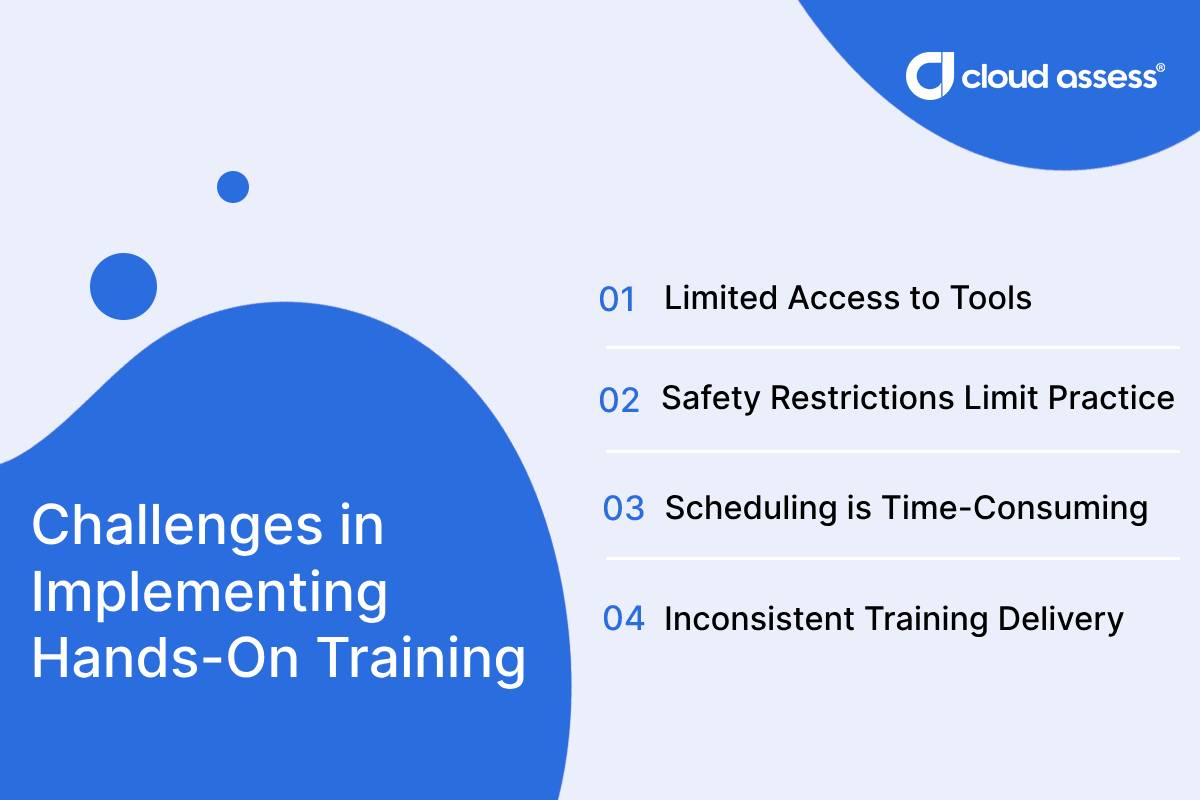
Learners Don’t Always Have Access to the Tools They Need
For hands-on training to work, learners need physical access to the tools, materials, and environments used in real tasks. This can be a major hurdle for small organisations, rural training sites, or learners who are preparing remotely. Without the right equipment, even the most well-designed task loses its effectiveness.
Solution: Focus on the essentials. Identify the minimum set of tools needed for each skill and find ways to provide shared access. Partner with local businesses, industry associations, or training hubs to borrow equipment. Consider creating loan kits or scheduling rotation-based practice. This makes sure every learner gets time with the core materials. When hands-on time is limited, use demonstration videos. You can also use task breakdowns to support early understanding until practice becomes possible.
Safety Risks Can Limit What Learners Are Allowed to Do
Hands-on learning often involves tools or environments with built-in risks. This includes electrical systems, blades, or chemicals. For many organisations, safety concerns lead to overly cautious delivery. In some cases, it restricts trainees from engaging fully. This can undermine skill development and learner confidence.
Solution: Integrate safety directly into your training design. Rather than front-loading rules and warnings, show safe practices in context as learners complete tasks. Use mock versions of high-risk tools early on. Examples include plastic blades or non-functional systems. This helps students build familiarity before moving to real equipment. Ensure your training space allows for close supervision. You must also encourage learners to talk through their actions for better safety awareness.
Scheduling Hands-On Sessions is Complex and Time-Consuming
Delivering hands-on training requires coordination between instructors, learners, tools, and physical space. When multiple cohorts or campuses are involved, timetabling becomes a major challenge. Without careful planning, sessions may be rushed, duplicated, or delayed. This can lead to inconsistent outcomes.
Solution: Separate the theory from the practice. Use digital delivery for foundational content like procedures, safety, and system overviews. Then, allocate focused practical sessions in smaller groups. This will allow learners to apply what they’ve already learned. This approach allows better use of equipment and trainer time while reducing the pressure of full-group sessions.
Maintaining Consistency Across Locations and Groups
As more learners or campuses are added, keeping hands-on training consistent becomes harder. Different instructors may teach the same task in different ways, leading to confusion or skill gaps.
Solution: Standardise your training approach. Use visual task sheets, video demonstrations, and clear step-by-step guides. Make sure that every instructor can use the content across. Create checklists for performance and feedback. This ensures that no matter who delivers the session, the expectations remain the same. This also makes it easier to train new facilitators and maintain quality across your programme.