Understanding and remembering information might seem simple, but it’s a complex process influenced by how our minds process and consolidate knowledge into long-term memory. Knowledge retention is essential in learning, ensuring that information doesn’t just pass through short-term memory but becomes a lasting resource learners can draw on when needed.
However, retention doesn’t happen automatically. Without the right conditions to reinforce learning, knowledge can fade over time, leaving learners unable to benefit from their efforts fully. For educators, trainers, and instructional designers, the challenge lies in crafting experiences that capture attention and foster deep and lasting understanding.
Knowledge retention is more than remembering facts—it’s about creating a foundation for learners to think critically, solve problems, and grow.
What is Knowledge Retention?
Knowledge retention is the cognitive process of absorbing, storing, and maintaining access to information over time. It involves encoding knowledge into memory, ensuring effective information recall, and preserving it for future use when needed.
The memory consolidation process is influenced by repetition, relevance, understanding, and the context in which the information is learned. Effective knowledge retention ensures that information remains accessible and usable, contributing to deeper learning and long-term application.
Knowledge Retention vs Learning Retention
Knowledge retention and learning retention differ in their scope and timeframes.
Knowledge retention focuses on the long-term preservation and accessibility of information, ensuring it remains valuable and applicable over extended periods. For example, a medical professional who recalls and applies advanced surgical techniques years after training demonstrates strong knowledge retention.
Learning retention emphasises the short- to medium-term recall of information, often immediately following a learning activity or training session. For instance, a student remembering details for a quiz the day after a lecture highlights learning retention.

Knowledge Retention vs Memorisation
Knowledge retention and memorisation are distinct in depth and purpose.
Memorisation involves storing information to be recalled exactly as it was presented, often focusing on discrete facts. For example, a student training as an electrician might memorise the colour codes for electrical wiring without fully understanding their practical applications.
Knowledge retention encompasses a broader cognitive process, where information is internalised, linked to existing knowledge, and applied meaningfully. In the same context, a student who understands how those colour codes are used in wiring systems and applies this knowledge to troubleshoot or design circuits demonstrates knowledge retention.
What is the Learning Pyramid, and How Does it Relate to Knowledge Retention?
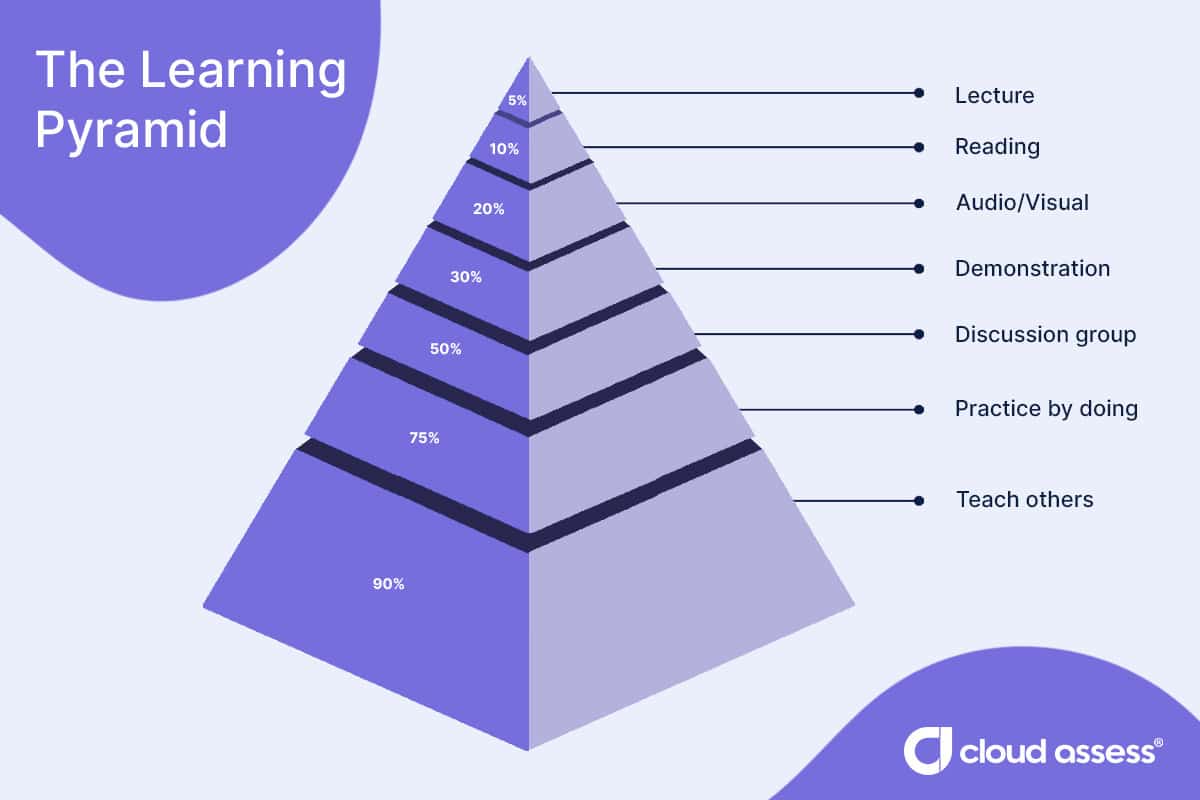
The Learning Pyramid, also known as the “Cone of Learning” or the “Retention Pyramid” or a model for pedagogical effectiveness, was developed by the National Training Laboratories (NTL) Institute in the 1960s. It’s an educational framework that categorises teaching methods by their effectiveness in promoting knowledge retention and highlights how active learning techniques significantly outperform passive methods in fostering long-term understanding.
Lecture
The pyramid suggests that lectures account for the lowest retention rates, approximately 5%. This is because lectures are passive and require minimal interaction or critical thinking. While effective for presenting foundational knowledge to large groups, they are best used in combination with more active methods to boost retention.
Reading
Reading improves retention to about 10% as it allows learners to process information independently. However, like lectures, it is a passive method, and retention rates remain low unless paired with activities that encourage engagement, such as discussions or reflective writing.
Audio-Visual
The pyramid shows that retention rises to approximately 20% when using audio-visual tools like videos or multimedia presentations. These methods are particularly effective for visual learners as they combine visual and auditory elements, making them more engaging and effective for illustrating concepts, particularly in technical or skill-based fields.
Demonstration
Retention increases to around 30% when learners observe skills or tasks being performed. Demonstration is an active learning method that helps make the learning process more tangible. Incorporating demonstrations into knowledge retention efforts is particularly effective in vocational training environments. Showing how a method or technique works helps learners better understand its application and ensures they can apply their knowledge effectively in real-world situations.
Discussion Groups
Retention rates climb to 50% with discussion groups, as the pyramid emphasises the power of collaborative learning. Group discussions allow learners to articulate their thoughts, ask questions, and hear diverse perspectives, deepening their understanding and improving recall.

Practice by Doing
Retention rates reach approximately 75% when learners engage in hands-on practice. This active approach, such as performing tasks in a workshop or applying simulation skills during on-the-job training, solidifies learning by directly connecting theory to real-world application.
Teaching Others
Teaching others is the most effective method for cognitive reinforcement, with rates reaching 90% based on the pyramid. Explaining or demonstrating a concept to peers requires deep comprehension, making it a powerful way to internalise and solidify knowledge. This method is best applied in mentoring programs or peer-led training.
Learning Pyramid Disclaimer: Addressing the Controversy
While the Learning Pyramid is a widely referenced in educational contexts, it is important to address its limitations and inaccuracies:
- Unverified Origin: The National Training Laboratories (NTL), often credited with creating the pyramid, has not provided empirical evidence or documentation to support its figures.
- Unscientific Percentages: The retention rates attributed to each method are not based on rigorous research and should be viewed as illustrative rather than definitive.
- Oversimplification: Research shows that retention rates are influenced by factors such as engagement, prior knowledge, and instructional design—variables the pyramid oversimplifies.
- Potential Misuse: The pyramid’s widespread use as a prescriptive tool risks overemphasising certain methods without considering their relevance to specific learning contexts.
Factors of Knowledge Retention
- Repetition and Practice: Repetition strengthens memory pathways, aiding in memory consolidation and making it easier to recall information over time. Regular practice reinforces these pathways, especially when spaced over intervals—a technique known as spaced repetition.
- Active Engagement: Many learners retain more knowledge when actively engaging with the material through active learning techniques rather than passively consuming it. Activities like discussions, hands-on exercises, and problem-solving encourage learners to process information deeply, promoting retention.
- Relevance and Context: Connecting new information to learners’ existing knowledge and real-life situations improves retention. When learners see the practical value of what they are studying, they are more likely to internalise it.
- Feedback and Assessment: Timely and constructive feedback reinforces learning by helping learners identify and correct mistakes. Formative and summative assessments provide opportunities to review and consolidate knowledge.
- Learning Environment: The setting in which learning occurs plays a crucial role in retention. A supportive and distraction-free environment fosters focus and engagement. Collaborative environments encouraging discussion and peer learning can enhance retention, as learners benefit from multiple perspectives and shared insights.
- Cognitive Load Management: When learners are overwhelmed with too much information at once, retention suffers. Breaking content into manageable pieces, or “chunking”, and ensuring the pace of instruction is appropriate helps balance challenge and cognitive capacity.
- Emotional Connection: Emotionally engaging content is more memorable because emotions play a significant role in encoding information into long-term memory. Relating material to learners’ personal experiences or presenting it in a compelling narrative format can strengthen retention.
11 Strategies for Improving Knowledge Retention
1. Use Advanced Applications of Cognitive Learning Theory
Cognitive learning theory emphasises that knowledge retention improves when learners actively process and apply information. A well-designed knowledge retention strategy that incorporates problem-based and scenario-based learning provides opportunities for learners to engage deeply with content. Learners connect theory with practice by solving real-world problems or navigating realistic scenarios.
2. Create Structured Collaborative Learning Initiatives
Collaboration fosters deeper retention by encouraging learners to exchange ideas and tackle challenges together. Structured group problem-solving activities ensure all participants engage actively while rotating leadership roles builds accountability and shared responsibility.
Collaborative learning tools, like shared workspaces or discussion forums, streamline communication, ensure knowledge sharing and documentation, and keep groups focused and efficient. In a classroom or corporate training setting, these initiatives boost retention and develop power skills like teamwork and communication.

3. Design Comprehensive Training Programs
Effective training programs are structured to meet immediate learning objectives while addressing broader development goals. Combining targeted upskilling for specific competencies with cross-training opportunities helps learners build depth and adaptability. A blended learning approach, which mixes face-to-face instruction with online modules, ensures flexibility while maintaining engagement.
4. Use Enhanced Spaced Learning Techniques
Spaced learning leverages intervals to reinforce retention by gradually revisiting the material. Breaking content into smaller, digestible microlearning modules helps learners absorb information without feeling overwhelmed. Thematic cycles, where related topics are revisited in a connected, progressive manner, improve understanding and memory.
5. Introduce Engaging and Interactive Training Methods
Interactive methods are vital for making learning experiences memorable and impactful. Immersive tools such as virtual reality can simulate real-world scenarios, allowing learners to practise in a controlled environment.
Using gamification in learning adds an element of fun and challenge, rewarding progress while maintaining focus. Customisable learning paths give learners control over their education, allowing them to explore content relevant to their needs, which drives engagement and retention.
6. Create Personalised eLearning Experiences
Personalised eLearning ensures learners have access to the resources they need when they need them. Individualised dashboards help learners track their progress, while AI-driven recommendations suggest lessons tailored to their strengths and weaknesses.
Self-assessment tools further support reflection and focus, allowing learners to identify gaps and revisit areas where retention is lower. These assessment tools collectively create a dynamic, learner-centric environment that promotes long-term memory retention.
7. Implement Feedback and Support Mechanisms
Timely feedback is crucial for identifying areas where retention may be weak and guiding improvement. Regular check-ins between instructors and learners foster an open dialogue for addressing challenges and reinforcing concepts.
Platforms for live Q&A sessions or discussion forums create ongoing opportunities for clarification and engagement. Detailed feedback reports provide actionable insights, ensuring learners understand their progress and have a clear roadmap for further development.
8. Use Motivation and Engagement Frameworks
Motivation plays a central role in retention. Frameworks that sustain learner interest, such as reward systems, encourage continuous effort and progress. Highlighting the long-term career benefits of acquired skills adds intrinsic motivation, helping learners see the broader value of their learning journey. Communities of learning, where participants share insights and celebrate achievements, foster a sense of belonging and accountability, further enhancing engagement and retention.
9. Include Emotional Intelligence in Training Delivery
Emotional intelligence in training makes learning personal and memorable. Empathy-based content connects learners to the material, fostering a deeper understanding. For instance, using interactive stories to illustrate customer service scenarios can evoke emotional responses that enhance recall. Identifying and addressing learner stress points, such as frustration with complex concepts, helps create a supportive environment that promotes retention and success.
10. Organise Practical Application Opportunities
Practical application ensures that knowledge moves from abstract to actionable. Simulation labs provide learners with realistic environments to test and refine skills, such as operating machinery or handling customer interactions.
Task-based assignments allow learners to apply concepts to specific problems, reinforcing their understanding. Reflective exercises, like journaling or group debriefs, help learners analyse what they’ve learned and its implications for future tasks.

11. Leverage Technology for Retention
Modern technology offers powerful tools to enhance retention. Digital learning platforms allow learners to access content anytime, ensuring consistent engagement. Adaptive algorithms tailor content delivery based on learners’ progress, creating a personalised experience and prioritising retention.
Analytics tools provide instructors with insights into learner performance, enabling data-driven adjustments to improve outcomes. By integrating these technologies, organisations can create scalable and effective learning environments prioritising long-term knowledge retention.
Benefits of Knowledge Retention
Enhances Long-Term Learning and Cognitive Development
Knowledge retention strengthens neural pathways, enabling learners to build on prior knowledge and refine cognitive abilities. By consistently reinforcing information, learners develop a solid foundation for advanced learning and problem-solving.
Improves Learning Efficiency and Test Outcomes
Effective retention minimises the need to repeatedly revisit material, allowing learners to focus on mastering new concepts. This efficiency not only saves time but also enhances test performance and boosts confidence during assessments.
Enables Transfer of Learning to Real-World Applications
Retaining knowledge is essential for applying concepts in practical scenarios. When learners effectively retain knowledge they can bridge the gap between theory and practice, ensuring their understanding translates into meaningful real-world applications. This transfer of learning is critical in skill-based environments and career development.
Counteracts the Forgetting Curve for Sustained Knowledge
Retention strategies directly address the forgetting curve, the natural decline of memory over time. By employing techniques such as spaced repetition and active engagement, learners can preserve and access critical knowledge long after initial learning.

Promotes Lifelong Learning Across Various Contexts
Strong retention skills foster adaptability by helping individuals navigate diverse challenges in educational, professional, and personal contexts. This is achieved through consistent cognitive reinforcement and the use of effective retention strategies. This foundation supports lifelong learning, empowering individuals to continuously acquire and apply knowledge in a variety of settings.
Why Does Knowledge Retention Matter in the Workplace?
Knowledge retention in the workplace is vital because it safeguards critical expertise, ensuring organisational continuity and resilience. Retaining knowledge minimises disruptions and preserves institutional memory when employees leave or transition roles. This is especially important for avoiding the loss of specialised skills and processes critical to operations.
Retaining knowledge also enhances workforce productivity and efficiency. It helps encourage employees with accessible and well-maintained knowledge to make informed decisions, solve problems quickly, and collaborate effectively. Knowledge retention also supports continuous learning and development, enabling organisations to build a future-ready workforce and adapt to changing industry demands.
In a competitive business landscape, prioritising knowledge retention enhances innovation and reduces training costs. It also gives organisations a competitive advantage by fostering a culture of expertise and ensuring they can adapt quickly to industry changes.
Maximising Knowledge Retention for Long-Term Success
Knowledge retention is a cornerstone of effective learning and organisational growth. By applying strategies such as active engagement, personalised learning, and practical application, individuals and teams can build a deeper understanding and maintain access to critical knowledge.
Prioritising retention ensures that skills and expertise remain valuable over time, driving productivity, innovation, and adaptability. Whether in education or the workplace, maximising retention fosters long-term success, empowering learners to excel in ever-changing environments.