Organisations today operate in increasingly complex environments, where teams must collaborate across different functions, locations, and projects. Managing these interdependencies effectively requires a structured approach that balances authority, expertise, and accountability.
Matrix management is one approach organisations use to achieve this balance. It enables cross-functional coordination and resource sharing, but it also introduces challenges that require careful oversight. How does this structure function? What are its key components? And how can businesses navigate its complexities to maximise its benefits?
In this blog, we’ll cover:
- What matrix management is
- The key components of a matrix structure
- The types of matrix management
- How it works in practice
- The benefits of a matrix management
- Strategies for effective implementation
- Challenges of matrix management
What Is Matrix Management?
Matrix management is an organisational structure in which employees report to multiple leaders rather than following a single chain of command. The reporting lines create a system where authority is shared across various roles.
For example, an employee may report to both a functional manager (such as the Head of Marketing) and a project or product manager overseeing specific initiatives. In more complex arrangements, they may also report to regional managers, client-specific leads, or matrixed teams within global organisations. This creates a network of accountability that spans functions, locations, and business units.
Matrix Management vs. Other Management Structures
The matrix management system differs from other organisational structures in how authority is shared and collaboration flows across departments. It enables dual reporting lines, typically to a line manager and a project lead, while preserving departmental focus and cross-functional teamwork.
- Hierarchical and Functional Structures: Feature a clear chain of command, where employees report to a single manager and operate within specialised teams that build deep functional expertise.
- Divisional Structures: Organise operations into semi-autonomous units based on product, region, or customer segment, each with its own resources and goals.
- Project-Based Structures: Focus on temporary teams formed around specific projects, with little long-term alignment to functional departments.
- Hybrid Structures: Combine aspects of functional, divisional, or project-based models, providing structural flexibility to support various strategic needs.
- Flat and Holacratic Structures: Decentralise decision-making and reduce hierarchy, encouraging autonomy and peer collaboration over traditional management roles.
Types of Matrix Management Structures

Weak Matrix
In a weak matrix, functional managers hold greater authority, while project managers play a more supportive role. Employees primarily report to their functional leads, who oversee workloads, performance, and decision-making. Project managers coordinate tasks and ensure timelines are met but have limited control over resources or personnel.
Since the functional manager retains decision-making power, project managers have little direct influence. This makes this matrix functionally closer to a traditional hierarchical structure. Multiple reporting lines are uncommon in this setup, as employees remain largely within their functional departments.
Common use cases for a weak matrix:
- Organisations with strong departmental structures
- Industries requiring specialised expertise, such as manufacturing, finance, and healthcare, where tasks often rely on well-defined functional roles and consistency in processes.
Balanced Matrix
A balanced matrix distributes authority evenly between functional and project managers. Unlike the other matrix management types, team members report multiple managers, requiring alignment and coordination between leadership roles. This matrix management structure encourages collaboration while maintaining functional stability.
Decision-making responsibility is shared, meaning both functional and project managers must work together to resolve conflicts around priorities and resource allocation. In some cases, employees may report to multiple project managers if they are involved in several ongoing initiatives across different departments.
Common use cases for a balanced matrix:
- Companies managing multiple cross-functional projects
- Industries such as technology, pharmaceuticals, and automotive, where innovation and operational efficiency must be balanced
Strong Matrix
In a strong matrix, the project manager has greater authority over resources, decision-making, and task allocation. Functional managers still exist but serve in a more advisory capacity. Employees primarily align with project priorities, and the centre of decision-making shifts towards the project team rather than functional departments.
This structure resembles a project-driven organisation, where project managers determine how resources are assigned, set goals, and lead execution. Their influence extends across multiple departments, enabling them to drive initiatives with greater autonomy. Employees may report to multiple project managers, particularly if involved in complex or overlapping projects spanning regions or business units.
Common use cases for a strong matrix:
- Organisations focused on rapid delivery or client-specific projects
- Project-driven sectors such as construction, IT, and consulting, where deliverables define workflows and resource planning
How Matrix Management Works in Practice

Roles & Responsibilities
- Functional Managers: Oversee employee productivity, performance, continuous professional development, and technical expertise within their department, while ensuring the necessary resources are made available for projects.
- Project Managers: Lead project execution, define objectives, manage timelines and budgets, and coordinate cross-functional efforts. They rely on functional managers to allocate the appropriate talent and technical support.
- Team Members: Operate under both functional and project managers, balancing responsibilities between long-term departmental duties and short-term project commitments.
How Decision-Making Works
Decision-making in a matrix management structure requires negotiation and alignment between functional and project managers. Functional managers guide long-term departmental goals and personnel development, while project managers focus on project-specific priorities. Clear communication channels and predefined escalation procedures are essential for resolving conflicts and maintaining operational efficiency.
Cross-Functional Collaboration
Effective matrix management depends on strong collaboration across departments. Teams must coordinate workflows, share knowledge, and align goals to minimise miscommunication and prevent duplicated efforts. Matrix managers play a key role in facilitating these interactions by ensuring clear expectations, consistent communication, and alignment between functional and project priorities. Regular alignment meetings, transparent reporting structures, and digital collaboration tools further support coordination across functions and leadership layers.
Benefits of Matrix Management
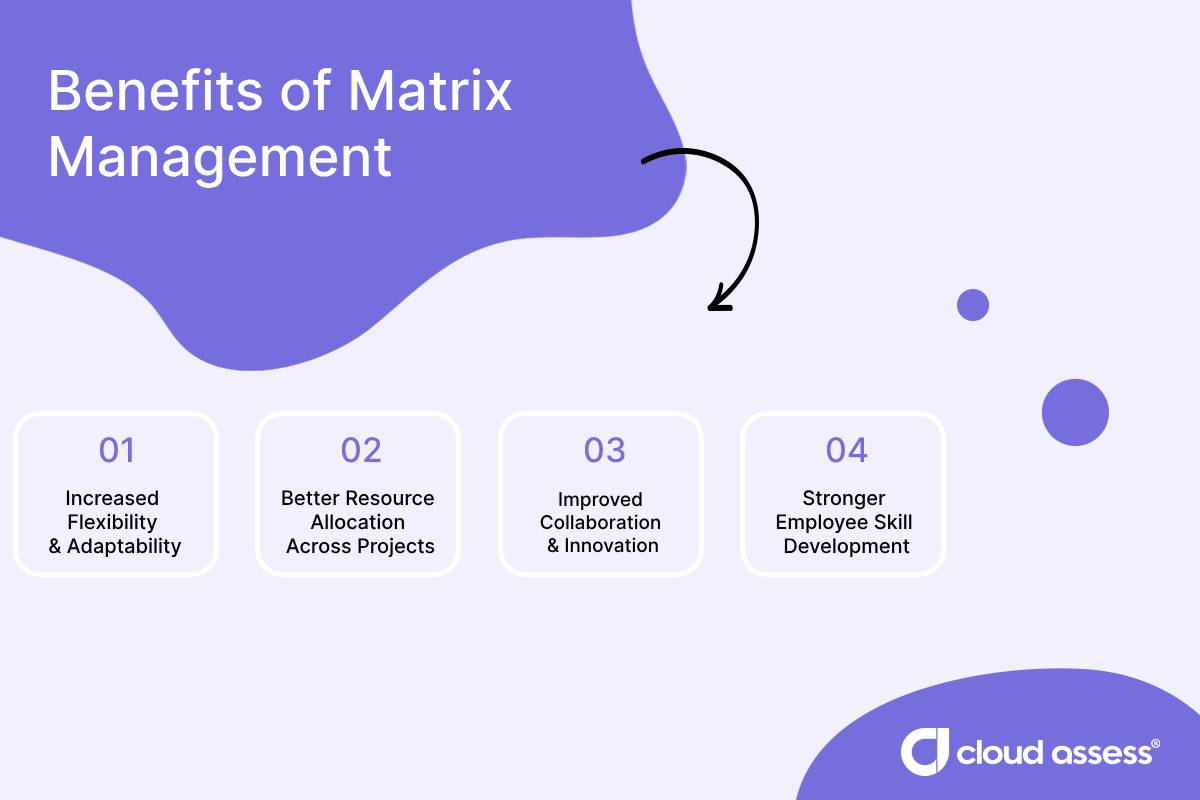
Increased Flexibility And Adaptability
Matrix structures allow organisations to respond swiftly to shifting priorities, market dynamics, and emerging demands. By enabling cross-functional collaboration, teams can reconfigure more easily without disrupting day-to-day operations. This structural agility supports innovation, faster decision-making, and resilience in changing environments.
Better Resource Allocation Across Projects
The matrix model supports efficient distribution of talent and expertise by allowing employees to contribute to multiple initiatives while maintaining their functional responsibilities. This targeted allocation of skills ensures that critical projects receive the right resources at the right time, minimising downtime and improving overall operational efficiency.
Improved Collaboration And Innovation
When businesses implement matrix management, they are actively encouraging skill mobility and cross-functional collaboration by bringing together individuals from various departments. This integration enhances problem-solving, supports knowledge sharing, and enables more innovative project outcomes through exposure to diverse perspectives and expertise.
Stronger Employee Skill Development
Employees in a matrix organisation gain exposure to different teams, disciplines, and leadership styles. These varied experiences contribute to skill development, broadening employee capabilities, increasing adaptability, and supporting long-term professional growth. Working across functions prepares team members to handle more complex challenges and gradually assume greater responsibilities, supporting organisational succession planning.
To support this growth, many organisations use a skills matrix to map capabilities, identify skill gaps, and align team development with strategic goals. A skills matrix also enables managers to make informed decisions about resource allocation and career progression across the matrix.
Adapt Matrix Management for Remote and Hybrid Work
As remote and hybrid work environments become more common, matrix structures must evolve to maintain effective collaboration. Define how virtual teams interact across functions, what communication tools are used, and how performance is tracked across distributed workforces. Regular virtual check-ins, strong documentation practices, and digital platforms can help sustain alignment and engagement.

Integrate Agile and Networked Team Structures
Agile methodologies complement matrix management by supporting flexibility, faster decision-making, and greater responsiveness. Introducing agile practices such as sprint planning, iterative development, and daily stand-ups can strengthen collaboration and improve team efficiency. Combining matrix structures with networked teams—where expertise is drawn from across departments—further enhances adaptability and cross-functional innovation.
Use Technology and AI to Improve Coordination
Digital tools are essential for supporting coordination in matrix structures. Project management platforms and collaboration software provide real-time visibility, helping teams stay aligned and organised across departments. AI-powered systems can further optimise resource allocation by tracking workloads, forecasting needs, and matching tasks with available skills. These technologies support matrix managers in managing complexity more effectively and improving overall efficiency.
Measure Performance and Ensure Accountability
In a matrix environment, traditional performance metrics may not fully capture an employee’s contributions. Organisations should implement a balanced evaluation approach that considers project outcomes, team collaboration, and functional performance. Feedback loops, 360-degree reviews, and clear accountability structures ensure fair assessment and sustained motivation.
Challenges of Matrix Management
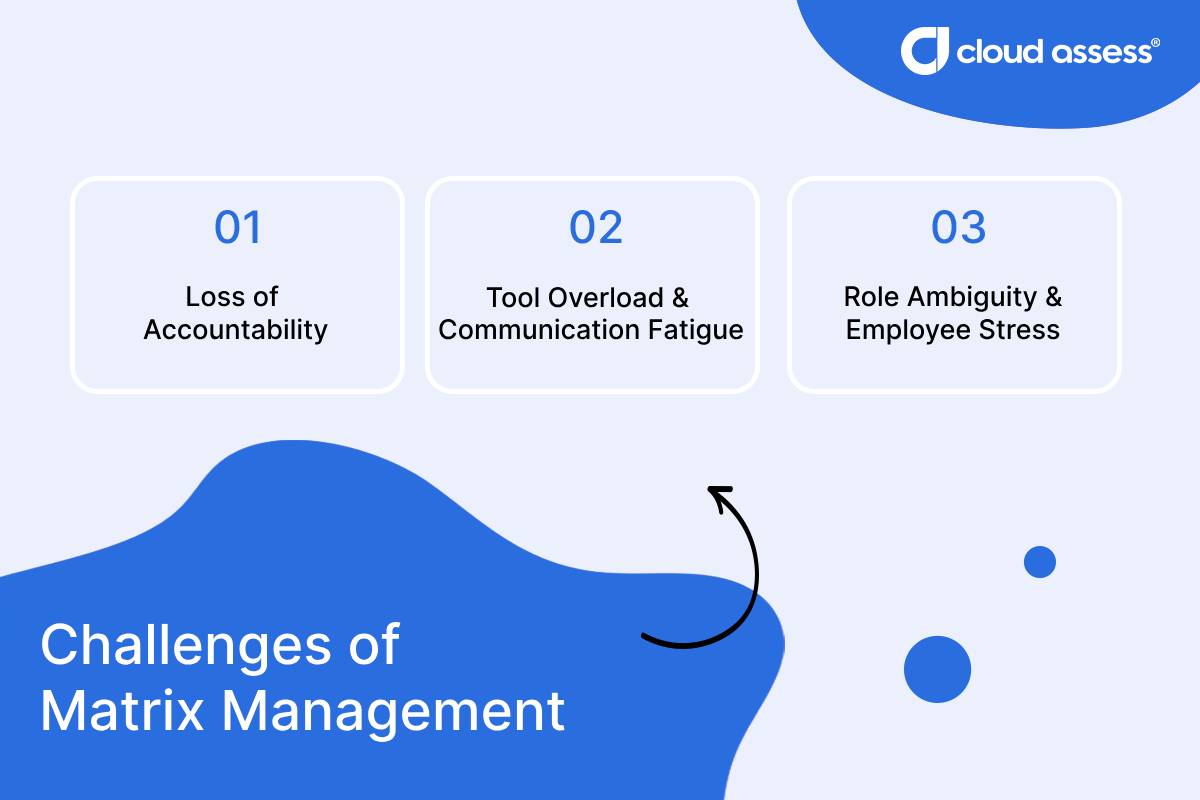
Loss of Accountability
With multiple reporting lines, task ownership can become unclear, leading to confusion and delays. When responsibilities are not clearly defined, it’s easy for key actions to fall through the cracks.
Solution: Establish clear accountability from the outset using tools like Responsible, Accountable, Consulted, Informed matrices. Regular check-ins and documented performance metrics also help reinforce ownership and follow-through.
Tool Overload and Communication Fatigue
Matrix teams often rely on a range of platforms and communication channels to manage cross-functional work. Without consistency, this can lead to tool fatigue, scattered information, and missed updates.
Solution: Standardise collaboration tools and communication guidelines across the organisation. Ensuring everyone knows where to share updates and how to track progress keeps workflows streamlined and teams aligned.
Role Ambiguity and Employee Stress
Balancing responsibilities between multiple managers can create conflicting expectations and contribute to overload or burnout. Without clarity, employees may feel pulled in different directions.
Solution: Ensure role clarity through structured role transition support, clearly defining reporting lines, responsibilities, and communication protocols when employees shift into a matrix setup. Alignment meetings and shared performance goals help reinforce expectations. Open communication and workload-balancing strategies are key to preventing unnecessary stress and inefficiency.
Is Matrix Management Right for Your Business?
Matrix management is ideal for businesses operating in complex, cross-functional environments where projects demand input from multiple departments. It enhances efficiency, collaboration, and resource allocation, but its success hinges on strong leadership, clear accountability, and well-developed management skills.
For organisations with stable operations and minimal cross-departmental collaboration, a traditional structure may be more effective. Before adopting matrix management, assess whether your business has the culture, leadership capacity, and systems in place to support it.
Cloud Assess can help you build the foundation needed to succeed in a matrix environment, including workplace training, leadership development, skills matrix tools, and change management support. Our solutions are designed to empower teams, streamline transitions, and drive sustained performance.
Ready to make matrix management work for your organisation? Start by enrolling your team in our free courses, start a Explore Pricing, or book a demo to see how Cloud Assess can support your transition to matrix management.