Managing talent within an organisation is an age-old challenge. You want to ensure that you’re hiring people who are a good fit for your company culture and are providing opportunities for learning and development (L&D). You also want to make sure they’re working productively and adding value to your business. However, measuring productivity and areas of improvement is no easy feat.
This is where the 9-box talent grid can be an asset to your workforce planning and a great tool for HR professionals in particular.
What Is The 9-Box Grid?
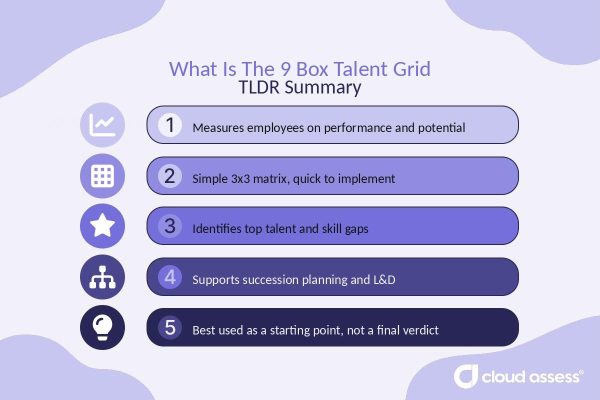
The nine-box talent grid is a human resources tool used to assess employees’ performance and potential. The tool measures employees according to two metrics: Potential and Performance. A 3×3 grid matrix is created, with employees being allocated a score between 1 and 3 for each metric, and aligned on the grid accordingly.
The concept dates back to the 1970s. The goal was to provide businesses with a tool they could use to perform employee evaluations quickly and easily. This provides an opportunity to understand where untapped talent lies within the organisation, and where employees were draining resources rather than adding value.
This method provides a simple but effective technique for determining employee success and highlighting areas for performance improvement.
Download A Free 9-Box Talent Grid Template
The 9 Box Grid was developed half a century ago. However, it remains a popular tool for measuring potential and performance in businesses around the world. It also helps companies plan employee development and training initiatives and ensure that they’re having the best possible impact on their operations.
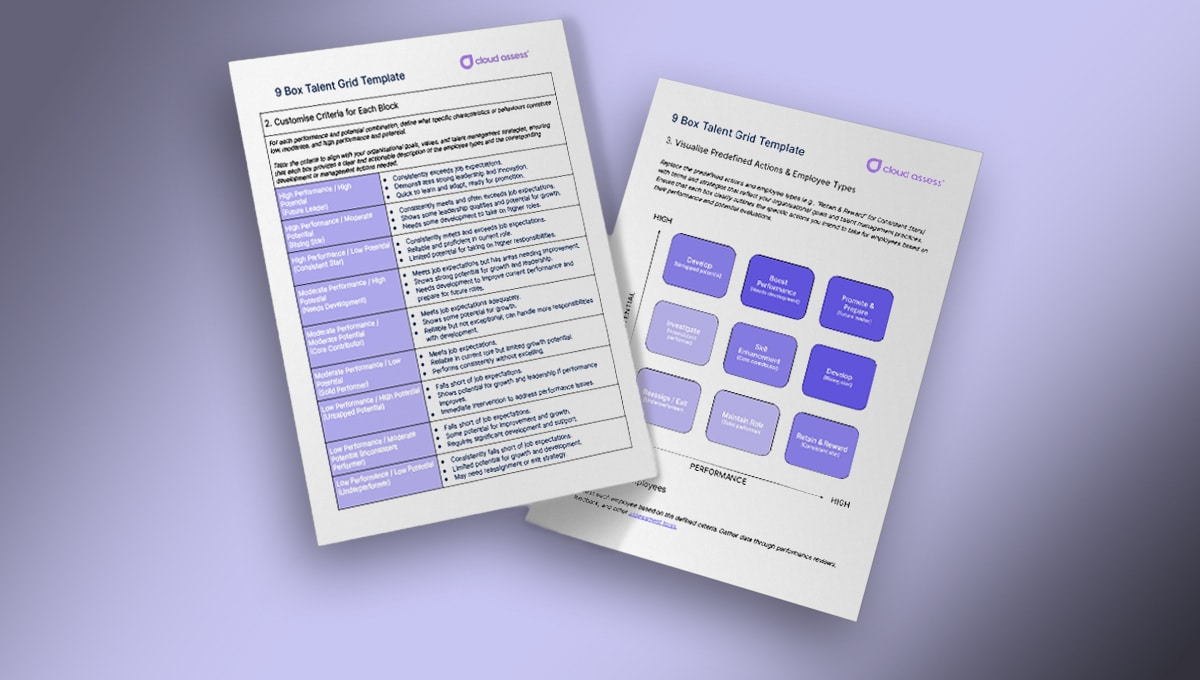
That’s why we’ve put together a handy, downloadable 9-Box Talent Grid Template as one of our many free resources to help you align performance and potential with training opportunities. We’ve even made it customisable to incorporate your own culture, performance metrics and criteria and more into the employee evaluation process. Enhancing your talent management strategy with this effective performance assessment tool has never been easier!
Download the template today.
How Do You Create A 9-Box Talent Grid?
One of the best aspects of the 9-box grid, or 9-box matrix as it’s also commonly known, is its simplicity. This makes it an easy tool to understand, to set up, and to adopt throughout your business. Creating your own 9-box talent grid is simple – or you can even just download the template above to get you started.
1. Evaluate employees based on performance
Performance is all about your employees’ current efforts. During the performance evaluation, consider aspects like:
- How well do they manage their time?
- Do they always meet deadlines, or do they often need extensions?
- How productive are they?
- Do they ask the same questions every month?
- Are they the kind of person that others turn to for help?
2. Evaluate employees based on potential.
It’s also important to think about each employee’s growth potential. During the potential assessment, consider factors like:
- How effective are they at change management?
- How quickly do they learn?
- How well do they apply their learnings to real-world citations?
- Do they take initiative, or wait to be assigned tasks?
- Are they reliable?
3. Create Your 3×3 Matrix
To create your 9-box talent grid, start by drawing a 3×3 matrix, resulting in nine equal-sized boxes. This forms the framework for your evaluations.
Next, label the horizontal axis as “Performance,” dividing it into three levels: Low, Medium, and High. This axis will capture the current performance of your employees. Then, label the vertical axis as “Potential,” also divided into three levels: Low, Medium, and High. This axis will reflect the future capability and growth potential of your employees. By clearly labelling these axes, you can accurately plot each employee based on their assessed performance and potential
4. Place employees on the 9-box grid
Next, it’s time to bring the two metrics together and assign your employees spots on the 9-box grid. It’s important to remember that it’s not only possible for high performers to have low potential, and vice versa, but it’s highly likely! Both will have important value to add to your business.
5. Review and validate placements
Once you’ve gone through the implementation process, step back and review it. Does the grid seem balanced, with the majority of employees sitting towards the middle ground? If not — if all employees are situated towards top right or bottom left — it likely indicates a problem. It is highly unlikely that everyone within the organisation is exceptionally productive with exponential potential, and it’s just as unlikely that they’re unproductive with no room for growth.
This problem is unlikely to lie with the employees themselves. It could indicate a positive or negative bias during the employee assessment phase. On the other hand, it could also indicate a larger problem with either hiring or training within your business. If it’s the former, re-evaluating employees with input from others, or realigning your performance and potential criteria, can see the grid evening out.
6. Use the grid for talent management decisions
With the grid completed, use it to inform and enhance your talent management decisions. This is your opportunity to tap into untapped talent, focus training in the areas where it will be most effective, and make some important decisions.
Identify high performers with high potential for leadership roles and consider them for promotions and advanced training opportunities. Recognise employees with high performance but lower potential to leverage their expertise in specialised roles. For those with high potential but currently lower performance, develop targeted development plans to help them reach their potential.
Additionally, use the grid to pinpoint areas where employees may need additional support, mentoring, or training. By systematically utilising the 9-box grid, you can make informed decisions that align with your organisation’s strategic goals and support employee growth.
Understanding Employee Value Based on the 9 Box Talent Grid
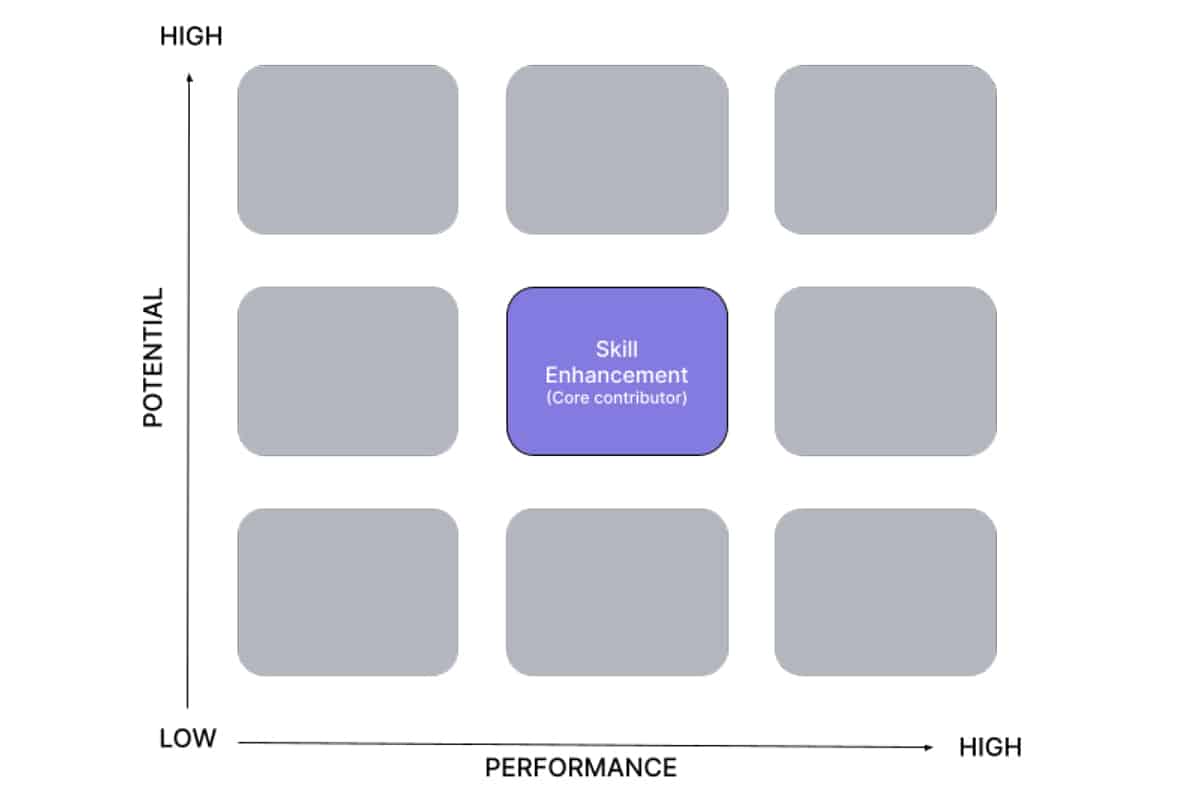
Most employees are likely to fall around the centre of the grid. These are your core contributors — those who work hard and show potential. Providing them with training in the right areas will see their performance and contributions grow even further.

Those in the upper right corner are excellent candidates for succession planning. They are ready to take on bigger challenges and new roles within your business.
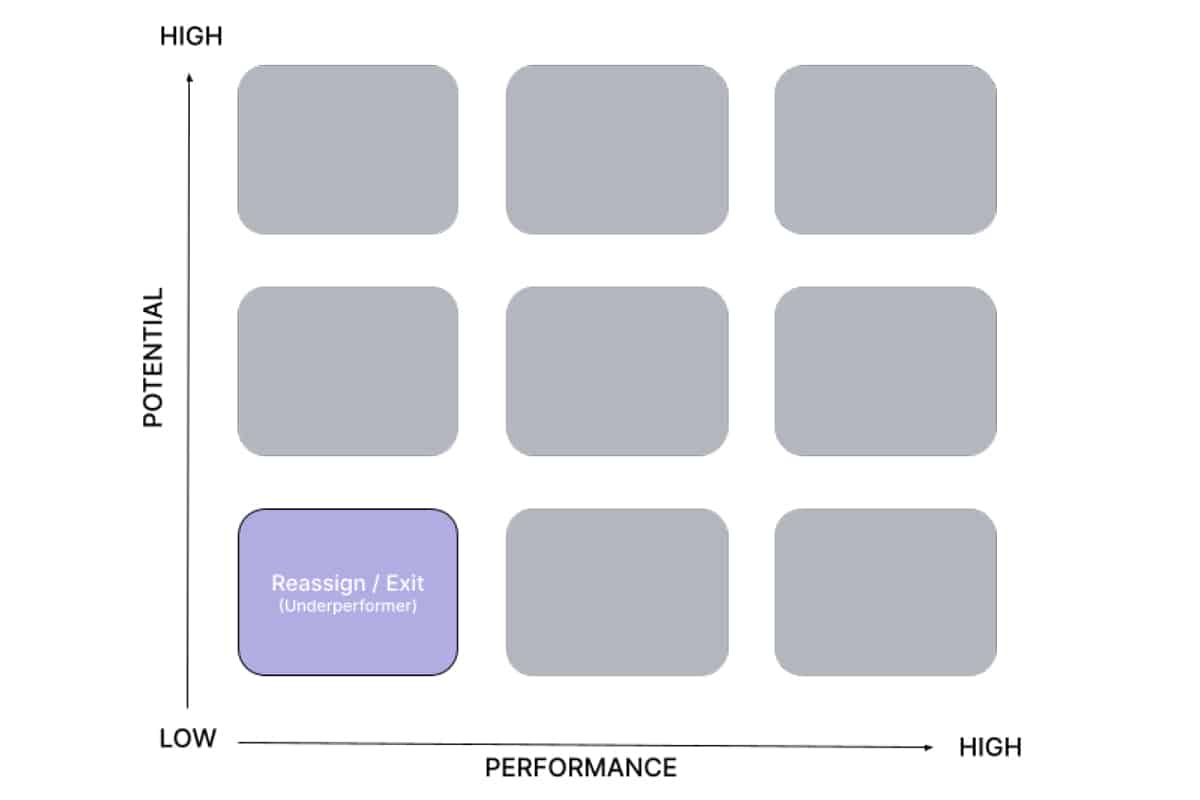
Employees who fall into the bottom left corner are underperformers. They are either not in the right role for their skills and talents or lack motivation within their position. People who fall in the bottom left either need to be reassigned if there is another role that would be better suited to them, or they need to be replaced.
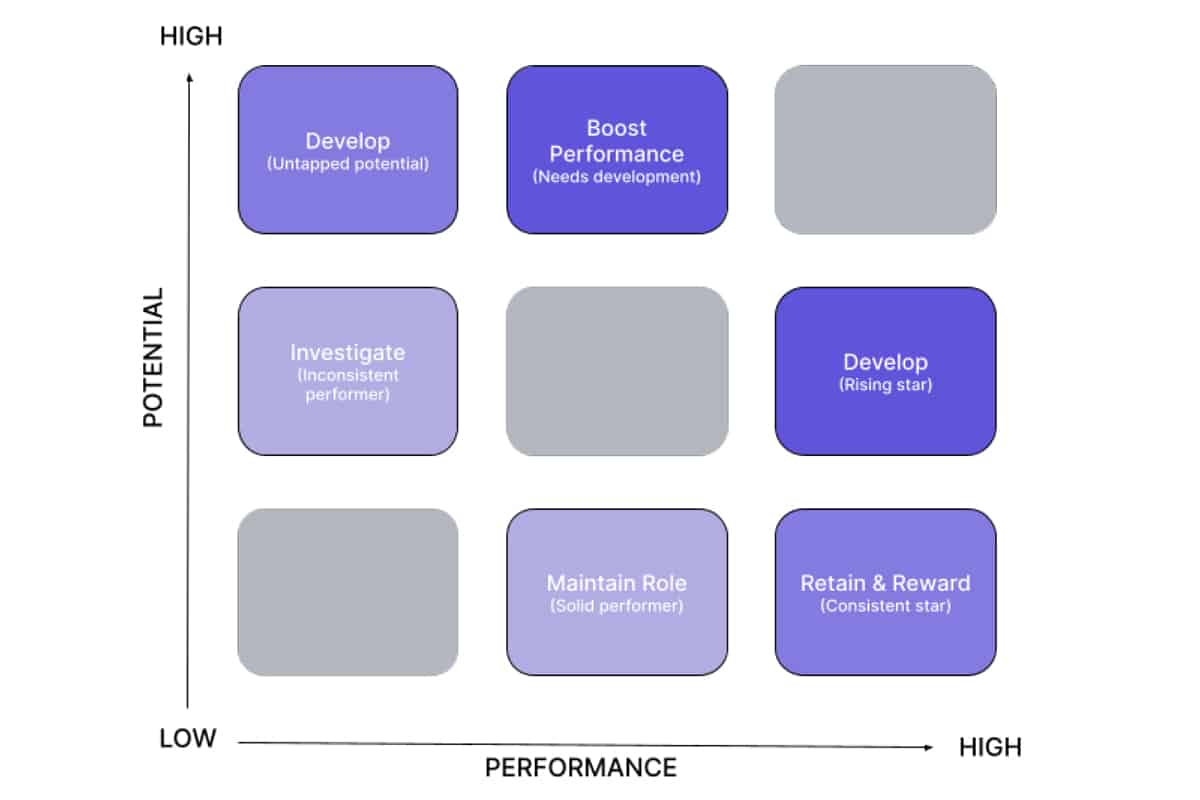
For employees found on the outskirts of the grid, developing the right plan of action for learning and skill development has the potential to see them either increasing their performance, becoming more confident in their role, or rising towards becoming future leaders.
What Are The Benefits Of Using The 9-Box Grid?
Easy To Use
The simplicity of the 9-box grid makes it very easy to use. Unlike many other assessment methods, which take time and training to both understand and put in place, the performance-potential matrix is intuitive.
Visualise Valuable Talent
The 9-box grid is a visual representation of your business’ talent and future potential. Once you’ve finished evaluating your employees, their performance and potential are laid out in a way that makes talent identification quicker and easier. It can help you visualise and recognise top talent, underperformers, and your core workers.
The visual representation can help you identify areas for improvement within your performance management process as well. If you find that the grid is uneven, with most employees fitting into one box or area of the matrix, this is likely to indicate an issue that needs to be addressed.
Holistic Approach
While the basic concept of the grid is about employee assessment, it provides a much broader range of information to businesses that use it. The 9-box grid can help you to identify individuals who are good fits for succession planning and areas where L&D initiatives should be focused. It can also highlight potential areas of organisational growth beyond just the future potential of employees.
Consistency And Objectivity
The 9-Box Grid helps you analyse team members using the same evaluation criteria. And they’re simple criteria at that. In many ways, this can help you stay objective in your decision-making, without taking areas like personal relationships into account.
Increases Transparency
Using the same performance criteria for every employee ensures that everyone has a thorough understanding of the standards they are expected to reach. This improves transparency throughout organisations, reducing the risk of bias and fostering trust and understanding among colleagues.
Future Planning
The 9-box talent matrix highlights the employees who are future stars within your business. However, it can also help you plan for the future in other ways. It provides insights that can be used to guide and bolster L&D initiatives. It highlights employees struggling in their roles who need further assistance. It also indicates employees who may be in the wrong positions altogether — those with high potential but low performance, for example, may do better in another role.
Identifies Skill Gaps
While some businesses may see this as a potential challenge or con of using the 9-Box Grid method, we see it as an advantage. By identifying skill gaps, you are taking the first step to correcting a problem within your business. The 9-box talent grid also has the potential to directly solve this problem by highlighting individuals who could be trained to fill those gaps.

What Are The Challenges And Limitations Of The 9-Box Grid?
While the 9-box grid may still be a popular method of employee evaluation, it is not without its critics. And they’re not entirely wrong. There are a number of challenges and limitations that the grid presents. This is why it’s also critical to consider best practices when using the 9-box matrix, as they can help you to overcome these challenging areas.
Outdated
The 9-box grid was developed over 50 years ago, and the world has come a long way since then. The challenge of onsite vs. remote vs. hybrid workers is difficult enough to navigate on its own. Trying to evaluate all of those workers according to the same simplified performance metrics can be headache-inducing. And if the 9-box grid is the only method that you’re using for assessment and evaluation, the outcome is likely to be skewed towards onsite workers. Those are often the employees whose work is most readily visible and available. You can see when they’re at their desks and more easily see the immediate potential of.
Inflexible
If you take the grid purely at face value, it can be extremely inflexible. Not every employee is going to perfectly fit into the boxes assigned to them by the grid. Someone who performs exceptionally well, and who you think might have vast potential might not be well suited to a senior leadership role. Someone who is underperforming and who you perceive to have low potential within the business may actually be one of your best performers whose work goes unnoticed.
Unclear Metrics
When creating talent analytics, and especially those that could impact future training and employment, it’s critical that the metrics you’re using are very clear-cut. The two simplified concepts that the 9-box grid uses are anything but clear-cut. What one manager expects from ‘performance’ may not align with another manager’s expectations. And potential, in particular, can look different depending on who you speak to. These unclear metrics make consistent and reliable evaluations difficult.
Not Always Reliable
Companies and managers aren’t always very good at predicting employee growth. A 2010 study details the difficulties in predicting who will fill future leadership roles. The challenge has become only more complex as the world has evolved in the 14 years that have followed. As one of the two foundational measures that the 9-Box Talent Grid uses, this inability to consistently recognise and measure potential can make the tool not just ineffective, but potentially harmful.
Potential For Bias
While the aim behind the 9-box grid may be objectivity, many companies have found that the opposite ends up being the case. Managers often consider those they get along well with to have more potential and better performance than those they find less personable, for example. This kind of subjectivity may not be intentional, but it can severely impact the effectiveness of employee assessment and evaluation.
Puts People Into Boxes
Few people like the idea of being labelled. They like it even less when the label is negative, as in the case of an underperformer or inconsistent performer. This can not only be demotivating, but it can also be inaccurate. A negative label could impact not only past performance but future performance as well, especially if an employee feels that the assessment is inaccurate. It can impact how others around them perceive their work beyond just their manager and can result in even lower performance. And it’s not only these two boxes that you need to be concerned about – an employee who perceives themselves as a future leader but is labelled as a core contributor instead could end up feeling that their work is undervalued. This can have a direct impact on employee retention.
What Are The Best Use Cases For The 9-Box Matrix?
Using the 9-box grid method of evaluation may come with its challenges, but there are two particular areas where it can be most effective.
Talent Management
Once the initial grid placement is complete, the 9-box talent matrix can give you a good idea of where time and resources would be most valuable. Looking beyond your organisation’s talent landscape, it can also provide insight into areas where further skills and talent acquisition may be needed. Just like the 6B’s model of talent management, which emphasises key areas such as acquiring, building, and retaining talent, the 9-box grid serves as a powerful tool for strategic workforce planning. It helps organisations effectively upskill employees, guide hiring practices, grow the talent pipeline, and enhance training programs.

Succession Planning
The three boxes that sit in the top right corner of your 9-box grid are a good area to look to when succession planning within your business. The employees that are assigned to these boxes are excellent candidates for leadership development. By using the 9-box talent matrix as a succession planning tool, you have an opportunity to identify not only the people who are going to be good fits for future management positions, but to provide them with training in the right areas.