Modern learners don’t rely on a single source of knowledge. They search, share, message, collaborate, and contribute. Learning happens across platforms, devices, and conversations, often at the same time. Classrooms, workplaces, and informal settings now blend into a continuous stream of discovery.
This shift raises important questions for educators, trainers, and instructional designers. How do we make sense of learning that is constant, fast, and digitally connected? How do we support learning that doesn’t begin or end with a single course or classroom?
Connectivist learning theory offers a clear framework for this environment.
In this blog, we’ll discuss:
- What connectivism is and how it works
- How it differs from other learning theories
- The core ideas that shape the connectivist framework
- Practical benefits for modern learners
- Real use cases in learning and development
- Digital tools that support connectivism
- Critiques and challenges

What is Connectivist Learning Theory?
Connectivism explains that people learn by building connections across three networks. These networks include people, information, and resources.
- People networks involve suitably qualified experienced persons, online communities, and professional associations
- Information networks include websites, databases, and digital content platforms
- Resource networks include social platforms, workplace collaboration tools. And, other digital tools that support learning and knowledge sharing
The theory was introduced by George Siemens in 2004 and later expanded by Stephen Downes. Traditional learning theories tend to focus on how knowledge is stored and processed in the mind. But connectivism believes learning is about creating and maintaining connections to these networks.
The theory reflects how people engage with information today. People search, filter, tag, save, share, and apply information across different contexts. Learning is continuous. It is shaped by the ability to access and connect to current, relevant information in the digital age.
Connectivism vs Cognitivism
Cognitive learning theory views learning as an internal process. It focuses on how the mind receives, organises, stores, and retrieves information. Learners are seen as processors of input who build mental models over time.
Connectivist learning theory takes a different view. It shifts the emphasis from internal memory structures to external learning networks. What matters is not just what a learner knows, but their ability to find and apply knowledge by connecting to the right sources..
Connectivism vs Constructivism
Constructivism learning theory sees learning as an active process. One where individuals build knowledge based on their experiences and understanding of the world. Learners interpret new information through their own background, beliefs, and context.
Connectivist learning theory moves beyond this individual construction of knowledge. It places more value on the role of networks, collective knowledge, and real-time access to information. Instead of relying on past experience, learning in Connectivism depends on connections.
Benefits of Connectivism
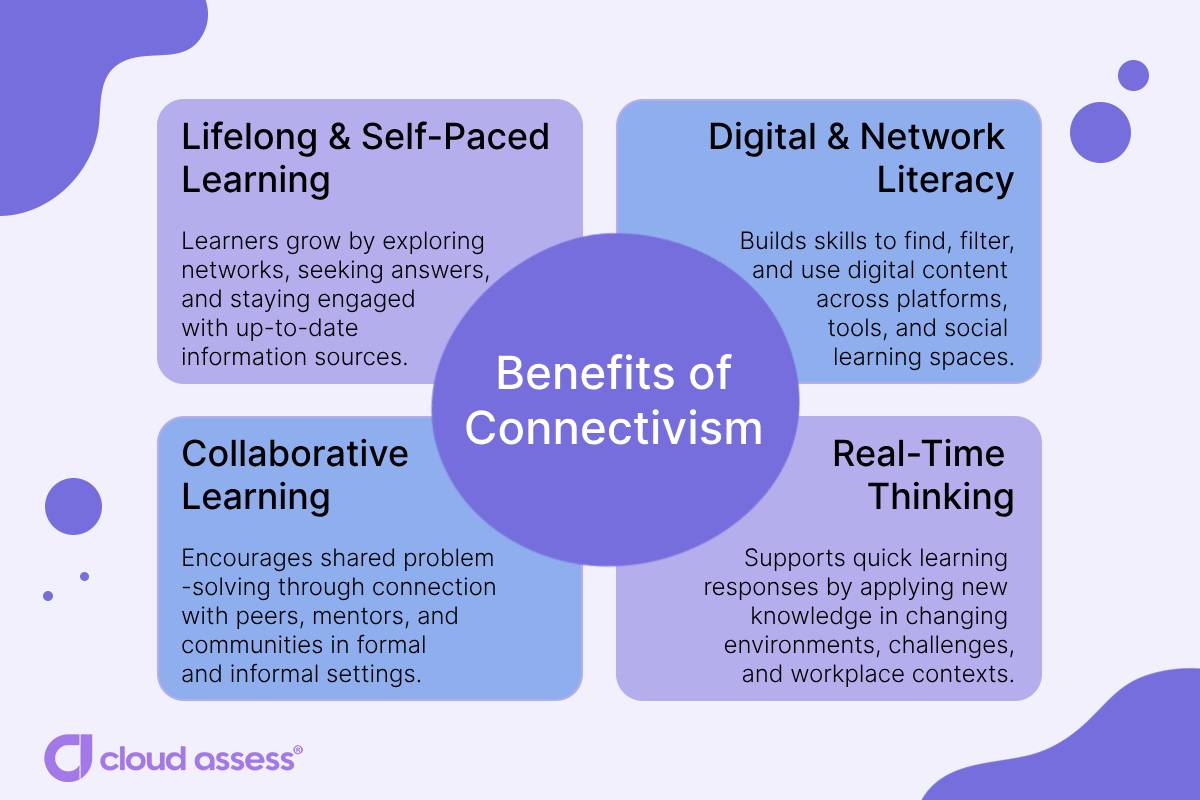
Supports Lifelong and Self-Directed Learning
Connectivism encourages learners to take ownership of their development. Learners do not rely solely on structured courses. Instead, they build networks. They explore new sources. They stay engaged with current knowledge. This makes the theory especially useful for lifelong learning. In this context, curiosity, initiative, and adaptability matter more than formal instruction.
Enhances Digital and Network Literacy
To learn in a connected environment, learners must know how to navigate digital learning platforms. They must assess online content. They must also use technology to find and share information. Connectivism naturally promotes these skills. It places learners in settings where they interact with data sources. They also engage with digital learning communities. They use digital tools to support their learning.
Fosters Collaboration and Social Learning
Because Connectivism is rooted in connections, it strengthens collaborative learning. Learners engage with peers, mentors, experts, and communities across digital networks. This leads to shared problem-solving, and peer feedback. It also allows for collective knowledge-building in both formal and informal contexts.
Promotes Adaptive Thinking and Problem-Solving
Connectivist learners adjust to change by analysing situations. They compare options, and apply knowledge in real time. This supports adaptive thinking and builds critical thinking skills. This is particularly true in environments where guidelines shift. And, in classrooms where learners must respond to new topics, feedback, or peer perspectives. It also helps vocational learners adapt to updated tools or protocols. In all learning environments, flexibility leads to better decisions and outcomes.
Principles of Connectivism

1. Learning and Knowledge Rest in Diversity of Opinions
This principle focuses on the value of diverse perspectives. In group projects, online communities, or cross-functional teams, learners engage with different viewpoints. This challenges their assumptions. It introduces alternatives. It also leads to a stronger understanding.
2. Learning is Connecting Specialised Nodes of Information Sources
This principle highlights that knowledge exists across people, platforms, and tools. Learners often draw from colleagues, subject matter experts, digital repositories, or AI systems. Learning happens through the process of forming, navigating, and activating these connections.
3. Learning May Reside in Non-Human Appliances
This principle acknowledges that learning does not depend solely on human memory. People can also rely on technology. This includes search engines, dashboards, content libraries, and automation systems. These tools store, deliver, and even organise knowledge. They are part of the learning process, not separate from it.
4. Capacity to Adapt is More Critical Than What is Known
This principle shifts the emphasis away from knowledge retention through memorisation. It focuses instead on the ability to adapt to change. In fast-paced environments, learners benefit more from recognising knowledge gaps. They also benefit from sourcing relevant information and applying it quickly. This is especially important in fields where information changes often. Examples include healthcare, technology, or regulation.
5. Maintaining Connections Supports Continual Learning
This principle highlights the importance of ongoing engagement to support continuous learning. Learners grow when they sustain access to learning communities, peer support, or curated resources. Without active effort to maintain these connections, learning may stall or become outdated.
6. Seeing Connections Between Concepts is a Core Skill
This principle emphasises cross-context thinking. Learners gain deeper insight when they can relate information across domains. For example, linking ethics to data design, or using communication theory to improve customer service. Making these links supports power skills such as flexible thinking and innovation.
7. Staying Current is Key
This principle reinforces the need to stay informed. Outdated knowledge can lead to poor decisions. It can also cause gaps in understanding or missed opportunities. Staying current ensures that learning remains relevant and accurate. This applies in many situations. A student may follow updates to research. A tradesperson may learn new safety standards. A professional may track policy changes. A self-directed learner may explore emerging tools.
8. Decision-Making is a Learning Process
This final principle reframes learning as ongoing judgement. Learners actively evaluate what information is credible, decide what matters most, and choose how to act on it. These choices directly shape how their learning develops. And, how they apply knowledge in real-world contexts.
The Application of Connectivism in L&D Programs

Onboarding Programs
Learning and development (L&D) teams apply Connectivism in onboarding. They help new starters learn through real interactions. Learners explore tools. They join team chats. They follow process guides. They ask questions in live support channels. Instead of reading long manuals, they learn by connecting with people and systems in real time.
Skills Development and Reskilling
L&D teams apply Connectivism to support skills development. They help learners access digital resources. They also help them join expert forums and collaborate through shared platforms. When learners need to reskill, they use these same networks. They explore new topics. They stay current with industry changes. They also apply unfamiliar knowledge in practice.
Leadership and Career Development
Connectivism supports leadership and career development. It encourages open dialogue, peer feedback, and exposure to diverse perspectives. Learners connect with mentors. They follow thought leaders. They take part in learning communities. These experiences help them reflect, plan, and grow. Whether they are preparing for a leadership role or shaping future careers, they build networks. These networks facilitate continual learning and informed decision-making.
Vocational Education Pathways
Trainers apply Connectivism by linking practical training with connected learning tools. Learners use online learning resources to follow industry standards. They join trade communities. They also learn from real-world examples. These connections help learners understand emerging job roles. They help identify skill gaps. They also support informed decisions about next steps. This builds clearer and more relevant vocational pathways.
Digital Tools that Support Connectivist Learning
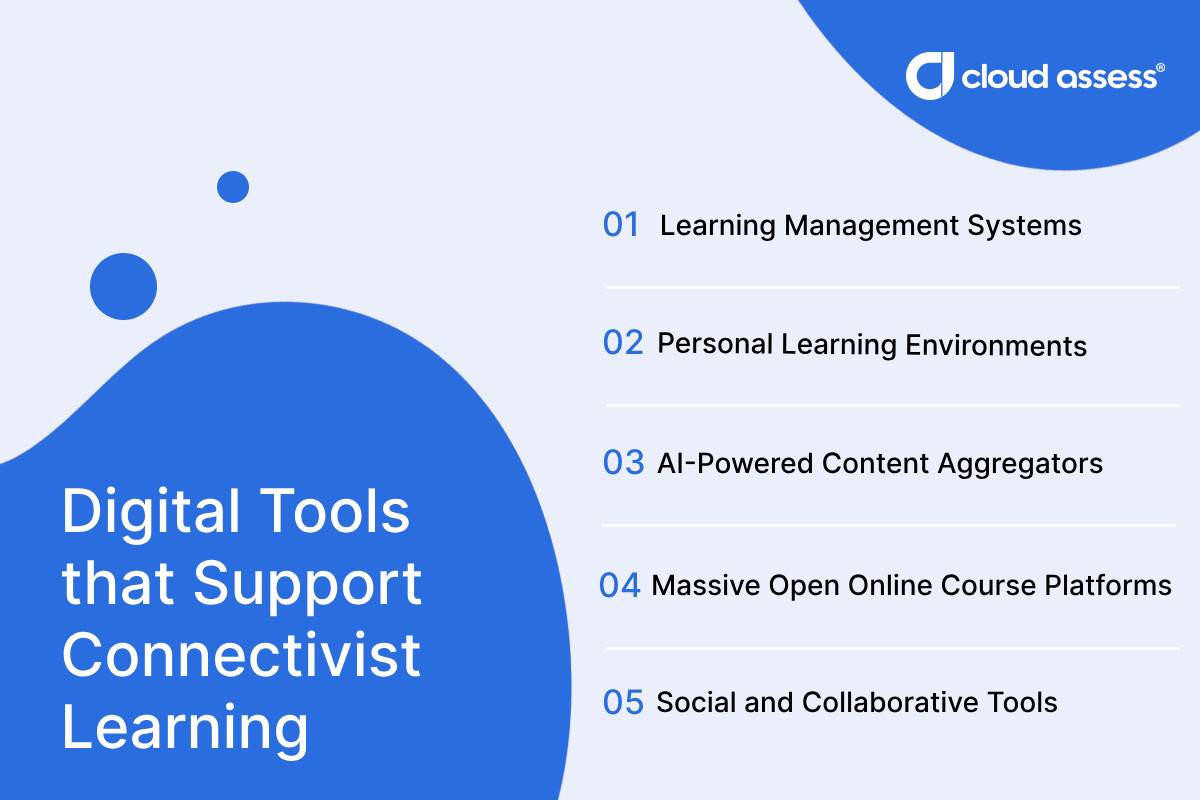
Learning Management Systems
Learning management systems (LMS) platforms support Connectivist learning. They bring content, discussions, and assessments together in one place. Critical LMS features include discussion forums, live classes, resource libraries, and group workspaces. These features help learners connect with peers and instructors. This creates a structured but flexible space. Learners can build their knowledge networks. They can also revisit materials as needed to improve their own learning.
Personal Learning Environments
Personal learning environments (PLEs) let learners create custom paths. These paths are based on their interests and goals. Learners use tools like RSS readers, note-taking apps, or bookmarking extensions. They choose how they collect and organise information. This supports self-directed learning. It allows each person to build a setup that suits their style, interests, and pace.
AI-Powered Content Aggregators
Artificial intelligence-powered tools make it easier to manage large amounts of information. They offer smart suggestions. They highlight trends. They summarise articles. They also pull in content from different platforms. This helps learners filter noise. It helps them stay updated. It also helps them build a personalised stream of relevant information.
Massive Open Online Course Platforms
Massive open online course platforms (MOOCs) provide open access to instructor-led training. They also provide opportunities for global peer interaction. Learners follow structured lessons. They take part in forums, live Q&As, and discussions with people from different backgrounds. This mix of guided learning and diverse perspectives supports Connectivist principles. It does this through both content and community.
Social and Collaborative Tools
Platforms like messaging apps, virtual whiteboards, and professional networks support real-time communication. They also support group learning. Learners ask questions. They share ideas. They build knowledge together. Social learning features include tagging, threaded replies, and co-editing. These features make learning more interactive and connected.
Connectivism Critiques
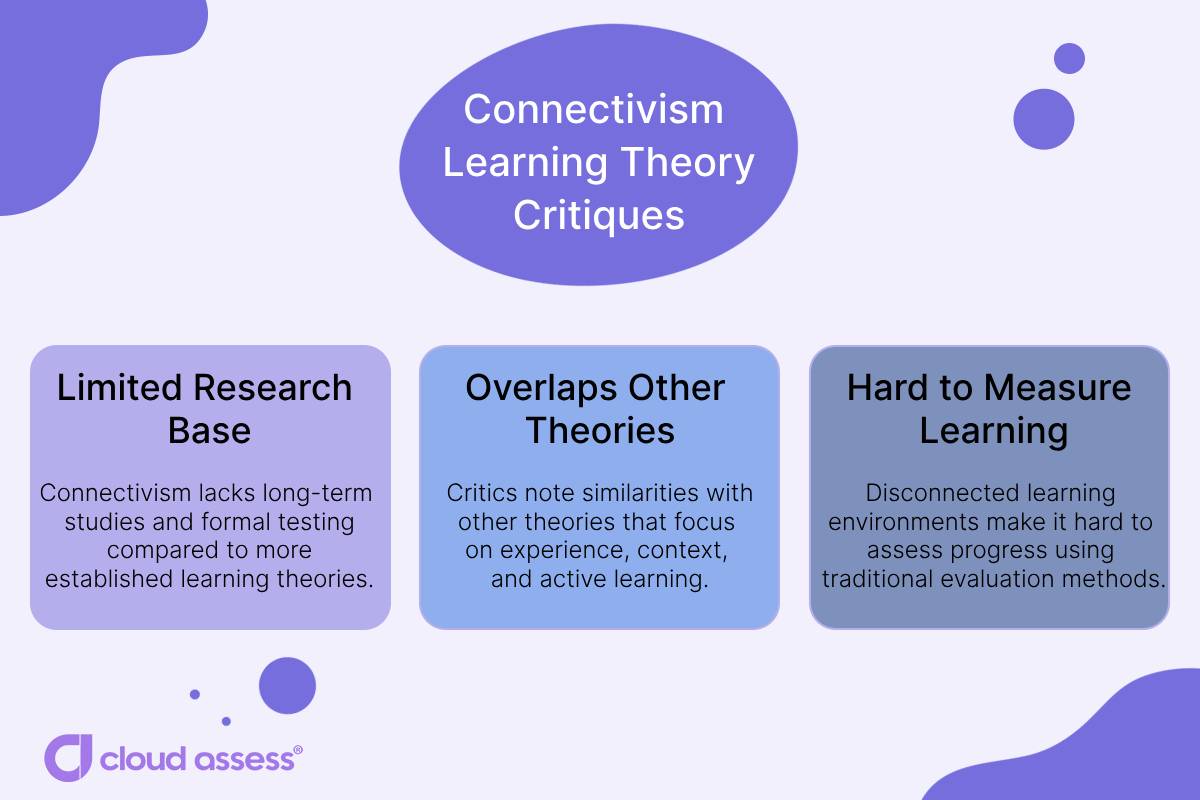
Lack of Empirical Testing as a Formal Learning Theory
Critics argue that Connectivism lacks rigorous research and validation. It does not yet match the level of evidence behind more established learning theories. It has not been widely tested through long-term studies. It also has not been applied consistently in formal academic models.
Solution: L&D teams can strengthen Connectivism’s foundation. They can pilot structured programs. They can collect feedback. They can also share measurable results. Small-scale studies in classrooms, training programs, or online courses can help. These studies can build the evidence base that the theory currently lacks.
Overlap With Existing Theories Like Constructivism
Some critics say Connectivism does not offer enough distinction from theories like Constructivism. These theories also emphasise experience, context, and active learning. This raises questions about whether Connectivism is truly a new theory. Some view it as a digital extension of earlier theories.
Solution: Educators can clarify the value of Connectivism. They can focus on what the theory adds. For example, Connectivism emphasises connected learning networks. It highlights the use of digital networks, distributed knowledge, and the role of technology. This focus shows how and where learning happens today. It helps position Connectivism as a distinct response to modern learning environments.
Challenges in Assessment and Measurement of Outcomes
Connectivist learning often unfolds across platforms and informal spaces. This makes it harder to track progress. It also makes it challenging to measure learning outcomes using traditional assessments. Educators may struggle to evaluate impact when learning is decentralised.
Solution: Program designers can address this by using flexible assessment methods. These may include portfolios, reflective journals, peer feedback, or performance-based tasks. These approaches allow learners to demonstrate growth. They do so in authentic, context-specific ways that align with Connectivist principles.
Applying Connectivism in Modern Learning
Connectivism challenges us to design learning strategies that reflect how people actually operate. People connect, adapt, and learn continuously. It shifts the focus from content delivery to connection-building. It moves from memorising facts to navigating information networks with purpose.
For educators and learning professionals, this means rethinking how we support learners. It means valuing digital and offline communities. It also means encouraging self-direction. We need to build systems that allow knowledge to flow. The goal is not to control learning. It is to enable it.
In a world where change is constant, Connectivism offers a practical and relevant way forward. It prepares learners not just to keep up. It helps them stay connected, think critically, and keep learning well beyond the classroom or course.
Connectivism FAQs
Do Learners Need To Be Tech-Savvy To Benefit From Connectivism?
Digital skills help because many learning connections happen through online tools. But Connectivism also includes learning through conversations and community groups. It also includes other sources outside the internet. Learners can benefit by slowly building confidence. They should build skills in using both digital and non-digital tools.
Can Connectivism Help With Learning Outside Of School Or Work?
Yes. Connectivism works well for personal learning. People often learn new things by watching videos, reading blogs, joining online groups, or asking others for advice. This type of learning also happens when people talk with friends or share ideas in everyday life. Connectivism helps explain how these different sources all come together to support learning.
Does Connectivism Replace Traditional Learning Methods?
Connectivism adds to traditional learning. It does not replace it. It shows how learning can happen through networks, tools, and real-time access to information. Connectivism highlights the value of staying connected to current knowledge. It also values learning with others across different settings.