Have you ever noticed how two people can take the same course, yet walk away with completely different understandings? Or how, when you ask a class full of students for their key takeaway, each person offers a different perspective?
That’s because learning isn’t one-size-fits-all. The way we interpret information is shaped by our existing knowledge, experiences, and personal contexts. We each connect ideas in our own way, building meaning from what we already know. This individual process of shaping perceptions is known as constructivism.
In this article, we explore:
- What constructivism is
- How it impacts learning
- Key theorists behind the concept of constructivism
- How constructivist learning theory compares to other learning theories
- Principles of constructivist teaching and best practices for applying them
- Challenges and limitations of a constructivist teaching approach

What is Constructivism?
Constructivism is a philosophical perspective that suggests individuals actively build knowledge and meaning based on personal experiences. Our understanding of the world is impacted by various factors. These may include our cultural background, existing knowledge, and interactions with others.
This means that no two people will interpret the same scenario in exactly the same way. This makes each person’s perspective, input, and insights uniquely valuable.

What is the Constructivist Learning Theory?
Constructivism suggests learning is most effective when students actively participate in the process. Learners make sense of new information by asking questions, solving problems, and reflecting. They also connect new learning to what they already know. This builds stronger foundations for future understanding.
Collaboration is a key element of the constructivist theory of learning. Engaging with others exposes learners to different perspectives. Collaborative learning helps individuals gain context and adjust their understanding. This leads to deep, meaningful engagement with content. It adds relevance and makes learning more memorable.
This approach fundamentally changes teachers’ roles. Rather than acting as transmitters of information, educators become facilitators of learning. They provide the tools, guidance, and environment learners need to develop their understanding.
Key Theorists Behind Constructivism
Many theories influence and contribute to constructivist learning frameworks. However, the works of Jean Piaget, Lev Vygotsky, and Ernst von Glasersfeld have helped define three distinct types of constructivism.
- Jean Piaget is a key influence on both constructivism and cognitive learning theory. He proposed that learners actively construct knowledge as they progress through developmental stages. His theory of cognitive constructivism explains that people gain new information through experience. They then adapt their mental frameworks to accommodate it.
- Lev Vygotsky is best known for his contributions to social constructivism. This is the idea that learning is shaped through interaction with others. He developed the concept of the Zone of Proximal Development (ZPD). This highlights the gap between what learners can do independently and what they can achieve with structured support. His ideas laid the groundwork for Scaffolding Theory. Scaffolding explains how educators can support learners as they build independence.
- Ernst von Glasersfeld developed the idea of radical constructivism. He argues that knowledge is entirely subjective and constructed by the individual. He believed we can never know objective reality, only our interpretation of it. This perspective places the student at the centre of the learning process. It also challenges traditional ideas about absolute knowledge.
- Jerome Bruner expanded on Vygotsky’s ZPD. He introduced the concept of scaffolding, where learners are supported as they tackle new challenges.
- John Dewey believed that learners deepen understanding by reflecting on real-world experiences. This laid the groundwork for David Kolb’s Experiential Learning Cycle.
- William Perry’s theory of intellectual development highlights the role of reflection, dialogue, and critical analysis. These are key principles for knowledge construction in higher education settings.
Constructivism vs Other Learning Theories
Constructivism vs Connectivism
Connectivism views knowledge as distributed across human and digital networks. It sees learning as being able to navigate, connect, and update information. It’s especially valuable in rapidly changing, tech-driven environments.
Constructivism takes a very different approach. It’s rooted in individual meaning-making through internal mental processes. It emphasises how learners interpret and construct knowledge based on personal experience.
Constructivism vs Behaviourism
Behaviourism is based on the idea that learning occurs through conditioning. It explains that responses to external factors shape behaviour. It suggests using reinforcement and repetition to encourage desired behaviours.
Constructivism focuses on how individuals process and interpret information internally. It places more emphasis on independence, meaning-making, and prior experience.
Constructivism vs Cognitivism
Cognitivism sees learning as the process of gaining, accessing, and organising information. It focuses on internal mental processes like attention, memory, and problem-solving. It draws on Information Processing Theory, which compares the mind to a computer.
Both learning theories consider internal processes. Yet, cognitivism supports more structured instruction. Constructivism sees knowledge as shaped by individual experiences. encouraging exploration and context-based learning.
Constructivism vs Self-Directed Learning
Self-directed learning sees learners take initiative in identifying their own learning needs. They set their own goals and test their outcomes. It often involves high levels of independence and personal responsibility.
Self-directed learning can overlap with constructivism. Learners are given the autonomy to explore their own knowledge, interests and experiences.
Constructivism vs Heutagogy
Heutagogy is the study of self-determined learning. It focuses capability, adaptability, and reflective practices. This is particularly common in adult learning and complex, evolving environments.
Constructivist theory supports personalised learning by promoting learner autonomy. Heutagogy pushes this even further by removing structured guidance altogether. Constructivist instruction is often facilitated by a teacher, trainer or mentor. Heutagogy is fully learner-led.
Key Constructivist Principles
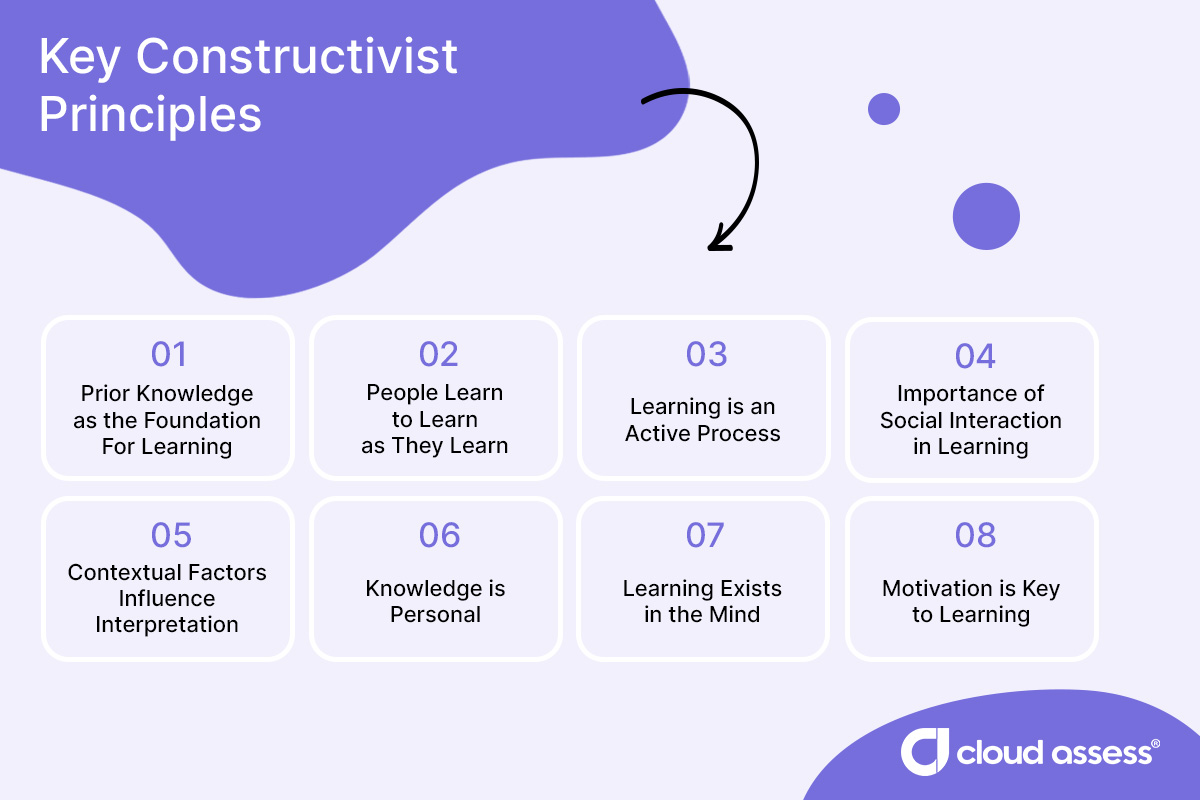
Prior Knowledge as the Foundation for Learning
In constructivism, learning isn’t about starting from scratch, it’s about making connections. We build on what we already know, creating deeper meaning by linking new concepts to familiar ideas already stored in our long-term memory.
Consider a cybersecurity course, for example. A trainee with an IT background will likely pick up advanced technical concepts quicker than someone from a general admin role. Their prior knowledge allows them to interpret the material through a familiar lens. This gives them a stronger foundation to build on.
People Learn to Learn as They Learn
Learning doesn’t just help us understand new information. It also helps us better understand how we learn. Learners use their experience to recognise which strategies work best for them. This helps them develop critical thinking, self-reflection, and problem-solving skills for future work.
Think of a student investigating plant growth. They might test how different levels of sunlight affect seed germination. They’re not just applying their science education and learning about biology. They’re also developing skills. These might include forming a hypothesis, setting up controlled environments, recording data, and adjusting thinking based on results.
These skills go beyond the experiment. They strengthen kinesthetic learning, helping the student approach future tasks more practically and independently in any subject. They may also discover that this hands-on learning style isn’t the most effective for them. This insight helps them narrow down their learning preferences. It helps them become more efficient, self-aware learners in the future.
Learning is an Active Process
Another key constructivist principle is that learning isn’t a passive activity. Listening and reading can help you gather information. However, it won’t become meaningful or stick with you unless you actively engage with it. That might involve discussing new ideas, experimenting, asking questions, or reflecting on what you’ve learned.
For example, a student learning about budgeting might understand the theory behind income and expenses. But they won’t internalise how budgeting works in real life. By creating a budget and tracking their spending, they turn information into lasting knowledge.
The more actively involved you are in the learning process, the more meaningful and transferable that knowledge becomes.
Importance of Social Interaction in Learning
Constructivist theory emphasises that learning doesn’t happen in isolation. When we collaborate with others, we’re exposed to new perspectives, language, and ways of thinking. These help us process and refine our own understanding. Social interactions, especially those involving dialogue or disagreement, encourage learners to clarify ideas, justify their thinking, and consider alternative viewpoints.
For example, a group of students debating the causes of a historical event will learn the facts. But they’ll also learn how to construct arguments, listen critically, and think more deeply. This social learning strengthens both individual and collective understanding.
Contextual Factors Influence Interpretation
While prior knowledge shapes what learners bring to a situation, the context in which learning takes place also plays a critical role. Our environment, emotions, social setting, and even the timing of a lesson all influence how we interpret new learning.
Imagine two employees attending the same customer service training. One is dealing with a stressful workload and may tune out, while the other, eager to improve, fully engages and takes notes. The difference isn’t in what they already know. It’s in the surrounding circumstances that affect how the learning is received and retained. Context can shape both the relevance and the depth of a learner’s understanding.
Knowledge is Personal
A constructivist perspective recognises that learning is a personal process. Each person filters new knowledge through their own values, experiences, learning preferences, and interests.
Consider a lesson on sustainability, for example. One person may focus on environmental policy while another is drawn to practical lifestyle changes. Both are engaging with the same topic. However, they prioritise different aspects based on what matters most to them. Constructivism encourages this kind of meaningful learning. This allows students to take ownership of what they learn.
Learning Exists in the Mind
The constructivist learning theory views education as something that happens internally. It’s not just about observation, but mental organisation and interpretation. We don’t store knowledge like static facts. Instead, we structure it in our minds based on our own frameworks and experiences. This cognitive development is what makes learning meaningful and adaptable.
For example, two learners might attend the same conflict management training. One may walk away with a clear strategy for handling team disagreements, while the other sees it as a broader approach to managing stress. Neither response is wrong. They reflect how each individual has mentally processed and structured the information in their mind.
Motivation is Key to Learning
Learners in constructivist classrooms should be curious, goal-oriented, or see value in what they’re learning. This makes them more likely to engage deeply and persist through challenges. Motivation drives attention, encourages reflection, and helps learners apply new knowledge to real life.
Think of an adult learner reskilling themselves to prepare for a career change. They are motivated to succeed. This drives them to connect learning with personal goals. They’ll ask deeper questions and stay committed even when tackling difficult material. The more motivated a learner is, the more meaningful the learning becomes.
Best Practices for Constructivist Instructional Design

Align Learning Objectives with Constructivist Outcomes
In a constructivist approach, outcomes should reflect how learners construct meaning. This means shifting the focus of training programs away from rote memorisation. Instead, prioritise skill development, problem-solving, and practical application.
Assessment Should Be Authentic and Reflective
Assessment in constructivist classrooms and workplace learning environments should mirror real-world situations. This helps learners demonstrate how they apply knowledge in context, rather than simply recall facts. It should also include moments for self-assessment and reflection. These see learners evaluating what they’ve learned, how they learned it, and how they can improve going forward.