What Details Should a CPD Log Include?
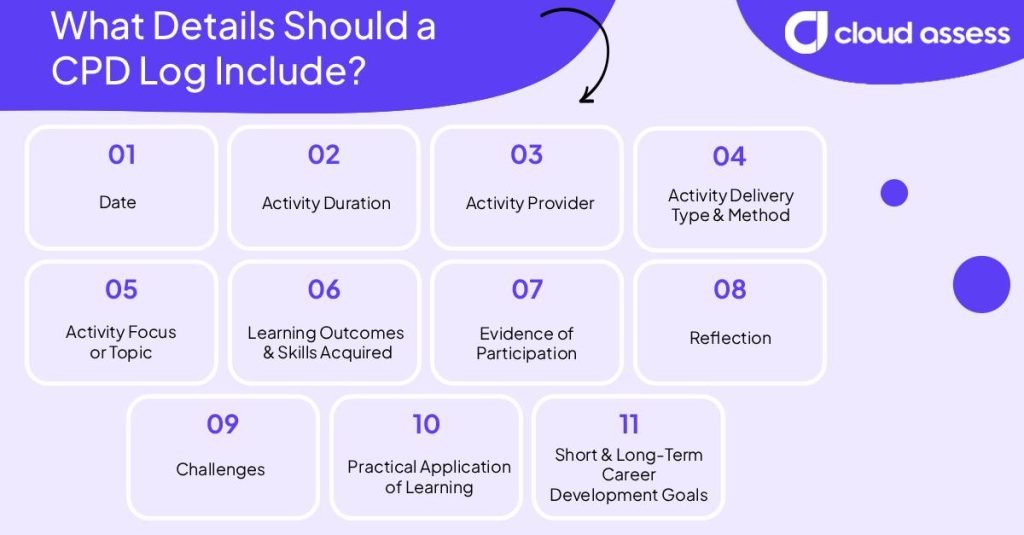
Date
The date shows when a worker completed each activity. Multi-day activities can use a date range or the final day. Consistent dates keep every record in chronological order.
Activity Duration
Duration records how long an activity took, in hours, days, weeks, or months. Accurate durations matter when professional bodies set minimum CPD hours.
Activity Provider
The provider entry names who delivered the activity, externally or in-house. Provider names help employers judge each course’s quality and relevance.
Activity Delivery Type & Method
Delivery type classifies how an activity took place. Options include formal courses, workshops, online modules, on-the-job training, and self-study. Recording delivery types shows the mix of learning across a workforce. Some professional bodies also cap or exclude certain activity types.
Activity Focus or Topic
A few words are enough to summarise the topic. Examples include ‘working at heights’ or ‘infection control’. The course name often works here.
Learning Outcomes and Skills Acquired
Learning outcomes capture the knowledge and skills gained from each activity. Across a team, outcomes show where expertise sits and where gaps remain.
Evidence of Participation
Certificates, licences, or other proof of completion support each entry. Where no certificate exists, a supervisor sign-off or attendance record can serve as evidence.
Reflection
Reflections capture how an activity changed a worker’s practice, which a certificate can’t show. Strong reflections note key insights and how they’ll be used on the job. Some professional bodies, particularly in healthcare, require reflective entries.
Challenges
The challenges field notes obstacles, such as complex content or an unsuitable delivery method. Recurring challenges point to training that needs adjusting.
Practical Application of Learning
Practical application links learning to a worker’s daily tasks. Clear links show the training’s value to the business.
Short and Long-Term Career Development Goals
Short and long-term goals connect each activity to a worker’s development pathway. Reviewing goals helps employers plan future training and support internal progression.
What Does a CPD Log Entry Look Like?
Date: 12 March 2026
Activity Duration: 8 hours
Activity Provider: XYZ Mining site training team
Activity Delivery Type & Method: On-the-job refresher training with practical assessment
Activity Focus or Topic: Haul truck operation refresher
Learning Outcomes and Skills Acquired:
- Reviewed updated traffic management rules for the pit and haul roads.
- Practised full pre-start inspections against the site checklist.
- Refreshed emergency procedures for brake failure and poor visibility.
Evidence of Participation: Signed verification of competency (VOC) record from the site assessor.
Reflection: The pre-start review showed I’d been rushing some checks. Slowing down at the start of each shift will reduce missed defects. The traffic management changes also clarified right of way at intersections.
Challenges: Reversing to the dump edge in low light took several attempts. Extra supervised practice on the night shift will help.
Practical Application of Learning: I’ll complete every pre-start check in full before each shift. I’ll also brief my crew on the new right-of-way rules.
Short and Long-Term Career Development Goals:
- Short-term: Complete supervised night reversing practice within a month.
- Long-term: Become a site trainer for haul truck operators.
Digital vs Paper CPD Logs: Which Format is Best?
Digital CPD logs are best for organisations tracking compliance across a workforce. Paper logs suit small teams with basic, offline recording needs. The right format depends on workforce size, compliance requirements, and site access.
Digital CPD Logs
Digital CPD logs store entries in a central, searchable system. Employers can view records across a workforce, set reminders, and export reports for audits. Workers can add entries and attach evidence from a phone or tablet. Many digital platforms also work offline, which suits remote sites. Set-up takes more time, and some workers may need support getting started.
Paper-Based CPD Logs
Paper CPD logs record entries by hand in a printed template. They’re simple to start and need no devices or internet access. However, paper records are hard to search, easy to lose, and slow to compile for audits.
How Often Should a CPD Log Be Updated?
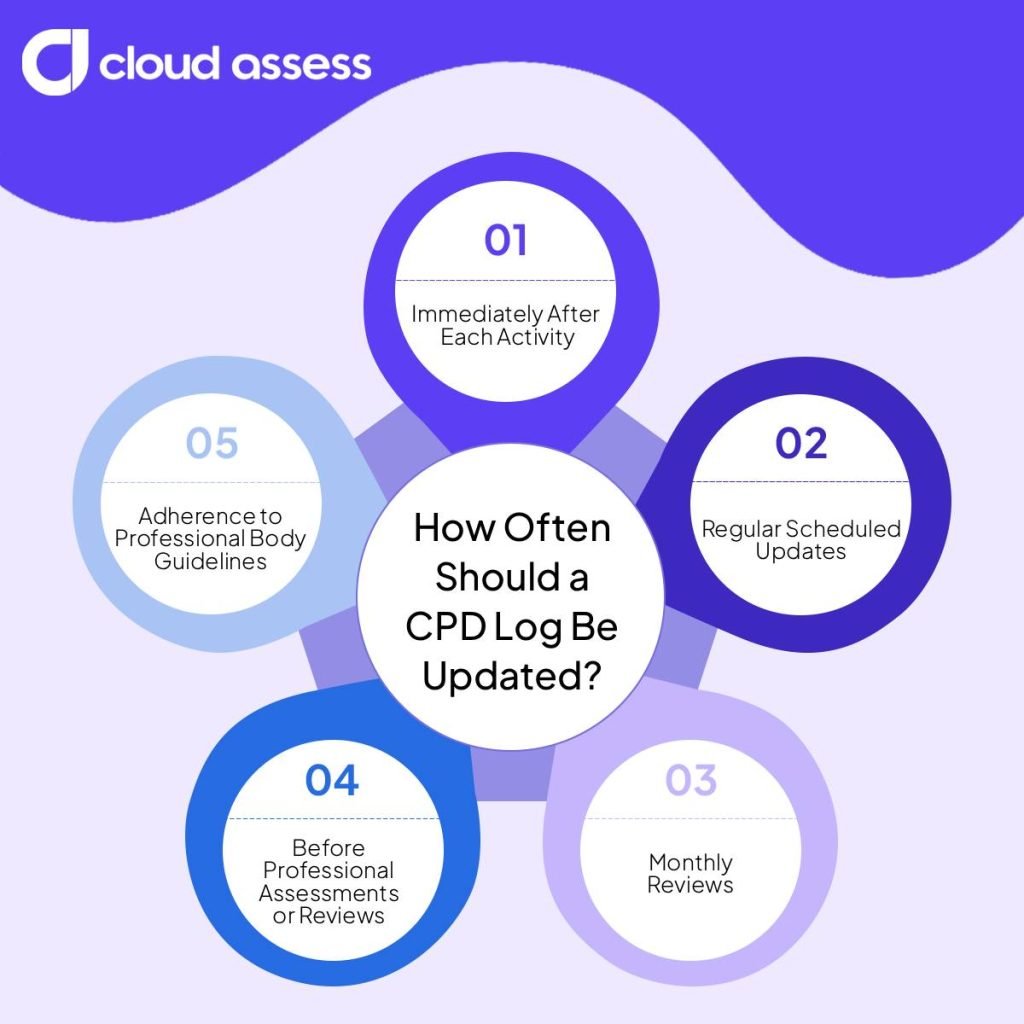
Immediately After Each Activity
Updating straight after an activity is the most reliable approach. Details are still fresh, so entries are more accurate and reflective.
Regular Scheduled Updates
Immediate logging isn’t always practical on busy shifts or remote sites. A weekly or fortnightly update keeps logs current instead. Regular slots also reduce the risk of forgetting key details.
Monthly Reviews
A monthly review is the minimum for keeping logs useful. Reviews give workers and supervisors time to reflect on recent activities. They also help set goals and adjust training plans for the month ahead.
Before Professional Assessments or Reviews
Logs should be up to date before appraisals, performance reviews, or audits. Current records accurately show recent learning and achievements.
Adherence to Professional Body Guidelines
Some professional bodies set their own rules for recording CPD. Workers who hold registrations or licences need to follow those requirements. Gaps in records can delay or affect renewals.
How Should Certifications Be Tracked in a CPD Log?
Certifications and accreditations need their own record in a CPD log. Each record should include the issuing body, issue date, expiry date, and competencies covered. These records are the foundation of effective training certificate management. Well-kept certification records prove workers hold current qualifications. They also give employers early warning before licences or tickets expire.
How Do CPD Logs Support Industry Compliance?
CPD logs give workers in regulated industries proof they meet licensing or registration requirements. Requirements vary by industry, role, and location. Most set minimum hours or points within a set period.
- Nursing and midwifery (Australia). The Nursing and Midwifery Board of Australia (NMBA) requires registered and enrolled nurses and midwives to complete at least 20 CPD hours each year. Workers holding both registrations need 40 hours.
- Nursing and midwifery (UK). The Nursing and Midwifery Council (NMC) requires 35 CPD hours over each three-year revalidation period. At least 20 hours must involve participatory learning. Records must also be accurate and verifiable.
- Residential building (NSW). Builders need 12 CPD points a year and declare them at licence renewal. They must keep records, since NSW Fair Trading runs random audits.
- Mining (NSW). Practising certificate holders in statutory roles complete set learning hours over the certificate’s five-year term. The required hours depend on the certificate type.
Up-to-date logs make audits faster for employers. Records are ready whenever a regulator or professional body asks for them.
What are the Common Challenges in CPD Logging?

Time Management for Regular Updates
Busy shifts and remote work leave little time for regular updates. Scheduled logging time, such as the end of a shift, makes updates part of the routine. Digital reminders and calendar prompts also help keep logs current. Short, regular sessions work better than infrequent catch-ups.
Retain Detailed Information
Workers often forget key details when entries are written weeks later. Quick notes straight after an activity capture the main points. Workers can then expand these notes into full entries. Mobile apps with voice notes make this easier on site.
Maintain Motivation and Engagement
CPD logging can feel like paperwork when workers can’t see the benefit. Regular progress reviews with supervisors are a simple way to boost employee engagement. Linking entries to future roles also shows workers where their learning can take them. Organisations can use CPD logs this way to support career mobility within the business.
Inconsistent Records Across Teams
When each team uses its own format, records become hard to compare or audit. Missing fields, such as expiry dates or evidence, often go unnoticed until an audit. A shared template gives every worker the same fields to complete. The free CPD log template above is a simple starting point. Supervisor spot checks also catch gaps before an audit does.
How Cloud Assess Supports CPD Logging
Cloud Assess is a learning management system (LMS) for frontline and regulated workforces. Organisations use it to deliver training, capture evidence, and track CPD in one place.
- Licence and certification tracking. Organisations record every licence, ticket, and certification against each worker. Expiry alerts give teams time to book renewals before anything lapses. Cyclical assessments keep recurring refreshers and VOCs on schedule.
- Verification of competency workflows. Assessors complete VOCs on site and capture photo, video, and GPS evidence. Each VOC sits in the worker’s training record alongside their other CPD.
- Site-specific compliance. Organisations set training requirements by site or team. Managers can see which workers meet each site’s requirements at a glance.
- Audit trails. Every completion and assessment is timestamped. Organisations can produce records quickly when a regulator, client, or professional body asks.
- Free course library. Organisations can give workers access to free, ready-made courses, including CPD options. Completions are recorded with the rest of each worker’s training history.
Request a demo to see how Cloud Assess keeps every worker’s CPD audit-ready.