Delivering quality care takes more than just hiring skilled professionals. It also means creating the right conditions for staff to keep learning, improving, and staying up to date. In the UK health and social care sector, organisations are expected to support this ongoing development as part of good practice and compliance.
Continuing professional development (CPD) plays an important part in making that happen. It helps shape confident, capable teams and supports consistent, high-quality care services.
In this blog, we’ll explore:
- What CPD means in a UK health and social care setting
- The difference between mandatory training and CPD
- Who regulates CPD in the sector
- CPD requirements by care roles
- The benefits of CPD for all involved
- Types of CPD and practical examples
- How employers can plan, track, and support CPD
- Common CPD challenges and how to overcome them
What is CPD in Health and Social Care?
Continuing professional development in health and social care refers to the ongoing process of learning and development that helps staff maintain and improve their professional knowledge, skills, and competence. It includes formal and informal learning activities that support individuals in delivering safe, effective, and person-centred care.
Mandatory Training vs CPD
Mandatory training and CPD both support safe, effective care, but they serve different purposes.
Mandatory training refers to the essential courses that frontline workers must complete to meet legal, regulatory, or organisational requirements. This includes topics like health and safety, infection control, safeguarding, and manual handling. It ensures everyone has the baseline knowledge needed to carry out their role safely and legally.
CPD focuses on broader professional development. It includes learning that helps staff deepen their understanding, expand their skills, and keep pace with changes in care delivery. While some CPD activities may overlap with mandatory topics, CPD is more flexible and personalised. It’s shaped by an individual’s role, career goals, and the evolving needs of the people they support.
In short, mandatory training keeps staff compliant. CPD helps them continue to grow.
Who Regulates Health & Social Care CPD?
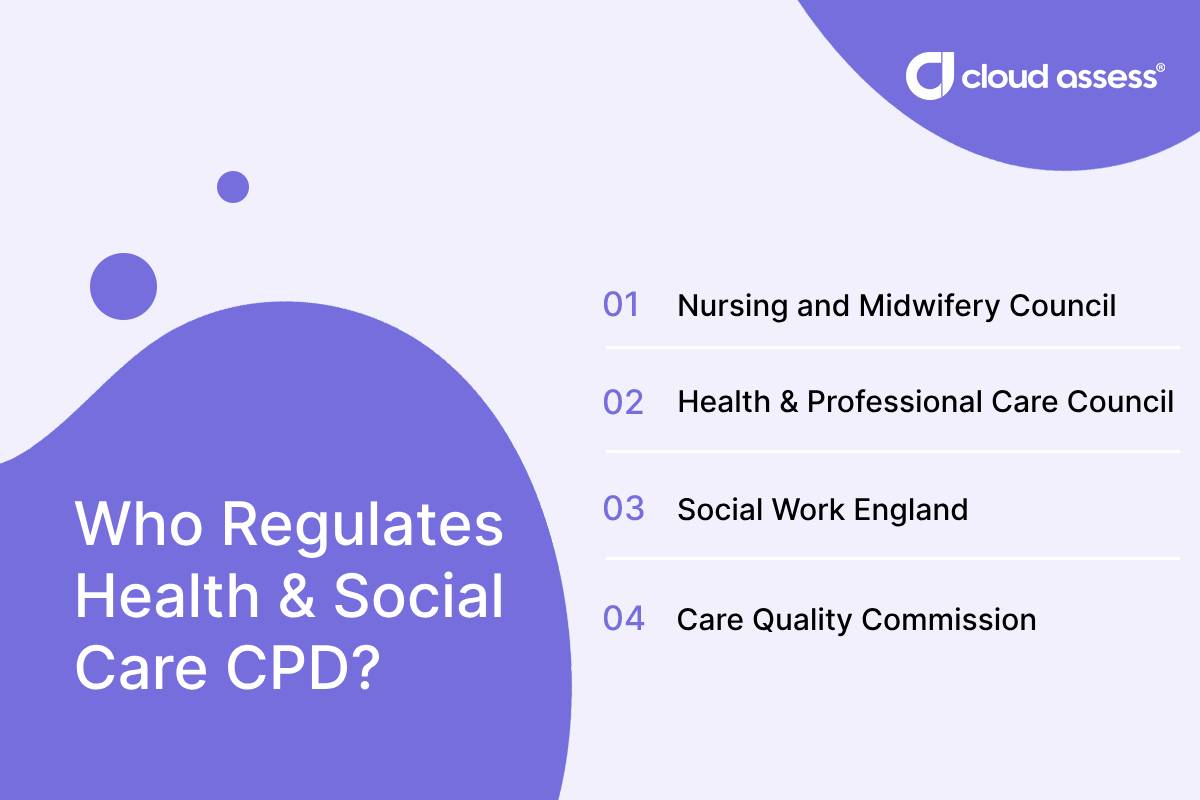
- Nursing and Midwifery Council (NMC): An independent regulator that sets the standards for education, training, and revalidation for nurses and midwives in the UK. It defines how CPD supports safe and effective practice and outlines how learning should be recorded and reflected on.
- Health and Professional Care Council (HCPC): The HCPC regulates a wide group of allied health professionals (AHPs) across the UK. It sets out what counts as CPD, how it should be approached, and what evidence professionals must keep if selected for audit.
- Social Work England: Regulates the professional standards for social workers in England. It provides a framework for how CPD should be recorded and how reflective learning supports ethical, person-centred care.
- Care Quality Commission (CQC): The CQC inspects and regulates health and care providers in England. While it doesn’t set individual CPD requirements, it looks at how employers support learning and development as part of delivering safe, effective health and social care services.
CPD Requirements by Care Roles
Nurses and Midwives
Registered nurses and midwives must complete a range of requirements, including 35 hours of CPD every three years, with 20 hours involving participatory learning. These activities need to relate to their area of practice and contribute to safe, effective care. They also need to record and reflect on how CPD training has improved their work as part of the NMC’s revalidation process.
Social Workers

Social workers in England must log at least one CPD activity per year through their Social Work England account. This entry must include a written reflection that shows how their learning has benefited the people and communities they support. Submitting CPD is a key part of maintaining their professional registration.
Allied Health Professionals (HCPC)
Allied health professionals regulated by the HCPC aren’t required to complete a fixed number of CPD hours. Instead, they must take part in continuous learning relevant to their role and keep a record of their activities. They may be selected for a random audit, where they’ll need to show how their development supports safe, effective practice.
Care Assistants and Support Workers
Although not typically regulated by a national body, care assistants and support workers are often expected to complete CPD as part of their employer’s internal policies. They are also required to stay up to date with mandatory and statutory training to meet CQC expectations. This may include training updates, service improvement activities, or informal learning that contributes to safe, person-centred care.
Who Benefits from CPD in Care Settings?
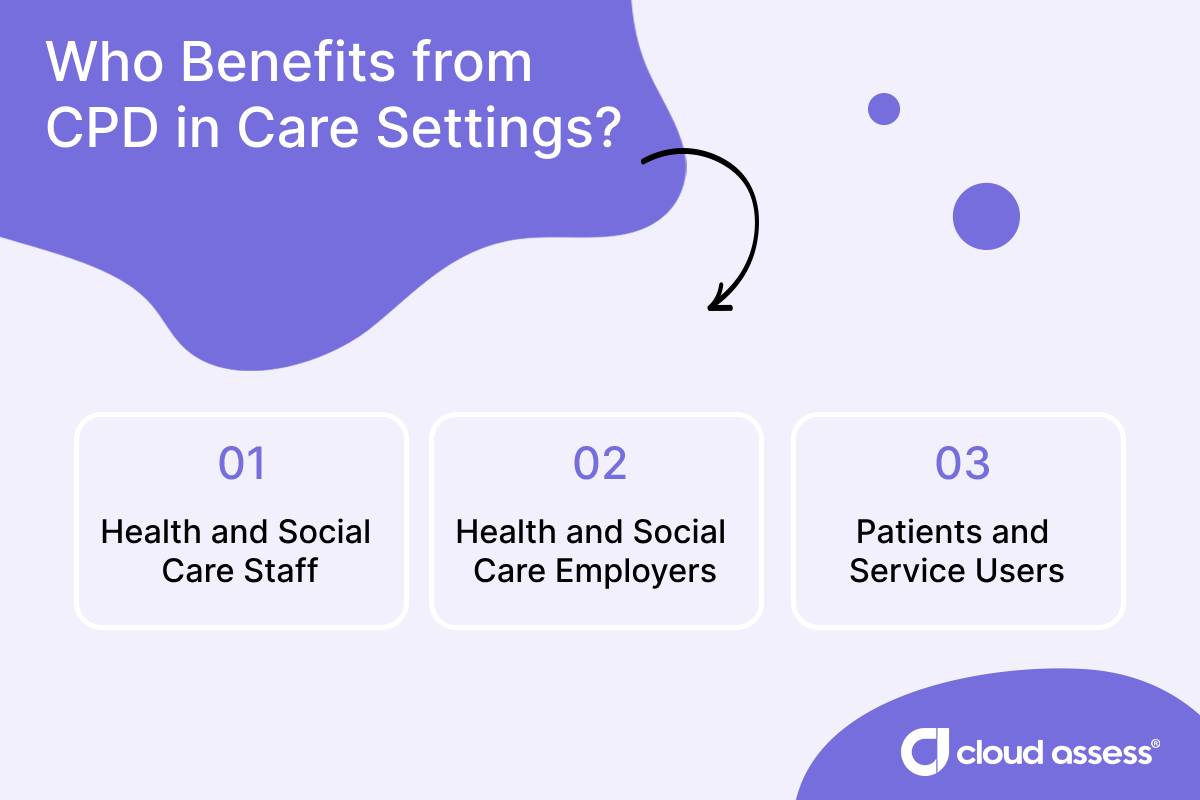
Care Staff
For health and social care staff, CPD builds confidence, strengthens skills, and supports long-term personal and professional development. It helps practitioners stay prepared for changes in guidance, refine their approach to care, and continue growing in their roles. Whether they’re new support workers or experienced allied health professionals, CPD ensures that their knowledge, skills, capabilities, and competencies stay current and relevant.
Employers
Care providers benefit from investing in staff’s professional development. When healthcare teams are supported through meaningful learning, they tend to be more engaged, effective, and committed to their work. A structured approach to CPD can also help employers meet compliance requirements, prepare for inspections, and promote a culture of high-quality care.
Patients and Service Users
Those receiving care feel the impact of CPD directly. When health and care professionals stay up to date with training and development, they’re better equipped to deliver safe, effective, and personalised support. This improves the quality of care and leads to improved patient outcomes, including better health, increased safety, and a more positive care experience overall.
Types of CPD in Health and Social Care
Formal CPD
Formal training in continuous professional development involves structured learning that usually leads to a recognised outcome. It’s typically delivered by external providers or accredited institutions and often forms part of a qualification or professional development plan.
Examples:
- CPD accredited courses
- Professional qualifications
- University modules
- Conferences and seminars
Informal CPD
This type of learning happens in a more flexible way and may not follow a formal structure. It still contributes to healthcare workers’ professional growth by broadening knowledge or offering new insights into practice.

Examples:
- Reading professional books, journals, or articles
- Listening to podcasts or watching webinars
- Informal discussions with colleagues
- Staff briefings and information-sharing sessions
Reflective CPD
Reflective CPD focuses on learning from experience. It involves reviewing situations, identifying lessons learned, and considering how practice can be improved in future.
Examples:
- Writing a reflective account of a care situation
- Reviewing cases during supervision sessions
- Analysing feedback from patients or peers
- Reflecting on outcomes after incidents or audits
Work-Based CPD
This is learning that happens within the working environment. It’s often practical and closely tied to day-to-day responsibilities or service improvement.
Examples:
- On-the-job training or coaching
- Shadowing team members in different roles
- Participating in service development projects
- Supporting or receiving workplace mentoring
How Health & Social Care Employers Can Plan and Record CPD

1. Conduct a Training Needs Analysis (TNA)
A training needs analysis helps identify skill gaps, compliance issues, and development priorities across the workforce. It ensures that CPD planning is relevant and tailored to the roles and responsibilities of your team. A clear TNA supports targeted investment in learning that aligns with both service goals and regulatory requirements. It also ensures training aligns with the expectations of the relevant regulatory body for each role, helping teams stay compliant and inspection-ready.
5. Evaluate CPD Outcomes and Reflect
It’s important to measure whether CPD is making a real difference. Use staff feedback, performance data, and care quality outcomes to assess impact. Encourage health and care professionals to reflect on what they’ve learned and how it’s influenced their approach to care. These reflections can also highlight opportunities for career development, showing how learning contributes to individual growth and service improvement. Regular reviews link CPD to both day-to-day practice and long-term career advancement.
6. Foster a Culture of Continuous Learning
Supporting CPD means building a workplace where learning is part of everyday practice. When continuous professional development is encouraged, recognised, and regularly discussed, it becomes a natural part of team life. This helps healthcare professionals feel confident and supported in their professional life. It also promotes a mindset of continuous learning across the organisation, increases employee retention, and contributes to safer, more consistent care.
CPD Challenges in Care Settings (and Solutions)
CPD That Feels Disconnected from Practice
Not all CPD translates easily into everyday care. For instance, a formal course on “emotional resilience” may feel abstract unless tied directly to patient interactions or shift stress scenarios. Staff often disengage when the training doesn’t resonate with their actual tasks or environment.
Solution: Anchor training in the lived experiences of your care team. For example, turn a module on patient dignity into a role-play scenario reflecting an elderly care setting. Use recorded incidents or feedback loops from recent audits to shape reflective activities. When staff see their own experiences in training, they’re more likely to retain and apply it.
Unequal Access to Learning Opportunities

Staff working night shifts, part-time hours, or in rural locations often miss out on training that’s delivered on-site or during business hours. This creates uneven professional development across teams and can lead to gaps in confidence, performance, and morale. It also limits opportunities for career progression, especially for those who don’t have the same access to learning as their full-time, centrally located peers.
Solution: Make CPD accessible by design. Offer flexible, on-demand learning that fits around shifts and responsibilities. For example, a care assistant finishing a night shift could watch a 10-minute safeguarding refresher from their phone before heading home. When everyone gets equal chances to grow, you build fairer, and stronger teams.
CPD That Happens in Isolation
CPD can often feel like a solo task, something staff complete on their own, in silence, between shifts. Without discussion or shared reflection, important insights are lost, and the learning becomes harder to embed into team practice. It’s also a missed opportunity to strengthen relationships and share diverse perspectives.
Solution: Turn CPD into a shared experience. Create space for team reflection through lunch-and-learns, group debriefs, or peer-led sessions. For example, after a safeguarding refresher, ask staff to share how they’ve handled difficult disclosures. These stories spark conversation, deepen understanding, and connect theory to frontline care. Learning that’s social is more likely to stick and lead to real change.
Inconsistent Leadership Support
If leaders aren’t talking about CPD, modelling their own learning, or actively supporting team development, staff may see it as a low priority. Even the best CPD plans can stall when they’re not backed by visible, consistent leadership.
Solution: Make CPD a leadership habit. Use one-to-ones to ask about learning goals, recognise progress in team meetings, and share your own development journey. For example, if a manager shares how one of the leadership and soft skills courses helped them better support a challenging situation, it normalises growth and sparks curiosity. When leaders learn out loud, teams follow.
Use CPD That Empowers Care
CPD is more than a compliance requirement. It’s a tool for building confident, capable teams and delivering care that meets the highest standards. When learning is meaningful, well-managed, and part of everyday practice, it leads to better outcomes for everyone, from care staff to patients and service users.
Cloud Assess helps you deliver CPD training that works. With flexible online courses, digital CPD logs, and accessible online learning, you can support your team to learn at their pace, reflect on their progress, and meet professional standards with confidence.
Ready to strengthen your team and improve care quality?
Enrol your staff in our accredited CPD courses or book a demo to see Cloud Assess can help you plan, track, and deliver CPD with ease.