Modern learning may differ from traditional training methods in many ways. But modern educators still face a familiar challenge. Learners often struggle to connect the dots between ideas. Whether they’re overwhelmed by content, distracted by poor design, or unable to see the bigger picture, the result is the same. Learning becomes fragmented, and understanding breaks down.
The Gestalt theory of learning offers a powerful solution. It helps students understand complex concepts as a whole. Instead of absorbing isolated pieces, they see how everything connects. The theory looks at how the brain naturally organises and interprets what it sees. This shapes the ways we design learning environments and structure information.
In this article, we explore:
- What Gestalt psychology is
- How it’s applied in the Gestalt theory of learning
- Gestalt principles, and examples of how they can be applied
- Benefits of taking a Gestalt approach to learning and development
- Challenges and practical solutions for implementing the theory

What is Gestalt Psychology?
Gestalt psychology is a theory about how people naturally perceive the world. It suggests we understand things as complete forms or patterns, not just as a collection of parts. For example, when looking at a picture, we don’t focus on every detail. We see the full image. The word Gestalt means ‘shape’ or ‘form’ in German.
Psychologists Max Wertheimer, Wolfgang Köhler and Kurt Koffka founded Gestalt psychology in the early 1900s. Their work examined how the human brain organises information. They also explored how people solve problems and recognise patterns. These ideas later shaped how educators and psychologists think about thinking and learning.
How is Gestalt Psychology Applied in Learning & Development?
Gestalt psychology suggests that people learn best when they can see the bigger picture. It shows that learning is most effective when students grasp the full meaning of what they’re studying. This makes training more memorable than studying isolated parts. Learners make sense of new content through pattern recognition. This helps them form connections and visualise structure. It also encourages them to link new ideas to existing knowledge. This improves understanding and memory.
The theory also highlights the importance of human perception in the learning process. Learners aren’t passive. They actively organise and interpret information based on how it’s presented. If something is unclear or incomplete, they’ll try to fill in the gaps to make sense of it. This means that how information is grouped, spaced, or connected can affect how well it’s learned. Gestalt principles focus on how learners naturally seek order and structure. This understanding helps educators design experiences that feel more intuitive and meaningful.
Gestalt Theory of Learning vs. Other Learning Theories

Gestalt Theory of Learning vs Structuralism
Structuralism is an early psychological theory. It focuses on breaking down mental processes into their simplest parts. These include thoughts, sensations, and images. It views learning as a process of building knowledge piece by piece through introspection.
Gestalt learning theory was developed in direct response to structuralism. It challenges the idea that learning is just about adding up smaller elements. Gestalt psychologists believed this approach overlooked how the mind naturally organises information. It looks at meaningful wholes, making perception and insight central to the learning process.
Gestalt Theory of Learning vs Behaviourism
Behaviourism sees learning as a change in behaviour caused by external stimuli. These include rewards or punishments. It focuses on observable outcomes. Behaviourism often uses repetition and reinforcement to shape human behaviour.
Gestalt theory takes a very different approach. It views learning as an internal, cognitive process. Perception and insight drive learning, rather than trial and error. Gestalt learning often happens through sudden realisation. It emphasises how learners make sense of problems, not just how they respond to stimuli.
Gestalt Theory of Learning vs Constructivism
Constructivism is a learning theory that views knowledge as something learners actively build. It’s based on experience, reflection and social interaction. Constructivists emphasise the role of prior knowledge, context and personal meaning. They argue that these factors shape understanding.
Both Gestalt learning and constructivism value understanding and meaning. However, Gestalt theory focuses more on how learners perceive patterns and gain insight. Constructivism highlights gradual knowledge construction. Gestalt theory emphasises sudden ‘aha’ moments. It’s less about social context and more about how the mind organises and interprets information.
Gestalt Theory of Learning vs Experiential Learning

Experiential learning focuses on learning through direct experience, reflection and active engagement. It’s often represented by David Kolb’s Experiential Learning Cycle. This shows how learning happens across four stages that repeat themselves over time. According to Kolb, feeling concrete experiences lead to reflective observation. This, in turn, leads to abstract conceptualisation and finally active experimentation. From there, the cycle goes back to new experiences.
Gestalt theory also values experience, but from a cognitive psychology perspective. It’s less about hands-on activity and more about how the mind organises experience into meaningful patterns. Both theories promote deep understanding. However, Gestalt learning often happens through sudden insight rather than structured reflection.
Core Gestalt Principles (or Gestalt Laws of Perception)

Prägnanz
Prägnanz is a German word meaning ‘clarity’, ‘precision’, or ‘conciseness’. In the Gestalt theory, the concept explains that anyone can understand even complex information. It just needs to be presented in simple and organised ways. This is also known as the Law of Simplicity. Information should also have a strong visual structure. Any clutter only detracts from learners’ understanding.
Example: In an online training module, use a clean layout with simple icons, minimal text, and consistent formatting. This will help learners quickly grasp key points. Overly decorative visual elements or cluttered slides would make it harder for learners to focus on what matters most.
Element Grouping
Gestalt theory explains that learners group elements by Similarity, Proximity and Common Region. It helps educators and instructional designers understand how learners perceive objects. This can help them develop more effective and meaningful learning materials.

Similarity
People consider elements that look alike part of the same group. For example, using consistent colours, shapes, or fonts helps learners connect key concepts. This supports pattern recognition and aids memory.
Example: In a course dashboard, grouping all quiz buttons in the same colour and style signals to learners that they serve a similar function. This visual perception helps learners identify patterns and navigate the content more intuitively.
Proximity
People see objects placed close to one another as related. Educational designers can use this to more easily connect visuals or pieces of information. This reduces learners’ cognitive load and supports logical organisation.
Example: In a printed learning guide, place definitions directly under related headings. This allows learners to associate them easily. If the definitions were placed far away on another page, it would be harder to make that connection.
Common Region
People interpret elements located within the same bounded area as a group. Using boxes, frames or background colours can help define related information. It enhances clarity and supports logical grouping.
Example: On an eLearning screen, group related instructions or examples within a bordered box. This will help learners understand the connection between the elements. Without this boundary, learners might view the information as unrelated and become confused.
Continuity
The law of continuity suggests that the eye naturally follows lines, paths or patterns. Learners are more likely to understand information that follows a clear, directional structure. Smooth transitions and consistent layouts support this principle.
Example: In an infographic that explains a process, use a clear flow from left to right. Arrows or visual lines will guide the learner’s eye from one step to another. This supports better comprehension of sequences and cause-effect relationships.
Closure
Closure refers to the mind’s tendency to fill in missing information to see a complete picture. This helps learners make sense of incomplete or abstract content. Activities that encourage problem-solving or inference can make use of this principle.
Example: Give learners an incomplete diagram or sentence and ask them to fill in the missing information. Their minds will naturally complete the picture. Use this in interactive exercises or problem-solving tasks to encourage deeper thinking.
How Does Learning Occur in Gestalt Theory
Gestalt theory views learning as an active, internal process. It explains that learners don’t memorise facts step by step. Instead, they make sense of situations by seeing patterns and relationships. This often leads to sudden realisations that create deeper understanding.
According to Gestalt theory, learning involves three interconnected processes:
- Insight Learning is a process where learners reorganise information to understand a problem in a new way. This involves a cognitive shift, where learners may start off feeling stuck or confused. However, once they see how elements connect, they suddenly understand the problem on a different level.
- Aha Moments are the feelings that learners experience when they solve a problem or a solution clicks into place. They happen suddenly and are often accompanied by emotion or surprise. These moments of clarity are the direct result of insight learning.
- Problem-Solving and Perception are closely connected in Gestalt theory. The way learners perceive the parts of a problem and the relationships between them affects how they find solutions. Cognitive restructuring changes how learners view a problem. This can often reveal new paths to understanding. This is especially common when shifting from focusing on details to seeing the whole.
Applications of Gestalt Learning Theory
Training Design

The Gestalt approach supports training design by helping learners make sense of information as a whole. For example, Gestalt principles suggest that instructional designers should group related visual objects. Use similarity, proximity or common region to help learners see connections clearly.
Using well-designed visual aids also reduces confusion and improves understanding. This is especially important when dealing with complex perceptions or unfamiliar topics.
A well-structured learning environment encourages students to draw on past experiences. This makes content feel more familiar. It also supports knowledge retention and helps learners apply what they’ve learned in new situations.
Vocational Education
Gestalt theory is well-suited to vocational education. These are learning environments where students often deal with real-world tasks. These can involve complex processes, particularly in the natural sciences or technical trades.
Using visual information, practical examples and hands-on exercises aligns well with Gestalt principles. These teaching strategies help learners break down complex ideas into understandable patterns. This will also help them develop stronger cognitive processes.
Gestalt-based learning also encourages students to connect new knowledge to past experiences. This leads to deeper learning and supports practical problem-solving.
Workplace Training
Gestalt principles help employees see how tasks connect, rather than viewing each step in isolation. This holistic view improves their understanding of how processes work as a whole.
The theory encourages teaching strategies that reflect real tasks. Educators support these with visual aids like diagrams and grouped content. Interactive tools and activities can also simplify complex processes and reinforce key ideas.
Gestalt principles promote social behaviour like discussion and knowledge sharing. These social learning strategies make learning more relevant. They encourage employees to exchange tips, apply prior experience, and build on what they already know.
Benefits of the Gestalt Theory of Learning
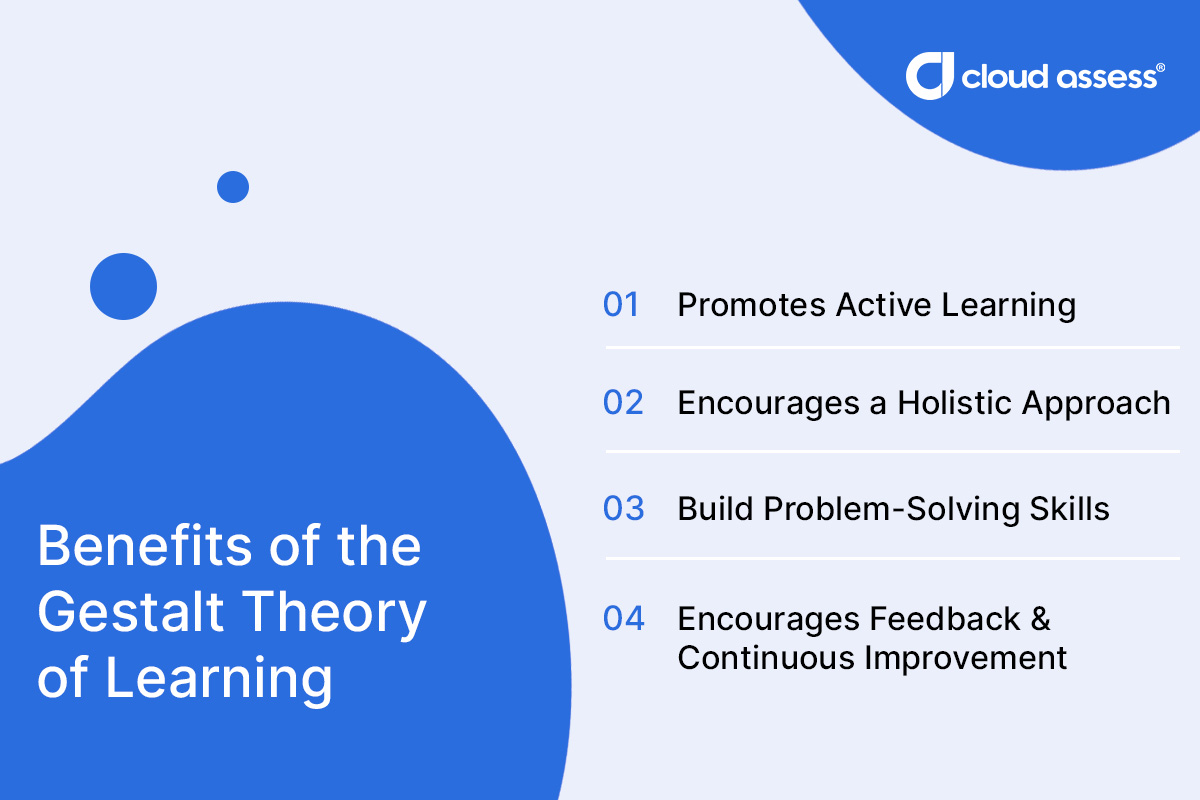
Promotes Active Learning
Gestalt theory encourages learners to actively engage with content. It’s not about just being passive learners who receive information. Instead, it motivates learners to explore, ask questions and test ideas. This helps them develop stronger critical thinking skills. It also improves their focus and engagement throughout the learning process. They solve real problems and apply their past experiences. This sees them actively build on knowledge, instead of just receiving new information.
Challenges with Applying the Gestalt Theory of Learning
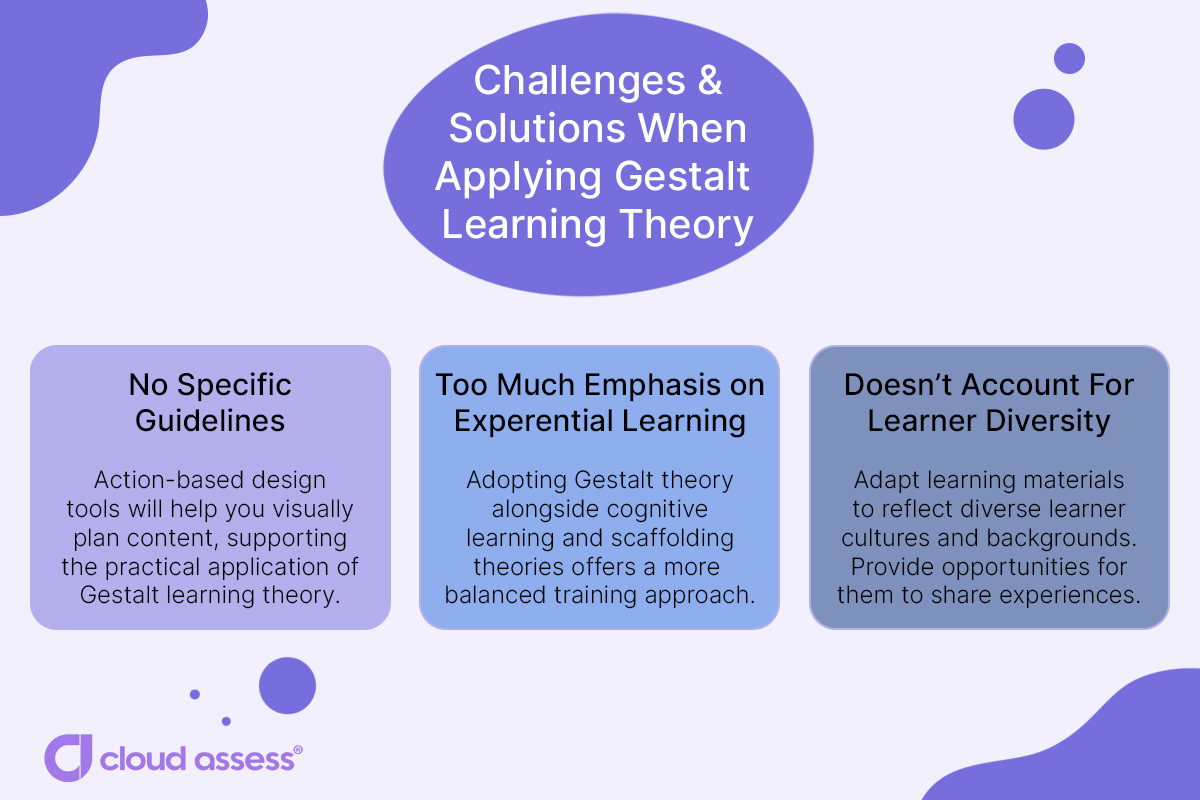
No Specific Guidelines
Gestalt psychology explains how learning happens. But it doesn’t offer clear steps for applying the theory of learning in training environments. This can make it feel vague or difficult to implement.
Solution: Use action-based design tools like storyboarding or wireframing to visually plan content. These tools support the visual structure that the Gestalt theory of learning recommends. But they also give educators a concrete planning method.
Too Much Emphasis on Experiential Learning
Gestalt learning often focuses on experience and perception. However, it can gloss over deeper cognitive processes like memory or critical analysis. Some educators prefer more structured or theory-driven approaches.
Solution: You don’t have to apply Gestalt theory on its own. You may want to adopt it alongside cognitive learning theory and Vygotsky’s scaffolding theory. This will help you blend Gestalt-based activities with guided reflection or scaffolded instruction. This offers a balanced approach, combining perception with deeper thinking and structured support.
Doesn’t Account For Learner Diversity
Gestalt theory assumes all learners interpret information in similar ways. But different learners see different patterns or may take unique approaches to problem-solving. Assuming similar reactions and associations ignores cultural, linguistic and cognitive differences.
Solution: Just because Gestalt theory doesn’t consider multiple perspectives, doesn’t mean you can’t. Adapt learning materials to reflect diverse learner cultures and backgrounds. Use varied visual aids and examples. Provide opportunities for learners to share their own interpretations and approaches. This turns Gestalt theory into a more practical and inclusive teaching strategy.
Evaluating Learning Outcomes Using Gestalt Principles
To evaluate learning outcomes through a Gestalt lens, educators should focus on more than just knowledge recall.
Look for signs that learners can recognise patterns. Help them draw connections and apply their understanding to new situations. Provide opportunities for reflection, problem-solving tasks, and visual demonstrations. These can reveal how well learners have grasped concepts.
When learners show insight, not just memorisation, the Gestalt theory of learning is working.
Other Learning Theories
The Gestalt theory of learning is just one approach to training. But there are plenty of others you may want to explore. At Cloud Assess, we want to ensure that you have all the information you need to guide your training strategies. That’s why we’ve put together guides to some of the most popular learning theories. These include: