What Are the Top RTO Compliance Concerns in 2026?

Contents

Get the latest insights

The vocational education and training (VET) sector is entering a new phase of quality assurance. The Standards for Registered Training Organisations (RTOs) 2025 came into effect in July. Since then, RTOs have had to adjust their processes to align with the new requirements.

The Australian Skills Quality Authority (ASQA) is placing a stronger emphasis on outcomes, not just policies on paper. This means RTOs must demonstrate compliance in their systems, workforce, and delivery methods. These need to produce quality learning experiences and genuine competency outcomes consistently.

It’s understandable that these changes are leading to RTO compliance concerns. In this article, we explore some of the most common challenges that training providers face. We also look at how they can be addressed within the evolving compliance landscape.

Looking For More RTO Compliance Resources?

We’ve put together a consolidated guide to help you stay on top of the latest requirements.

rto administrator manages paperwork on desk

What is a Compliance Concern for RTOs?

A compliance concern is any risk or gap that could cause a provider to fall short of requirements that govern the student experience. This includes gaps across marketing, enrolment, training delivery, support and progression, assessment, and completion.

These aren’t just technicalities. Compliance concerns signal areas that could undermine student outcomes, accountability, and your reputation.  They are early warning signs that need to be addressed to ensure compliance and excellence across your organisation.
Learn About Key Changes To The Standards For RTOs 2025

Access the free webinar recording today.

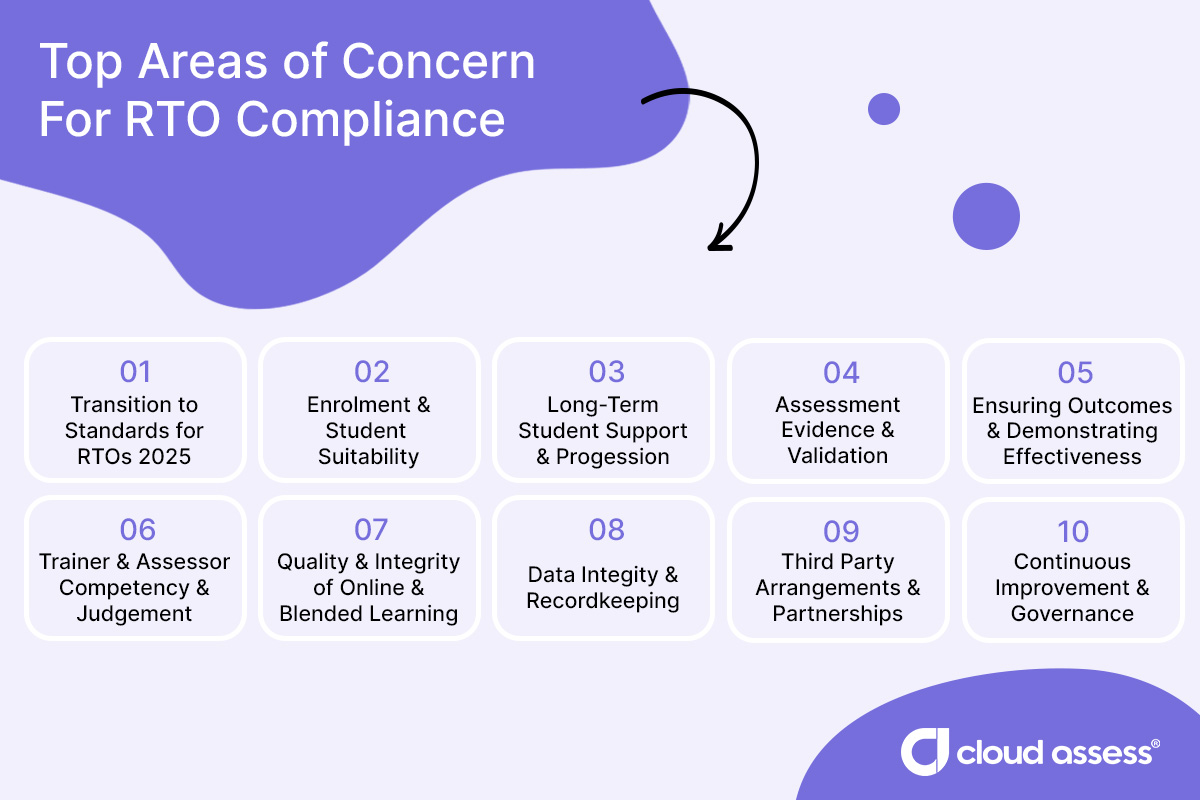
top areas of cocern for rto compliance

Top Areas of Concern for RTOs

1. Transition to Standards for RTOs 2025

The introduction of the Standards for RTOs 2025 represents the most significant regulatory shift in nearly a decade. These new standards replace the 2015 version and introduce outcome-based measures. They also explain student support obligations, and require clearer accountability for trainers, assessors, and governing bodies.

For many RTOs, the transition period poses a compliance risk. This is especially true for those whose systems and quality frameworks are still aligned to the older requirements. Complying with the 2025 Standards isn’t just about updating policies. RTO adherence requires a cultural and procedural shift. Providers must map existing processes to new expectations for outcomes, governance and data integrity.

However, operations can’t come to a halt during this transition. Organisations must keep delivering training while making these adjustments. Without proactive planning, RTOs risk operational gaps and unclear responsibilities. They also face non-compliance once audits begin under the new framework. Yet proactive planning requires time and resources that many smaller RTOs can’t afford.

Solution

  • Conduct a gap analysis to identify where systems fall short of the updated Standards.
  • Consult RTO compliance experts to guide the implementation of the new requirements.
  • Update RTO compliance management systems to support ongoing monitoring and reporting.

2. Enrolment & Student Suitability

vet student struggles in class

Student support is a key component of the 2025 Standards. This isn’t just about extra lessons and tutorials. It’s about ensuring students understand which training packages are available and align with their skills and goals. This stronger focus on learner suitability addresses ongoing communication issues. In the past, this has led to financial loss, low completion rates and RTO non-compliance.

Outcome Standard 2.1 details the specific information that RTOs must make accessible to existing and potential learners. This includes course codes, delivery modes, support services, fees, and funding entitlements. Outcome Standard 2.2 also requires RTOs to conduct pre-training assessments. These measure skills, competencies, Language, Literacy and Numeracy (LLN) abilities and digital literacy.

Enroling students in the right course helps improve satisfaction, completion, and compliance. However, to meet these new expectations, RTOs will need robust systems. They need to screen learners, document pre-training assessment results, and track communication. Providers delivering versatile training may also struggle to maintain consistency across all channels.

Solution

  • Automate pre-enrolment communication. Develop checklists and templates that include course details, delivery modes, and support options.
  • Use the right software. Assessment tools can help you measure LLN proficiencies, digital literacy, skills and competencies.
  • Maintain accurate public information. Regularly review websites, brochures, and third-party materials to ensure all data and costs are up to date.

3. Long-Term Student Support and Progression

Student support doesn’t end once learners are enrolled in the right training product. RTOs have an ongoing responsibility to help students progress and reach successful completion.

Outcome Standards 2.3 to 2.6 set out the steps RTOs must take to ensure support structures are in place for both learning and wellbeing. Providers must also demonstrate that they promote diversity and inclusion. For example, they must make reasonable adjustments to accommodate learners with disability. Just as importantly, these support options must be clearly communicated so students know where to turn when they need help

Support is not a one-way obligation. RTOs must proactively identify and respond to student needs using defined systems and processes. This includes managing concerns and implementing effective complaints and appeals policies. It’s important to maintain evidence of communication and record actions and outcomes. These steps are critical to maintaining student satisfaction and promoting completion. They can also prevent RTO issues from escalating into non-compliance.

Solution

  • Establish clear support pathways. Ensure students know who to contact for academic or wellbeing support and how to reach them.
  • Implement a transparent complaints process. Maintain a register of concerns, timeframes for resolution, and documented actions taken.
  • Review feedback regularly. Use student surveys and complaints data to improve delivery, accessibility, and wellbeing. (The ASQA Quality Indicator surveys offer insight into what students and employers think of training.)

4. Assessment Evidence & Validation

Fair, consistent, and reliable assessment practices are at the heart of VET. Ensuring assessments accurately reflect real skills and knowledge is a quality assurance benchmark.

Under the 2025 Standards, assessment quality is governed by two interconnected areas. These are the Principles of Assessment and the Rules of Evidence.

principles of assessment

The Four Principles of Assessment, explained in Outcomes Standards 1.4 (2) (a) are fairness, flexibility, validity and reliability. Together, these ensure that evaluations:

  • Meet the needs of diverse student cohorts.
  • Recognise skills gained through prior learning or work experiences.
  • Allow learners to demonstrate vocational competencies in practical contexts.
  • Produce consistent results across assessors and settings.
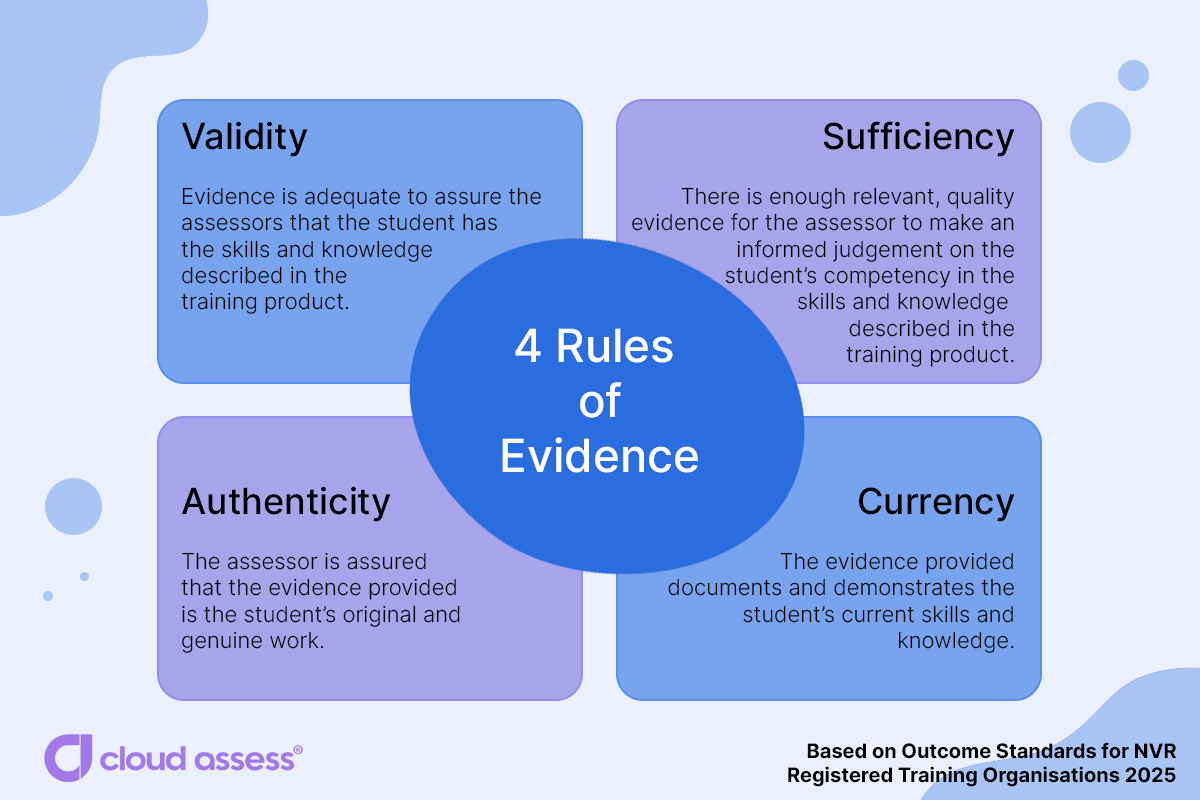
rules of evidence

To complement these principles, Outcomes Standards 1.4 (2) (b) also outlines Rules of Evidence that must be applied. These ensure that assessment judgements are justified based on validity, sufficiency, authenticity, and currency. Together, they ensure that:

  • The assessor is confident that the learner has gained the skills and knowledge described in the training product.
  • There is enough relevant and high-quality evidence to support competency.
  • The evidence represents the learner’s own work.
  • It reflects the student’s current abilities and knowledge.

These standards uphold the fairness and consistency of assessment practices and decisions. They ensure that every qualification issued represents genuine competency.

Solution

  • Collect evidence in your learning management system. Digital evidence portfolios allow students and assessors to upload multimedia records, including videos, voice recordings and eSignatures.
  • Enable third-party assessor access. Give qualified validators or industry experts secure, role-based access to assessment evidence.

Want Your Assessors to Stay On top of Admin?

Watch this showcase to learn more.

  • Implement automated validation workflows. Schedule regular post-assessment reviews within your platform. This will help you identify gaps, record findings, and track follow-up actions.

5. Ensuring Student Outcomes & Demonstrating Effectiveness

RTO compliance isn’t achieved by meeting a single set of benchmarks. It’s about ongoing alignment between training delivery, assessment quality, and learner outcomes. RTOs must continually evaluate their performance. They must also use the findings to strengthen both their systems and their student experience.

This expectation spans multiple areas. Outcome Standard 1.1 requires training to be engaging, structured, and consistent with the qualification’s skills and knowledge. Outcome Standard 1.5 (2) (g) focuses on using validation outcomes to improve assessment tools and processes. Meanwhile, Outcome Standard 4.4 (2) (b) and Compliance Requirements 15 and 20 require RTOs to monitor operations. They must also address risks and ensure decisions comply with legal and ethical obligations.

This means regularly reviewing learner progress, trends in student feedback and performance data. It ensures training remains relevant and effective. Any areas of concern could be addressed by refining delivery methods, improving assessment tools, or enhancing trainer support. Training packages or resources may also need to be updated to reflect new technologies, industry standards, or regulatory shifts. This keeps courses aligned with workforce needs. It also ensures graduates remain job-ready and competent, improving long-term training effectiveness.

Solution

  • Track learner outcomes with live dashboards. Capture and analyse assessment data, completion rates, and learner feedback in real time. This will help you address gaps and challenges as they emerge.
  • Automate validation and improvement cycles. Set up automated workflows to trigger reviews when validation outcomes identify trends or risks.

6. Trainer & Assessor Competency & Judgement

capable trainer conducts lecture

RTOs must ensure that trainers and assessors are qualified, current, and competent. This applies to both the industry they’re catering to and the training products they deliver. It’s a risk that the Australian Skills Quality Authority regularly identifies in audit findings. Unqualified trainers or those with outdated skills can significantly impact learner outcomes. They can also impact the credibility of your qualifications.

The Credential Policy outlines the specific qualifications and units of competency required for those conducting training, assessment, or validation. It also makes allowances for individuals actively working towards credentials under appropriate supervision. Maintaining this documentation and being able to produce it at audits is essential.

To remain compliant, RTOs must also demonstrate that staff maintain ongoing industry currency. This includes engaging with employers and participating in industry placements. It could also mean conducting staff training and encouraging professional development. RTOs must documenting these activities as evidence and regularly review trainer profiles. Trainers and assessors should also maintain evidence portfolios and continuous professional development logs. This can help you demonstrate current competence and continuous alignment with industry standards.

Unsure What Training Trainers and Assessors Need?

Learn more about the specific standards that apply.

Solution

  • Centralise credential records. Store secure copies of trainer and assessor qualifications, licences, and evidence of professional development.
  • Track industry engagement. Record activities that demonstrate industry currency. These could include participation in workshops, placements, or employer engagement.
  • Automate reminders. Set up automated notifications for expiring qualifications or incomplete professional development activities.

7. Quality & Integrity of Online and Blended Learning

Online and blended learning models have become central to how many RTOs deliver training. However, they also introduce compliance challenges. Every delivery mode must lead to the same skills, knowledge, and outcomes as traditional face-to-face training. It doesn’t matter whether learning occurs on campus, at work, or through virtual learning environments. RTOs must ensure training remains fit-for-purpose, well-structured, and effectively supported.

Outcome Standards 1.1(b) and 1.8 explain that training must be engaging and effective across all delivery modes. Facilities, digital platforms, and learning tools must be accessible, safe, and sufficient for every student. This applies across online platforms, eLearning resources, and any third-party training systems.

Meeting these expectations is about more than choosing an LMS that’s built for RTOs. It also requires due diligence when developing online training resources. Providers must ensure that training activities, materials, and assessment practices directly relate to the training packages they deliver.

Solution

  • Ensure delivery consistency. Map each training product’s outcomes against all delivery modes.
  • Monitor resource sufficiency. Track equipment, software access, and online materials. This confirms that facilities and resources remain fit-for-purpose.
  • Provide direction and oversight. Assign credentialed trainers to oversee online delivery quality.

8. Data Integrity & Recordkeeping

Accurate data management and recordkeeping are crucial compliance obligations for RTOs. Inaccurate or missing records can lead to serious breaches. These can result in loss of registration and reputational damage, even if training and assessment are sound.

Outcome Standard 4.4 requires RTOs to lawfully collect, store, and analyse data. These are used to evaluate performance and inform continuous improvement. Meanwhile, Compliance Requirements 9–11 focus on protecting the integrity of qualifications. These clauses set out strict rules for maintaining assessment records, storing student evidence, and keeping a register of issued AQF qualifications and VET statements of attainment. Together, they ensure that data management processes are transparent, traceable, and secure.

In practice, RTOs must maintain comprehensive student files, assessment evidence, and certification records. This supports internal audits and reduces administrative burden. It also ensures providers uphold the integrity of nationally recognised qualifications. They also need to ensure their systems and software are maintained to prevent unauthorised alteration or loss.

Solution

  • Centralise student data. Use secure platforms to store enrolment information, assessment records, and issued certifications.
  • Automate data validation. Implement systems that ensure accuracy in AVETMISS and DEWR reporting. This reduces administrative burden and minimises the risk of human error.
  • Maintain audit readiness. Keep long-term archives of qualifications. Ensure all evidence is backed up, version-controlled, and accessible for regulators.

Make Sure You’re Staying On Top Of All Your Annual Obligations!

We’ve got the checklist you need to stay on track and compliant year-round.

9. Third Party Arrangements & Partnerships

rto hr representatives shakes hand with third party trainer

Third-party partnerships are common in the VET sector. Providers regularly subcontract trainers and assessors or work with co-branded delivery partners. But these arrangements bring significant compliance risks if not carefully managed.

Outcome Standard 4.2 explains that an RTO remains fully responsible for the quality and integrity of training, assessment and certifications, even if a third party is delivering them. Compliance Standard 17 also details what any agreement for third-party delivery should cover. Requirements include each party’s responsibilities, obligations, and cooperation with ASQA and internal audits or investigations. Together, these standards ensure transparency, accountability, and regulatory oversight across all delivery channels.

RTOs must closely monitor how third parties represent and deliver their training and assessment. They need to check partners’ marketing materials, maintain documentation, and ensure thorough oversight.

Solution

  • Formalise agreements. Ensure written contracts outline roles, responsibilities, and audit cooperation.
  • Monitor performance. Conduct regular reviews and internal audits of third-party operations and delivery quality.
  • Centralise evidence. Maintain shared access to training records, assessment outcomes, and feedback. This ensures traceability and consistency.

10. Continuous Improvement & Governance

Strong governance and continuous improvement ensure RTOs don’t just deliver compliant training today. They are enhancing their services to ensure quality, accountability and transparency over time. This reduces the risk of small operational issues escalating into quality failures.

Outcome Standard 4.1 makes it clear that operating with integrity starts at the top. RTOs need to allocate clear leadership responsibilities. This ensures fit and proper persons oversee operations, make decisions, and lead a transparent culture. Compliance Standard Schedule 1 also details how these requirements will be evaluated and upheld. Beyond leadership requirements, Outcome Standards 4.3 and 4.4 also require providers to undertake evidence-based monitoring of systems, data, and student outcomes. This helps them identify gaps and risks, and implement measurable improvements.

Together, these clauses establish a culture of quality assurance. One where compliance isn’t reactive but part of ongoing operations. RTOs that regularly evaluate training, assessment, and support don’t only strengthen audit readiness. They also improve student outcomes and organisational resilience.

Solution

  • Conduct self-assessments. Schedule internal quality assurance annually to evaluate compliance and identify areas for improvement.

Standardise Your Self-Assessments!

Download our free, customisable RTO self-assessment template today.
  • Use RTO compliance appraisal tools. Document findings, track actions, and demonstrate evidence-based decision-making.
  • Integrate feedback loops. Analyse learner, staff, and industry feedback. This will help you drive updates in delivery, assessment, and governance processes.
Registered Training Organisations
Scale and automate training and deliver learner journeys without restriction or compromise
RTO Software - Cloud Assess

You might also like