Artificial intelligence (AI) is changing how businesses operate. It’s redefining how people learn at work. Organisations can now deliver training that adapts to each employee’s role, performance, and pace. Tools can recommend content based on real needs, track progress in real time, and flag skills gaps before they affect performance. This allows teams to focus on completing training and applying what they learn.
But AI in training is not a one-size-fits-all solution. How it’s applied, and how well, varies enormously from one organisation to the next. Understanding what AI can realistically do, and where it adds value, is the first step to using it effectively.
- What is AI in training and development?
- How AI has evolved since ChatGPT
- Why does AI in workplace training matter now?
- What types of AI are being used in training?
- 10 practical uses of AI in business training and development
- Benefits of using AI in training and development
- Compliance and regulatory considerations
- How to apply AI in your organisation’s training programs
What is AI in Training and Development?
AI in training and development refers to the use of artificial intelligence technologies to design, deliver, and manage learning within organisations. AI moves training beyond fixed content and scheduled sessions. It responds to the needs of the business and the individual.
At its core, AI applications in training are about making learning more intelligent. But AI does not replace the human elements of training. Facilitation, coaching, and judgement still matter. What AI does is handle the operational complexity, so those human elements can have greater impact.
How AI Has Evolved Since ChatGPT

ChatGPT demonstrated that AI could generate coherent, contextually relevant content on demand. For the training industry, this was significant. It opened the door to faster content creation. It also created opportunities for instant learner support and more flexible learning experiences.
Since then, AI capabilities in training have expanded. AI training trends highlight new and improved ways AI is used in training:
- eLearning authoring software now uses generative AI to produce course material, assessments, and scenarios faster.
- Digital learning platforms personalise content delivery based on role, behaviour, and performance data.
- Conversational AI supports learners through onboarding, compliance, and on-the-job queries in real time.
- AI analyses skills gaps across an organisation and recommends learning pathways accordingly.
- Simulations for scenario-based learning can now be generated quickly and at scale.
- Content can be translated and localised automatically, making training accessible across global teams.
The pace of development has been rapid. What started as content generation has grown into an ecosystem of tools that touch every stage of the training process. This includes everything from design and delivery to tracking and improvement.
Why Does AI In Workplace Training Matter?
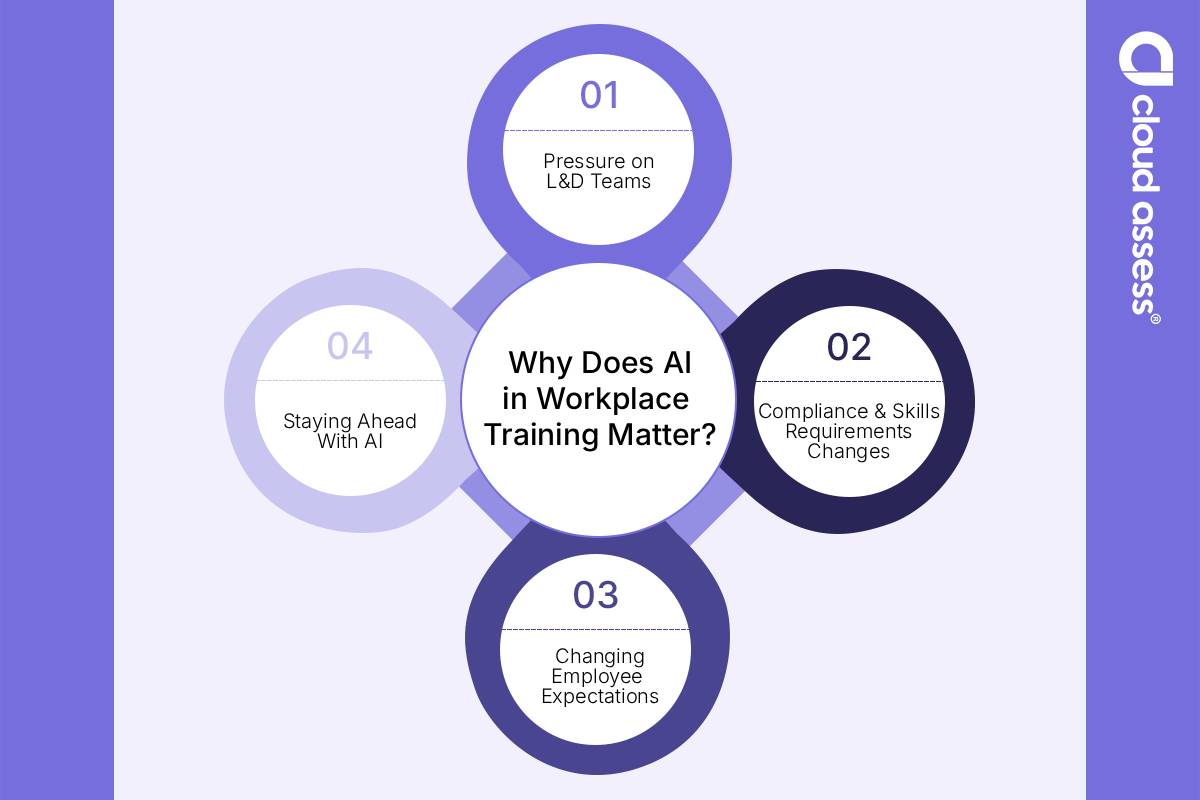
The Pressure on L&D Teams to Do More With Less
Learning and development (L&D) teams have to deliver more training to more people with greater relevance to performance. Headcounts stay lean. L&D budgets don’t always grow. But the demand for timely, effective training does. AI helps close that gap. It reduces the time spent on content creation, administration, and reporting. This frees up training professionals to focus on strategy, quality, and impact rather than operational and routine tasks.
The Pace of Change in Compliance and Skills Requirements
Regulations change and industries evolve. The skills businesses need today are not always the skills they needed two years ago. Keeping training current has traditionally been slow and resource-intensive. AI makes it easier to update content quickly, identify emerging skills gaps, and ensure compliance training reflects the latest requirements. Organisations that can adapt their training quickly have a clear advantage.
What Employees Expect From Workplace Learning
Employees are used to personalised experiences outside of work. Streaming platforms recommend content. Apps adapt to behaviour. When training feels generic or irrelevant, learner engagement drops. AI enables training that reflects an employee’s role, experience level, and progress. That relevance makes a measurable difference to both completion rates and knowledge retention.
The Competitive Case For AI-Powered Training
Businesses that invest in effective training build more capable, adaptable workforces. In markets where talent and agility are competitive advantages, that matters. Organisations that use AI for continuous skill development are better positioned to respond to change. They are able to enter new markets, meet evolving customer needs, and retain the skilled employees they have invested in.
What Types of AI Are Being Used in Training?

Machine Learning
Machine learning enables AI systems to analyse data and improve over time without being explicitly reprogrammed. In training, this powers adaptive learning paths. Platforms use machine learning to track how employees engage with content. They also use it to identify where learners struggle and adjust what they see next.
Deep Learning
Deep learning is a subset of machine learning that identifies patterns within large datasets. In training, this is particularly useful for processing and transforming content. For example, it enables tools to convert text into audio and generate summaries from video content. It also allows training tools to produce visual representations of complex information.
Natural Language Processing
Natural Language Processing (NLP) is how AI understands and generates human language. It does so in a way that feels natural and contextually appropriate. In training, it powers chatbots and virtual assistants. These respond to learner queries and guide employees through content. They can also simulate realistic conversations for practice-based learning.
Computer Vision
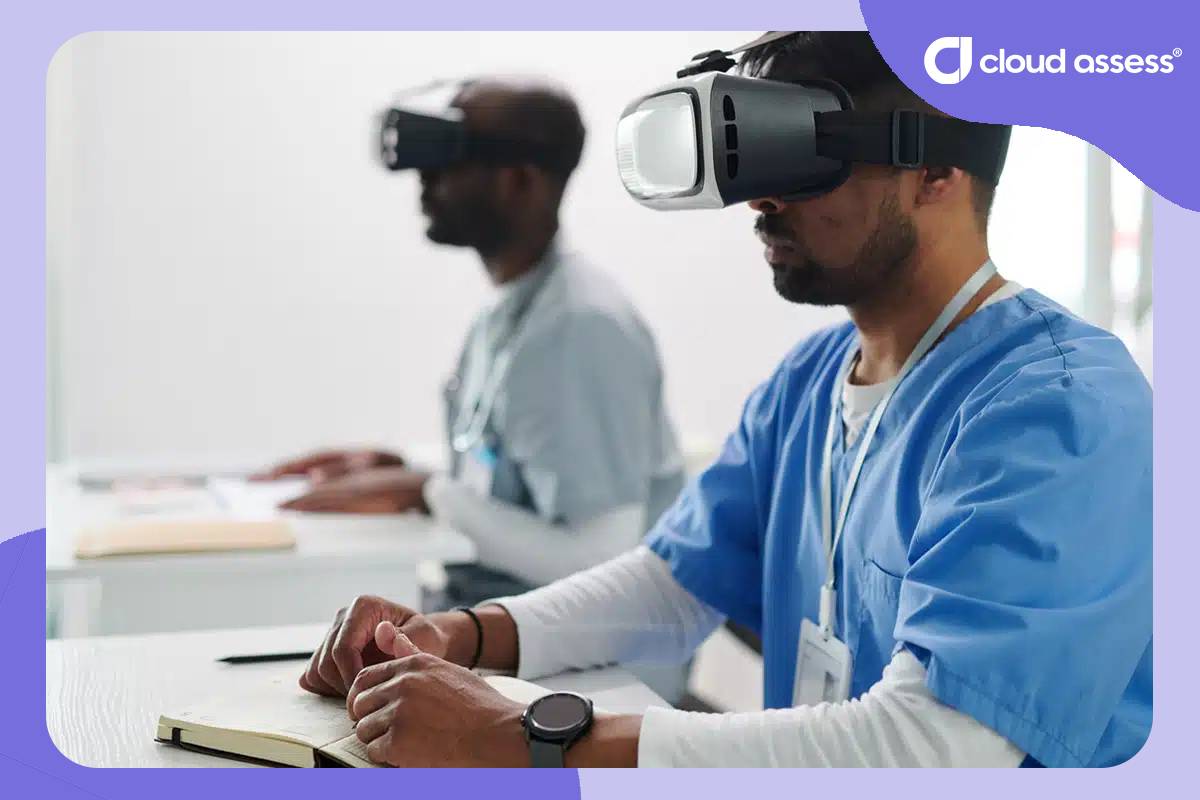
Computer vision enables machines to interpret and understand visual information. In training, this supports virtual and augmented reality simulations. This allows employees to practise tasks and procedures in realistic environments without real-world risk.
Reinforcement Learning
Reinforcement learning is the process by which AI improves itself. It incorporates feedback and outcomes over time. In training, this supports adaptive learning platforms that respond to learner performance. These platforms also adjust difficulty, content, and pacing based on what the data shows.
Generative AI
Generative AI creates new content based on patterns learned from existing data. In training, this has had the most visible impact. It enables rapid content creation, realistic scenario building, and automated assessment generation. Learner experiences can also be personalised and delivered at scale.
10 Practical Uses of AI in Training and Development

1. Addressing Skill Gaps
AI can help you identify skill gaps within your workforce and implement steps to address them. Start by issuing standardised assessments to each of your employees. AI can then analyse their answers as soon as the assessment is completed to identify areas of weakness. From there, it can recommend different training courses that will further each employee’s skillsets in areas they didn’t perform as well in. Tools like chatbots or LMS-integrated AI can then push relevant content directly to the learner. It does so without requiring manual intervention from your L&D team.
2. Personalising Learning Experiences
Artificial intelligence can also create personalised learning experiences. You can provide your teams with engaging content in their preferred type of learning style. This gives them access to a training journey that suits their role as well as their personality.
In practice, this works by feeding employee data to your learning management system. This includes each employee’s role, performance history, and completed training. The AI uses this to recommend relevant content and identify each employee’s learning style. It then serves content in the format that suits them best, whether that’s video, written guides, or interactive modules.
3. AI-Driven Assessments to Save You Time
Corporate training takes a lot of time to manage. There’s onboarding employees, helping your teams upskill, and designing and managing training courses. AI can analyse assessment results by testing them for plagiarism. It can also compare them against your skills matrix to show where employees meet role requirements and where gaps remain. This cuts down on manual steps, saving you time and money. Define your assessment criteria and skills matrix upfront. Most AI-enabled LMS platforms can then automate the analysis and flag results that need human intervention. Make sure you know how to detect assessments completed by AI to avoid jeopardising the validity of your assessment results.
4. AI-Powered Analytics and Reporting
AI technology can pull meaningful insights from large amounts of data far quicker than any human can. Using AI-powered analytics will give you a better understanding of where your training is working and where you can improve. Most AI-enabled LMS platforms allow you to set custom dashboards. Define the training metrics that matter to your business. These could include completion rates, assessment scores, or time to competency. From there, let AI highlight trends automatically.
5. Brainstorming Training Ideas
It can be difficult to come up with new ideas and initiatives, especially if you’ve been involved in training for a long time. Turning to AI solutions can help with creative problem-solving, generating new ideas, enhancing productivity, and boosting efficiency in your training programs. A practical starting point is to prompt the AI with your business context, the role you’re training for, and the outcome you want to achieve. The more specific your input, the more useful the output.
6. Compiling Key Takeaways Based on Transcripts
If you’re conducting virtual training sessions, having an AI bot in attendance can be a great asset. Bots can transcribe meetings and take notes, saving you time and manpower. They can also compile key points and takeaways. This can help you to keep sessions on track and provide learners with quick and effective summaries. Tools like Otter.ai, Fireflies, or Microsoft Copilot can be added to virtual sessions. After the session, they generate transcripts and summaries that can be shared directly with learners or stored in your LMS.
7. Enhanced Storytelling for Engaged Training
Providing employees with content they can relate to in the context of their work makes a real difference to engagement and knowledge retention. However, writing unique content for every role is both challenging and time-consuming. AI can adjust your existing training materials for different roles. Input your existing content into a generative AI tool along with details about the role you’re tailoring it for. It can reframe scenarios and adjust language without requiring a full content rebuild.
8. Role Playing Scenarios
Learning about theory isn’t always as effective as applying knowledge in practical situations. Using AI to provide realistic virtual scenarios gives employees a safe space to practise. They can also make mistakes without affecting operations. Define the situation, the decision points, and the possible outcomes. The AI adapts its responses based on how the learner engages.
9. Quick Training Videos and Images
AI can analyse text, video, and graphics and repurpose them to create training videos and images in new formats. This expands your existing learning solutions by repurposing content into richer, more engaging formats without starting from scratch. Tools like Synthesia, Descript, or Adobe Firefly can convert written content into video or visual formats. Start with your highest-traffic or most frequently updated content for the quickest return.
10. 24/7 Support

You can set up an AI chatbot to respond to learner questions at any time. You can customise it with answers to frequently asked questions that come up during training. Identify the most common learner queries and use these to build your chatbot’s knowledge base. Most LMS platforms have built-in chat features that can be configured to handle these automatically.
Benefits of Using AI in Training and Development
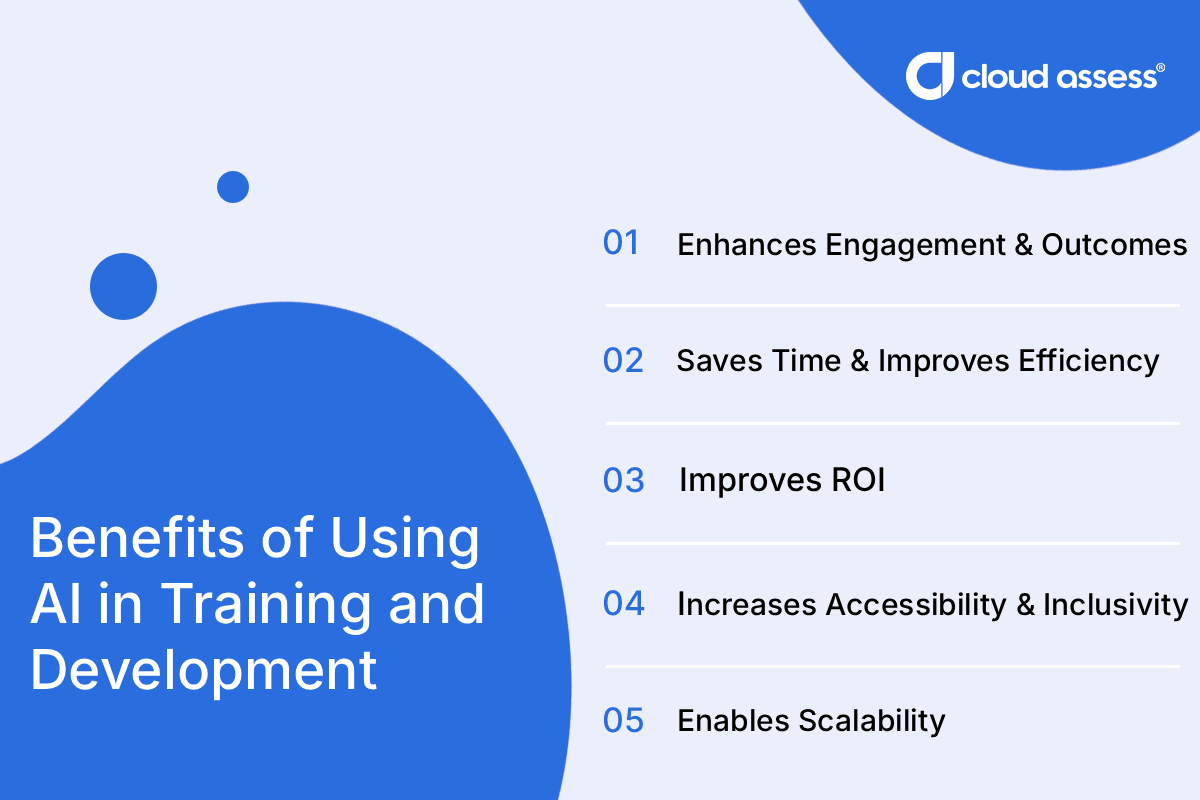
Enhances Engagement and Improves Outcomes
Training that is relevant to an employee’s role and delivered in formats that suit how they learn is more likely to be completed. It is also more likely to stick, and learner engagement is likely to improve. AI training for employees makes this level of relevance achievable at scale. This has a direct impact on knowledge retention and performance on the job.
Saves Time and Improves Operational Efficiency
The administrative side of training can consume a significant portion of an L&D team’s time. This includes enrolment, reporting, marking, and course updates. AI automates much of this. Teams can manage larger training programs without increasing headcount. The risk of human error in manual processes is also reduced.
Improves ROI
Effective training reduces the cost of poor performance, high turnover, and compliance failures. AI helps organisations get more out of their training investment by ensuring content is used, understood, and applied. Better learning outcomes translate directly into business results.
Increases Accessibility and Inclusivity
AI makes it easier to deliver training across diverse workforces. Content can be translated, transcribed, and adapted into different formats. This makes it accessible to employees with different languages, learning needs, or disabilities. Organisations can meet their inclusivity commitments without building separate content for every audience.
Enables Scalability
As organisations grow, training needs grow with them. As the list of companies using AI for training and development grows, the scalability benefits have become harder to ignore. AI allows businesses to scale their learning and development without a proportional increase in resources. Whether onboarding ten new employees or a thousand, the quality and consistency of training can be maintained.
Compliance and Regulatory Considerations
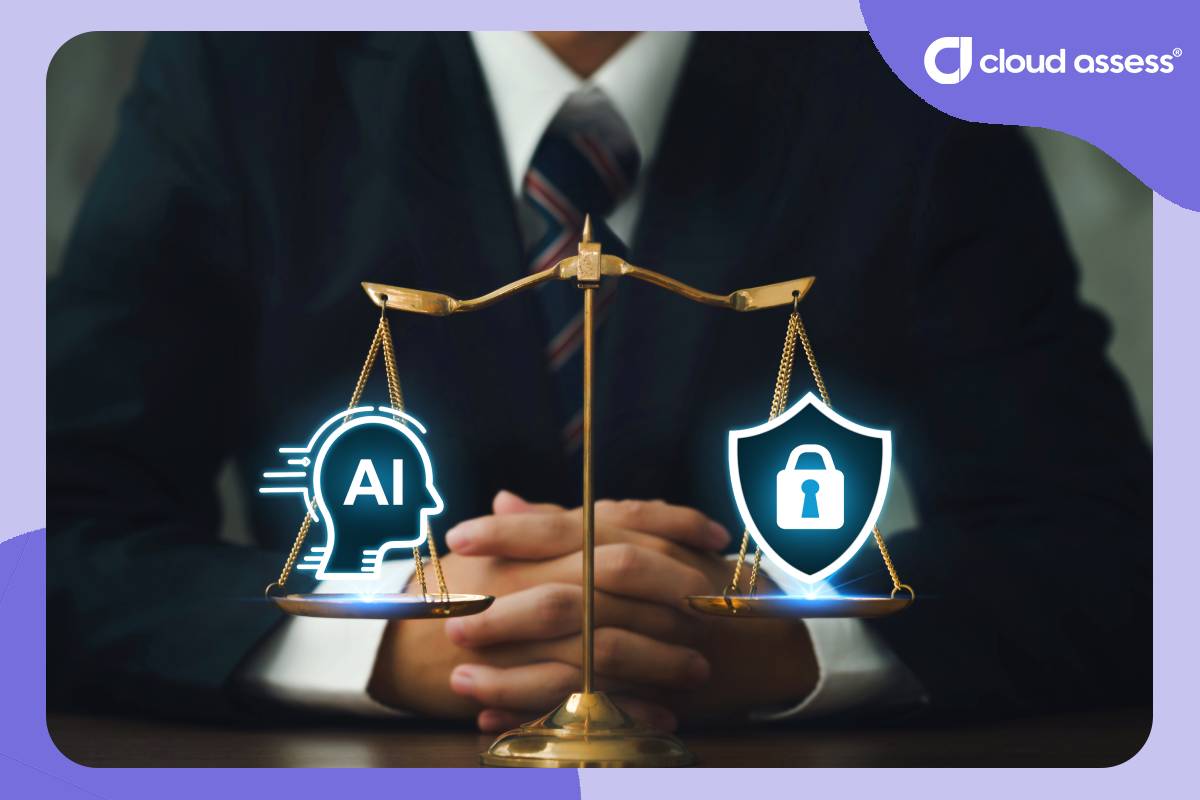
For Organisations Operating in Australia
Australia does not yet have AI-specific legislation. AI use is governed by existing laws. These cover privacy, discrimination, workplace safety, and consumer protection. Key considerations for organisations using AI in training include:
- The Privacy Act 1988. If your training tools collect or process employee data, that data handling must comply with the Australian Privacy Principles.
- Privacy Policies. From December 2026, organisations must disclose in their privacy policies how personal information is used in automated decision-making, where those decisions could significantly affect individuals. Organisations should begin reviewing their privacy policies now.
- Guardrails for High-Risk Applications. The Australian Government has proposed mandatory guardrails for high-risk AI applications, covering governance, risk management, transparency, and human oversight. It is worth assessing how your AI tools for training may be classified as the framework develops.
For Organisations Operating in The UK
The UK currently has no dedicated AI Act. This report suggests that its framework is principles-based and sector-led, with existing regulators applying relevant rules within their domains. Key considerations include:
- AI use in the workplace must comply with the Equality Act 2010, the Employment Rights Act 1996, and UK data protection law. This applies when AI is used to assess performance, recommend learning pathways, or make decisions that affect individuals.
- The Information Commissioner’s Office (ICO) is developing a statutory code of practice on AI and is scrutinising automated decision-making in employment contexts. Organisations should monitor ICO guidance closely.
- A formal AI Bill is expected but not yet confirmed. Organisations should ensure their AI governance policies are documented and regularly reviewed.
For Multinational Organisations
Organisations operating across multiple jurisdictions face overlapping and sometimes inconsistent requirements. Key considerations include:
- Under the EU AI Act, high-risk AI systems face extensive requirements, including conformity assessments, data governance, documentation, and human oversight. AI tools used in employment and training contexts may fall within this category, according to GDPRLocal.
- Building a governance framework that meets the most stringent standard across your markets provides a more defensible position globally.
- Document how your AI tools work, what data they use, and how decisions are made. That transparency will be required in some markets. It is better to have it in place everywhere.
How to Apply AI in Your Organisation’s Development Programs
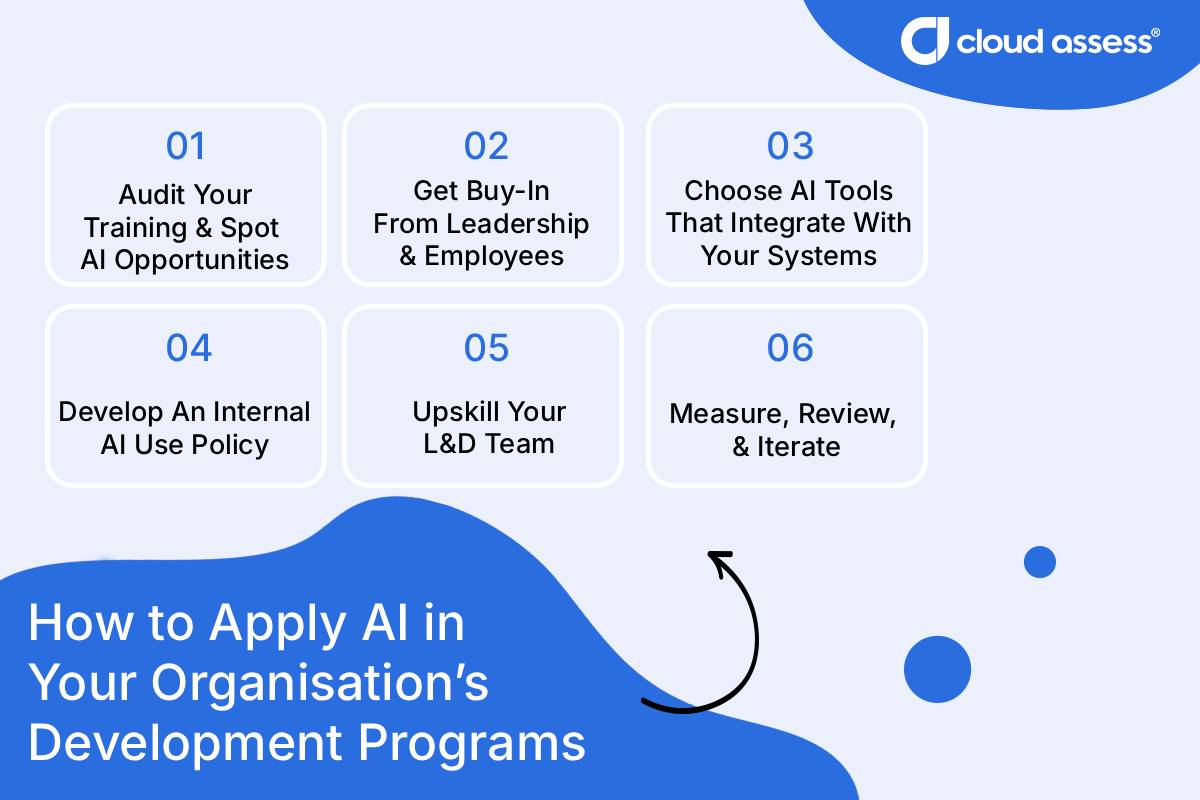
Audit Your Current Training Delivery and Identify AI Opportunities
Before introducing any AI tools, get a clear picture of where your training currently stands. Look at how content is created, how it is delivered, and where the gaps are. Identify the processes that are most time-consuming or inconsistent. These are typically the areas where AI can add the most immediate value. Start there rather than trying to transform everything at once.
Get Buy-In From Leadership and Employees
AI adoption in training is more likely to succeed when business leaders and employees understand why it is being introduced. For leadership, frame it around business outcomes. For employees, focus on how it makes their learning experience more relevant and less burdensome. Address concerns early, particularly around data use and job impact. Transparency at this stage prevents resistance later.
Choose AI Tools That Integrate With Your LMS & Other Systems
Avoid tools that operate in isolation. AI in training works best when it connects to your existing systems. Pulling in data and feeding insights back into the platforms your teams already use. Before committing to any tool, confirm how it integrates with your LMS, your HR systems, and your reporting processes. A powerful tool that creates data silos will create more problems than it solves.
Develop An Internal AI Use Policy
Organisations need clear guidelines on how AI can and cannot be used in training. This includes how employee data is collected and stored. It also includes how AI-generated content is reviewed before use, and how automated decisions are monitored. A documented policy protects the organisation. It also builds employee trust and ensures consistent practice across teams.