Success in Australia’s vocational education sector requires more than just technical skills. Many learners face unexpected challenges that make completing a qualification difficult. These include struggling with course materials, adapting to workplace expectations, and keeping up with digital tools.
That’s where Foundation Skills Training (FST) comes in. As an essential part of Vocational Education and Training (VET), it helps students succeed in training, work, and everyday life.
In this blog, we’ll explore:
- What are foundation skills?
- Foundation skills frameworks
- The Foundation Skills Training Package and how it differs from general FST
- How FST training is delivered
- Why foundation skills programs matter for businesses and individuals
- Government funding & support for FST
- The future of foundation skills training in Australia
What Are Foundation Skills?
Foundation skills are abilities that help people learn, communicate, and perform tasks effectively. They form the basis for acquiring new knowledge and adapting to different situations. They’re also fundamental to processing information, expressing ideas, solving problems, and using technology.
These skills are not tied to any specific job or industry but are applicable across all aspects of life. For example, core foundation skills that are developed throughout education are Language, Literacy and Numeracy (LLN) abilities. This covers reading, writing, using basic maths, and communicating effectively. These skills are used on a daily basis across different sectors and scenarios.
Foundation skills are an essential part of the future of work skills. Developing them helps learners keep up with changing workplaces and evolving technologies. This adaptability is crucial in modern environments. This makes developing and reinforcing foundation skills critical in vocational training.
8 Foundation Skills Examples: Key Areas Covered in Training
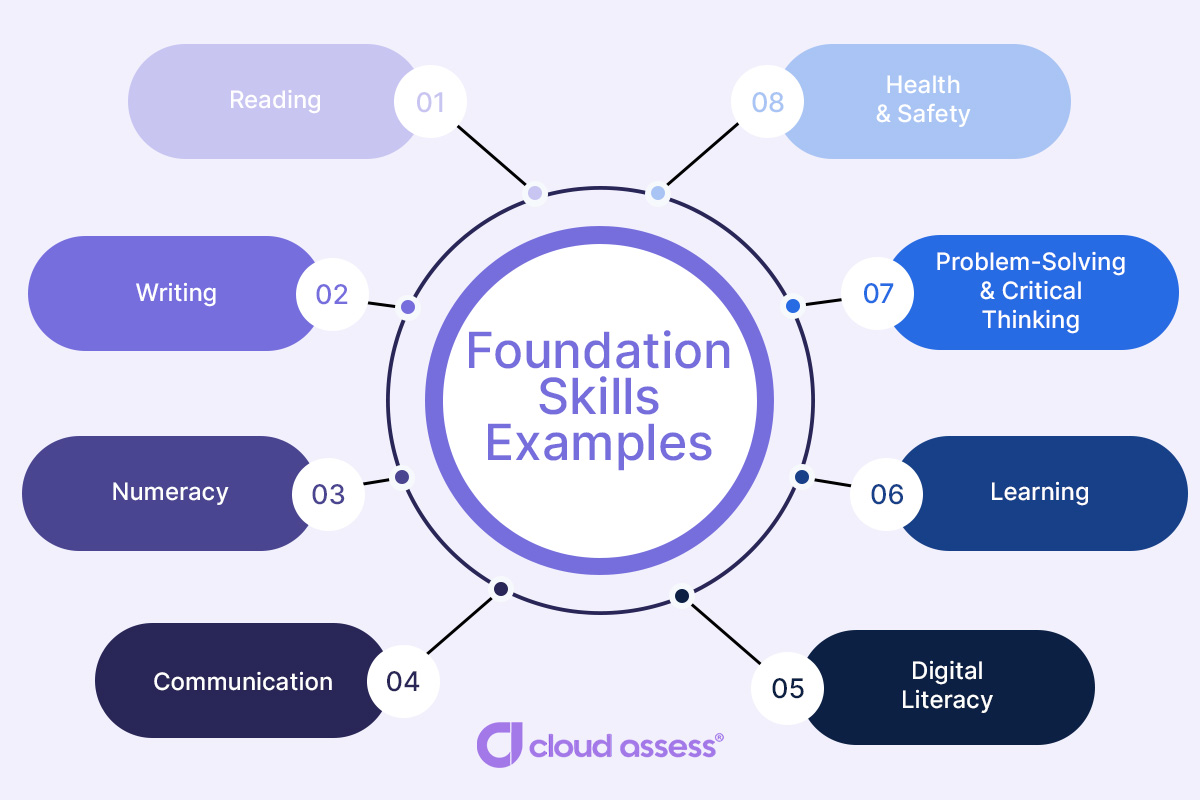
1. Reading
The ability to understand and interpret written information is crucial in any work environment. It helps employees follow workplace procedures, participate in training, and access resources. Reading skills help individuals:
- Understand workplace documents, policies, and instructions
- Extract key information from reports, manuals, and charts
- Interpret written communication, such as emails and notices
2. Writing
Clear and effective writing and typing skills ensure accuracy in documentation. It also supports professional interactions. Writing skills support individuals in:
- Completing workplace forms, reports, and structured documents
- Documenting procedures, incidents, and work-related activities
- Capturing information quickly and accurately
3. Numeracy
Mathematical skills are essential for financial management, data interpretation, and technical work. Numeracy skills support individuals in:
- Calculating costs, measurements, and time allocations
- Analysing numerical data, charts, and financial information
- Applying mathematical concepts to workplace tasks
4. Communication
Strong communication skills enable individuals to collaborate, share ideas, and follow instructions accurately. It’s important to develop both written and oral communication. These enhance employees’ abilities to:
- Engage in discussions and workplace collaboration
- Give and receive instructions effectively
- Present ideas and respond to feedback in professional settings
- Interact effectively with colleagues, managers, subordinates, and clients
5. Digital Literacy
Being able to confidently use technology is becoming increasingly important. These skills are invaluable in the workplace and daily life. Training helps individuals:
- Navigate online platforms and workplace software
- Communicate effectively using digital tools such as emails and video conferencing
- Understand cybersecurity basics and digital safety practices
- Adapt more quickly to new technologies
6. Learning
Acquiring new knowledge, recalling it at important times, and applying it effectively is a skill in itself. By understanding how learning works, employees are better prepared to:
- Identify the learning styles and training methods that work best for them
- Acquire and apply new knowledge efficiently
- Engage in practices that support knowledge retention and improve recall
- Develop strategies for continuous learning and self-improvement
7. Problem-Solving and Critical Thinking
Knowing how to find, evaluate and use information is key to modern workplace practices. It ensures accuracy, promotes innovation, and encourages creativity. It also makes it easier to identify and solve problems. Developing problem-solving and critical thinking skills helps employees:
- Evaluate information to ensure accuracy and reliability
- Analyse data and reports to gain deep and meaningful insights
- Make confident and informed decisions
8. Health and Safety
Workplace health and safety is especially important in compliance-heavy and high-risk environments. Health and safety skills help employees recognise risks to themselves and others, and take steps to avoid or address them. Developing these skills ensures learners:
- Practice safe habits within work environments
- Proactively avoid dangerous scenarios
- Recognise risks and react to them appropriately
- Report issues to the right people quickly and effectively
What is the Foundation Skills (FSK) Training Package?
The Foundation Skills Training Package (FSK) is a structured educational program in Australia. It develops essential language, literacy, numeracy, and employability skills, among others. This equips learners with fundamental abilities needed to engage in Australian vocational education. It also helps them perform effectively in the workplace and navigate daily tasks.
This training is designed for individuals who don’t have the foundation skills needed to complete a qualification or find a job. It helps them strength their skills and boost their employability. The FSK package covers three full AQF qualifications. These are:
- FSK10119 – Certificate I in Access to Vocational Pathways. Designed for individuals who need significant foundational skills support to access vocational training.
- FSK10219 – Certificate I in Skills for Vocational Pathways. Designed for individuals who need specific skills to prepare for vocational training. It can also be appropriate for those who want to improve their foundation skill proficiency levels.
- FSK20119 – Certificate II in Skills for Work and Vocational Pathways. Designed for individuals who want to improve their foundation skills even further. This prepares them for entering the workforce or exploring advanced vocational education pathways.
- A learner could complete the Certificate I in Access to Vocational Pathways before enrolling in other courses.
- They could work towards the Certificate II in Skills for Work and Vocational Pathways while also completing another qualification.
- A construction safety training course could include a numeracy module.
Who is the Foundation Skills Training Package Designed For?
- People who aren’t ready for other VET qualifications. Students may be motivated to study further. However, they may struggle to read course materials, understand assessments, or respond clearly.
- People who’ve had disrupted or non-standard education pathways. These foundation skills learners may not have completed their K-12 education. This can happen for various reasons, including health concerns, family problems, or relocation. This also describes people who decide to further their studies later in life. They may not be familiar with new practices, such as effective use of technology.
- Migrants and international students who need assistance with workplace communication. These learners often have speal English, but may not understand technical language. FSK training helps them interpret documents and instructions and communicate confidently.
Foundational Skills Training vs the FSK Training Package
Scope
Foundation skills training is a broad term. Any training designed to develop foundational competencies could be a foundation skills program. It can include informal community programs or formal, accredited learning. The FSK Training Package is a specific, nationally endorsed VET training package. It covers defined qualifications and units of competency.
Purpose
FST can be delivered for many reasons. It may focus on everyday life skills, community participation, or general learning improvement. The FSK Package builds foundational skills to directly support training and workplace participation.
Learning Environments
Foundation skills training can take place in many settings. These could include community programs, workplaces, adult learning centres, or online courses. The FSK Training Package is delivered within the VET system, usually by a Registered Training Organisation (RTO). This means it follows formal training and assessment requirements.
Recognition and Outcomes
FST does not always lead to nationally recognised credentials. Some programs are non-accredited and only provide participation-based learning outcomes. The FSK Training Package results in nationally recognised units and AQF qualifications. This makes it useful for foundation skills learners who need formal recognition for work or further training.
Foundation Skills Frameworks
Australian Core Skills Framework
The Australian Core Skills Framework (ACSF) outlines five core skill areas. These are learning, reading, writing, oral communication, and numeracy. It provides a structured way to assess and develop these skills across proficiency levels. This helps individuals, educators, and employers identify skill gaps and improvement pathways. The ACSF is widely used in education, vocational training, and workplace skills development.
Core Skills for Work Developmental Framework
The Core Skills for Work (CSfW) Developmental Framework extends beyond literacy and numeracy. It focuses on workplace skills such as problem-solving, teamwork, communication, and self-management. This framework helps individuals build capabilities needed to succeed in diverse work environments. This makes it particularly valuable for career development and workforce transition programs.
Digital Literacy Skills Framework
The Digital Literacy Skills Framework provides guidance on developing digital competencies. It outlines essential workforce skills to navigate, create, communicate, and manage digital information. This makes it easier for individuals, educators, and employers to use technology confidently. It also helps them adapt to new technologies more quickly.
Why Foundation Skills Programs Matter

Improve Learner Success
Vocational training requires learners to interpret course materials, complete various types of assessments, and apply knowledge in real-world scenarios. Without strong literacy and communication skills, students may find it difficult to keep up with coursework. They may also struggle to demonstrate competency. Foundation training improves comprehension and builds learner confidence.
Bridge Skill Gaps for Workforce Readiness
Many job seekers struggle with literacy, numeracy, or digital skills. This applies to those starting their careers and those with skills that have become outdated. It makes it harder to find and keep a job. The National Foundation Skills Strategy reports that 88% of companies are impacted by low literacy and numeracy levels. Of these, 21% are highly affected.
These skill gaps create real challenges for both workers and businesses, as they lead to:
- Poor completion of workplace documents
- Time wastage and reduced efficiency
- Lack of staff confidence and reluctance to take on new work
- Teamwork and communication difficulties
Boost Business Productivity and Performance
Workplaces rely on employees who communicate effectively, interpret information accurately, and problem-solve efficiently. When workers struggle, it can lead to errors, miscommunication, and reduced productivity. Employers who invest in FST see improved in workflow efficiency, teamwork, and overall performance.
Support Lifelong Learning and Career Growth
Technologies and industry standards are continually evolving. Foundation skills support continuous learning, helping individuals adapt to these changes more smoothly. They encourage upskilling, the pursuit of higher qualifications, and career advancement. For employers, these skills foster adaptability, improve problem-solving, and support continuous professional development.
Contribute to Australia’s Economic and Social Development
A workforce with strong foundation skills benefits businesses and the broader economy. Higher literacy and numeracy levels among Australian adults contribute to increased workforce engagement. This reduces unemployment rates and supports greater national productivity. It also gives individuals greater financial independence.
How is Foundation Skills Training Delivered?
Assessing Learners’ Foundation Skills Needs
Under the Standards for RTOs 2025, registered training providers must conduct pre-training assessments. These help to identify gaps in foundational skills that could impact training. Where gaps do exist, RTOs need to advise students on the best way forward. That could involve enrolling in the FSK training package or receiving additional support. It could also mean choosing an alternate qualification that aligns with their existing skills.
Companies often conduct similar assessments. These often take place during hiring, but could also be part of a skills audit. They might involve self-assessments, manager evaluations, or standard tests applied across a workforce. This helps companies recognise where skill gaps lie and provide targeted support and training.
Through Various Training Delivery Models
FST isn’t restricted to a single training method. It can be adapted to various learner needs, training environments, and industry requirements. Popular delivery models include:
- Instructor-Led Training. Training is led by a suitably qualified, experienced person. It can take place in-person or online through virtual learning environments.
- Self-Paced eLearning Courses. These are online courses that foundation skills learners can access at any time. Companies can enrol learners in training, or learners can find online foundation skill courses to enrol themselves in.
- Blended Learning. Incorporates elements of in-person and online training. This approach works well for onsite, remote, and hybrid employees. It ensures access to training sessions and materials regardless of where learners or employees are based.
- Work-Based Learning. Apprenticeships and traineeships may include foundation skills training. This is common for developing specific digital skills required in particular roles or industries.
- On-the-Job Training. Learning that takes place in the course of work, rather than outside of it. It can involve direct instruction and guidance or can take place through extended exposure to workplace tasks. This helps learners develop the specific hard and soft skills they’ll need in their current or future roles.
Accredited and Non-Accredited Foundation Skills Programs
FST can be delivered through accredited or non-accredited programs. Both approaches build skills, but they differ in structure, recognition, and learning outcomes.
FSK Training Package
FSK courses are accredited. They lead to qualifications and FSK certificates on completion. These training courses are often used to proceed further with vocational education or to gain work-ready skills. This is one of the most common nationally recognised approaches to building foundational skills in VET.
Other Accredited FST
Many VET providers also offer additional accredited courses that support digital and LLN skills. These may include standalone courses or modules that are embedded into a vocational qualification. These nationally recognised units often build foundation skills for specific industries or roles.
For example, an accounting course may build numeracy and digital skills aligned with bookkeeping tasks.
Non-accredited Foundation Skills Programs
Non-accredited training offers flexible learning opportunities without leading to a formal certification. These programs may be created and delivered by community organisations or workplaces. They usually focus on practical skill development in less structured environments.
They don’t result in qualifications, but non-accredited courses improve workplace readiness and confidence.
Technology in FST
While digital literacy has become a critical component of FST, this is not where the influence of technology ends. Tools like artificial intelligence and advances in virtual reality also drive training approaches. Some examples of how technology is being used in training for foundational skills include:
- Digital learning platforms. These support interactive modules that make training more engaging and effective.
- AI Peronalisation. Another technique for making training more impactful. Features like AI course recommendations, personalised learning paths, and adaptive assessments. These ensure learners can progress at the right pace. AI translations and transcriptions also bridge language gaps and barriers for international learners.
- Workplace simulations. Virtual environments where learners can practice real-world tasks. This supports skill development without the risks associated with workplace training.
- Assistive technology. These tools support learners with disabilities or additional learning needs.
The Role of Foundational Skills in VET
Identifying Foundation Skills

Supporting foundation skill needs is not just a value-add for VET providers. It’s part of RTO compliance.
The Standards for RTOs 2025 explain that providers must conduct pre-enrolment assessments. These include evaluating language, literacy, numeracy and digital literacy skills. Capabilities and proficiency levels need to align with the requirements for specific courses. For example:
- A hospitality student must be capable of reading and following food safety regulations
- A construction apprentice needs numeracy to measure materials accurately
- A business administration trainee requires oral communication for reports and emails
Meeting Industry Demand And Workforce Readiness
Employers expect VET graduates to enter the workforce with both technical and foundation skills. Industry consultation helps shape training packages. It ensures foundation skills align with real workplace tasks and evolving job requirements.
This is also more than a best practice. Engagement with industry, employer and community representatives is another compliance requirement. RTOs need to show that they actively seek advice and feedback, and use it to continuously improve their offerings.
VET Student Support
Where learners don’t have the required foundation skills, training providers must advise them on the best course of action.
RTOs also need to provide adequate training and wellbeing support services to all learners. This includes foundation skill support. They must have enough trainers, assessors, and staff to accommodate this support. They also need to ensure students are informed about the options available to them.
Government Policies And Initiatives
The Australian government supports foundation skills development through national and state-level programs. These initiatives are designed to improve literacy, numeracy, and digital competencies. They help individuals build workplace skills while strengthening adult literacy across the community.
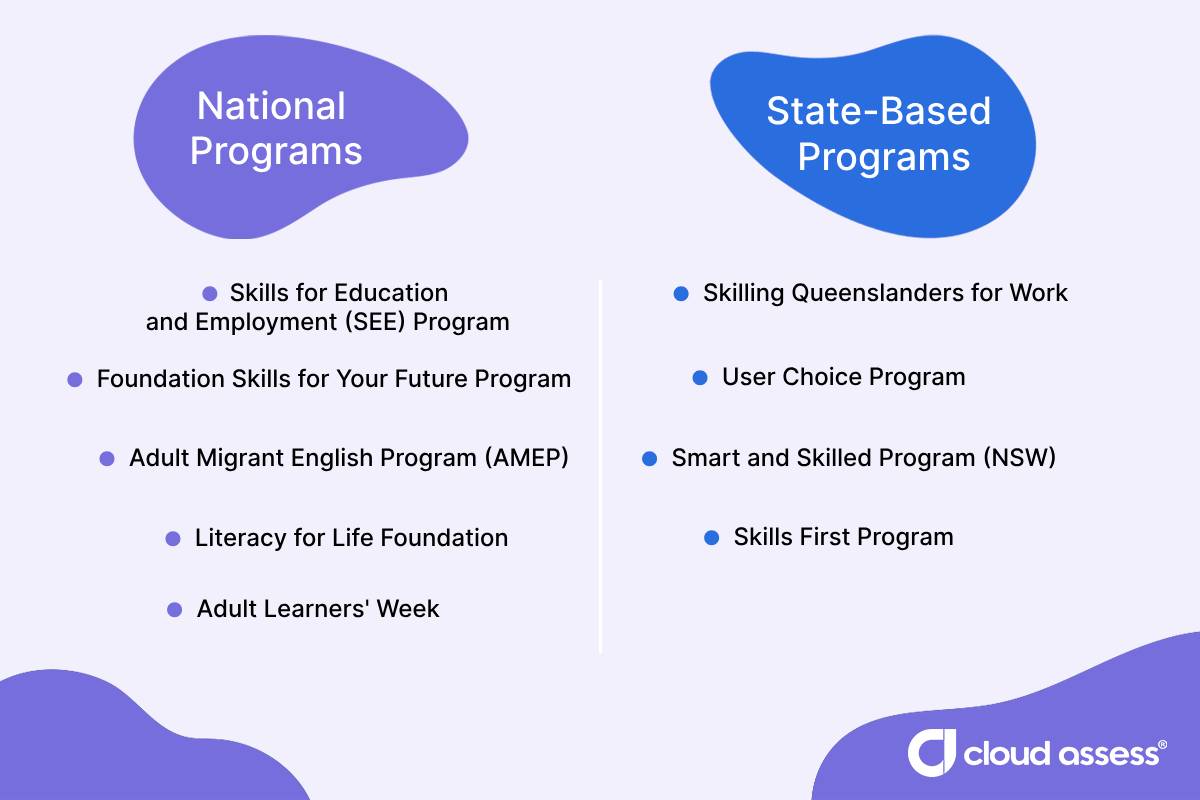
National Foundation Skills Programs
- Skills for Education and Employment (SEE) Program. Part of the National Foundation Skills Strategy (NFSS). It improves literacy, numeracy, and employability skills to enhance workforce participation.
- Foundation Skills for Your Future Program. Provides targeted training in literacy, numeracy, and digital skills.
- Adult Migrant English Program (AMEP). A federally funded initiative to help migrants and refugees develop English language skills.
- Literacy for Life Foundation. An Indigenous-led initiative. Focuses on improving literacy in First Nations communities through the “Yes, I Can” model.
- Adult Learners’ Week. A national campaign that promotes lifelong learning. It encourages adults to engage in skill development opportunities. The program particularly supports those who have faced barriers to education.
State-Based Foundation Skills Programs
- Skilling Queenslanders for Work. Provides training and employment support for disadvantaged job seekers.
- User Choice. Allows apprentices and trainees to access training that enhances their LLN skills.
- Smart and Skilled. Offers government-subsidised vocational training to eligible learners.
- Skills First. Funds training for priority qualifications in Victoria.
Embrace FST Today
Foundation skills are essential for workforce participation, vocational training, and overall productivity. Industries are evolving and technology is transforming learning. But it’s crucial that training remains accessible, relevant, and aligned with workforce needs.
The rise of digital learning solutions makes building foundation skills more efficient than ever. Cloud Assess offers flexible, technology-driven training solutions. They help organisations streamline assessments, enhance learner engagement, and ensure compliance.
Book a demo, start a Explore Pricing, or explore our vast course library with free courses today!
Foundation Skills Training FAQs
Who Is Foundation Skills Training Designed For?
Foundation skills training is designed for individuals who need to improve their literacy, numeracy, digital, and employability skills. This includes job seekers, employees, apprentices and trainees, and those returning to study or the workforce.
Can Foundation Skills Training Be Customised For Different Industries?
Yes, foundation skills programs can be tailored to industry needs. Many vocational courses embed foundation skills relevant to specific sectors. These include numeracy skills for construction or digital literacy for business administration.
How Long Does Foundation Skills Training Take?
The duration varies according to learner needs and training formats. Some foundation skills training is delivered as a standalone course. Other FST is integrated into vocational training. Some programs run for a few weeks, while others are ongoing efforts.
Can Foundation Skills Training Help People Transition Between Careers?
Absolutely. Workers shifting to new industries often need to refresh their foundation skills. This is common when new roles require different literacy, numeracy, or digital proficiencies. Training helps bridge these gaps and supports smoother career transitions.
Where Can I Find FSK Training Resources?
FSK training materials are available through a mix of official and delivery-ready sources. The most reliable starting point is training.gov.au. Here you’ll find the latest FSK qualifications, units of competency, and assessment requirements. There are also learner workbooks, assessor tools, and mapping documents available.
What Are Foundation Skills in a Unit of Competency?
Units of competency often include foundation skills that learners need to perform. They relate to specific workplace tasks. The skills may be embedded in the performance criteria or listed in a dedicated ‘foundation skills’ section.
How Does Foundational Skills Training Relate to the National Skills Agreement?
Foundation skills programs support the goals of the National Skills Agreement. It helps more Australians participate in further education and transition into employment. The training supports and improves learning outcomes, workforce inclusion and productivity. These are all key priorities under national skills and workforce reform.