1. Multiple Assessment Types
Assessment software with multiple assessment methods gives assessors a range of formats in one platform. Each format suits a different purpose, from checking what a learner knows to measuring their current skills.
Common assessment methods include:
- Knowledge assessments, which test what learners know through written or short-answer questions
- Quizzes, which give a quick check of understanding through fixed-response questions
- Simulations, which test how learners apply skills in a realistic scenario
- Portfolios, which assess a body of work the learner has produced against set criteria
- Gap assessments, which compare current skills against job role or unit requirements
Assessors can match each format to what they need to measure. A registered training organisation (RTO) must run pre-training assessments before students enrol. An employer might use one to see which workers need refresher training. Knowledge assessments and quizzes can then confirm understanding after training. Keeping every type in one platform also results in one record per learner. Organisations avoid juggling separate tools for each stage of assessment.
2. AI Assessment Generation
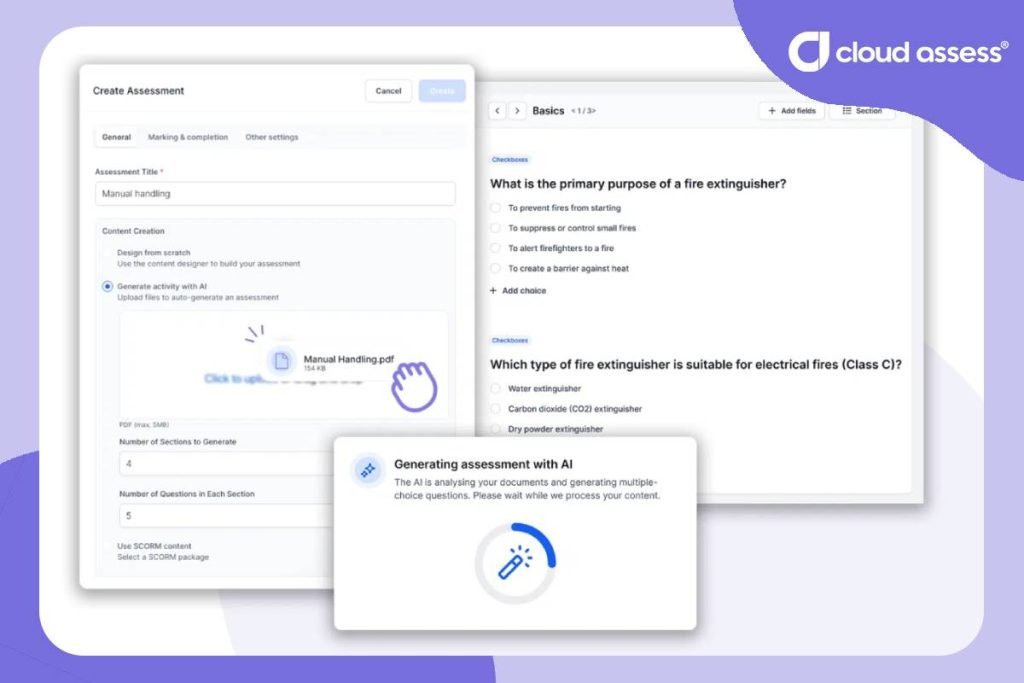
AI assessment generation is an AI feature that creates questions from existing documents or prompts. It allows assessors to input an idea for an assessment, or upload a Word, PDF, or text file to generate multiple-choice questions. Most written training content works as source material. RTOs might use learner guides or unit resources. Employers might use standard operating procedures, safety policies, or equipment manuals.
Assessors then review and edit each question before publishing. This keeps the assessment accurate and relevant to the job or unit. The feature cuts the time spent writing questions from scratch. Organisations can build new assessments faster when procedures, equipment, or training packages change.
3. Drag-and-Drop Assessment Builder
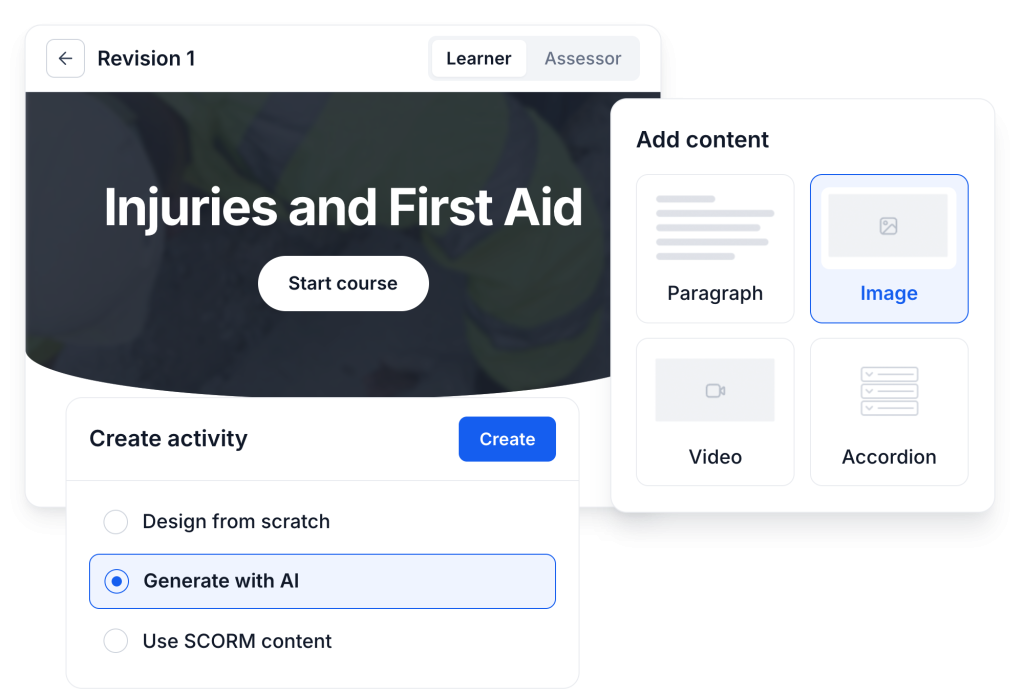
A drag-and-drop assessment builder is a tool for creating assessments without design or technical skills. Assessors drag elements like questions, text, and media into place to build each activity. Assessors can embed video, images, or audio within an assessment. A short video might demonstrate a task before learners answer questions on it. An image might show a piece of equipment, a hazard, or a site layout.
Permission settings control who can see or complete each part of an assessment. Assessors can keep marking notes visible only to other assessors. They can also set aside a section for a workplace supervisor to complete. Visual content helps learners who find long blocks of text hard to follow. Assessors can also build and update assessments themselves, with no developer or designer needed.
4. Observation Checklists
An observation checklist is an assessment tool for recording how a learner performs a practical task. Assessors watch the task and mark off each criterion as the learner meets it. Each checklist lists the steps or standards a learner needs to show. For an RTO, the criteria usually come from the unit of competency. For an employer, they might come from a safe work procedure or an equipment operating standard.
Digital checklists let assessors record results on a tablet or phone as the task happens. Assessors can add comments and attach a photo or video of the work. Recording results on the spot means no transcribing paper notes later. Each observation is saved with a date and time, ready for audit.
5. Log Books and CPD Logs
A log book is an assessment record where learners log the tasks they complete over a period of time. Each entry adds to a body of evidence that shows consistent performance. Log books suit skills that need repeated practice before a learner is assessed as competent. Apprentices and trainees might log tasks completed during work placement or on the job. Healthcare students might log clinical placement hours or procedures.
Employers often use a continuing professional development (CPD) log. Workers record courses, training, and on-the-job training to keep their skills current. Some roles require a CPD log to maintain a professional registration or licence.
Digital log books let learners and employees add entries from their devices as they work. Supervisors can confirm each entry, and assessors can review the full record. Assessors see performance across weeks or months, not just a single day. Digital entries also can’t be lost or damaged like paper log books on site.
6. Verification of Competency (VoC)
Verification of competency (VoC) is a safety-focused check of a worker’s skills. VoC usually applies to high-risk tasks, plants, or equipment. Workers may already hold a licence or qualification. A VoC confirms they can apply those skills consistently, or on a particular site. Employers in mining, construction, and rail rely on VoC for high-risk roles. Many RTOs also deliver VoC assessments for industry clients.
Dedicated VoC workflows bring observation, evidence, and sign-off into one process. Assessors follow the same steps every time, which keeps results consistent across sites. Organisations can also schedule repeat VoCs when skills need re-verifying.
7. Photo, Video, and Audio Evidence Uploads
Evidence uploads let learners submit photos, videos, or audio recordings as part of an assessment. Learners, assessors, or supervisors capture evidence on any device and upload it to the platform.
Each format suits a different kind of evidence. A photo can show finished work, like a weld or a wound dressing. In the workplace, a photo might show a completed pre-start check or equipment inspection. A video can capture a full task from start to finish. Employers might use video to record a worker operating plant during a VOC. An audio recording lets learners explain a process in their own words. Audio also suits learners who find written answers difficult or are uncomfortable being video recorded.
Each upload attaches directly to the assessment and the learner’s record. Assessors can review the evidence remotely when they can’t be on site. Assessing learners across multiple sites or regions becomes far easier.
8. eSignatures
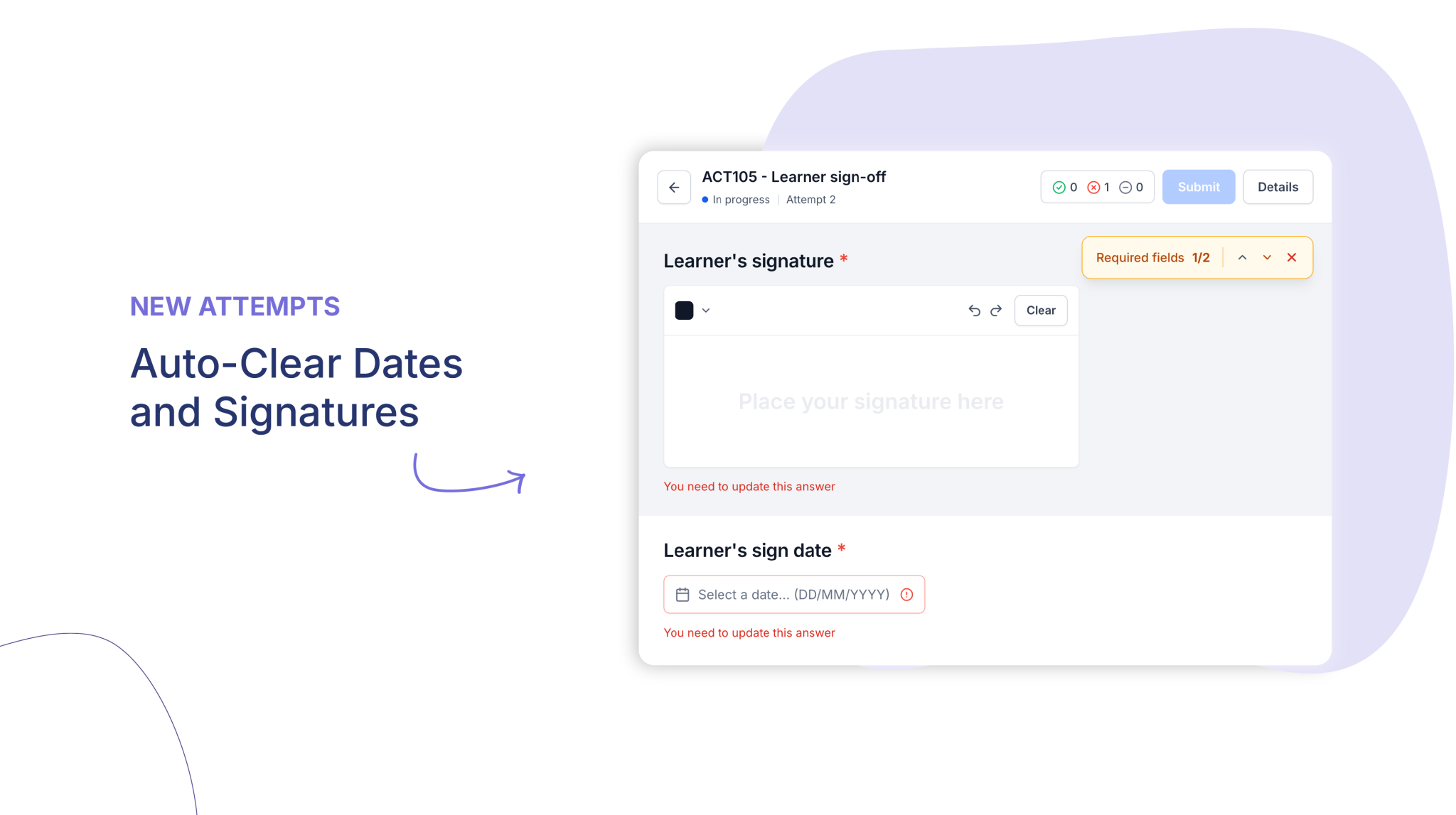
An eSignature is an electronic signature captured within an assessment record. Learners, assessors, and supervisors sign directly on a phone, tablet, or computer.
Signatures confirm key points in the assessment process. Learners might sign a declaration that their work is their own. Assessors sign to confirm their decision. Employers might require a sign-off before a worker operates equipment unsupervised.
Some platforms capture audio or video alongside the signature. Recording the moment of signing adds proof of who signed and when. That extra evidence strengthens authenticity during audits and incident investigations. Signed records stay attached to the assessment, with nothing to print, scan, or chase.
9. Third-Party Access
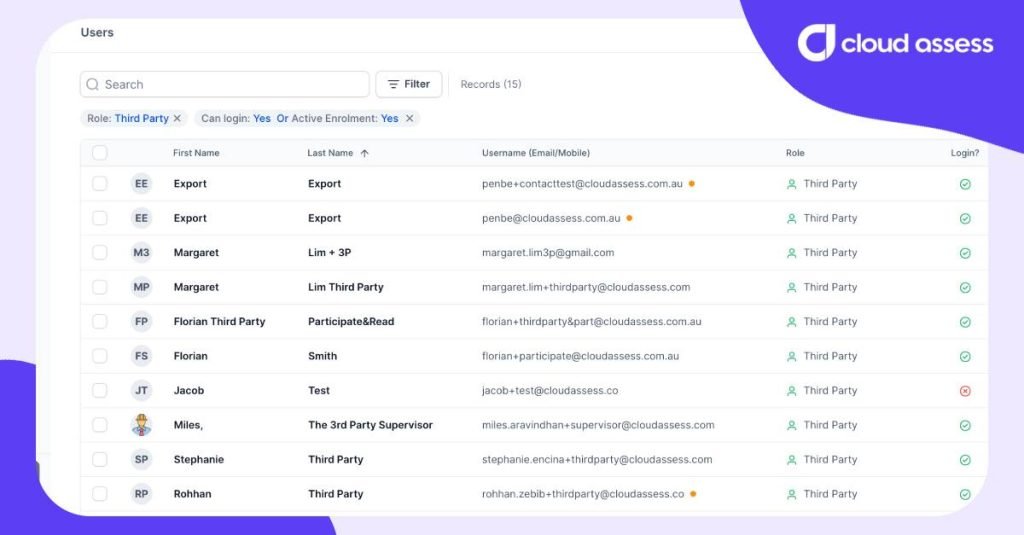
Third-party access lets people outside the assessment team contribute to an assessment. These users often include workplace supervisors, host employers, or external trainers. Third parties log in with limited access to complete only their part of an assessment. They can’t see or change anything else in the learner’s record.
In VET, supervisors often complete third-party reports. These reports confirm how a learner performs tasks on the job. The assessor then weighs the report alongside other evidence to make the final decision. In the workplace, supervisors might observe tasks or confirm log book entries. Organisations decide who can sign off competency under their own policies.
Collecting third-party input digitally replaces emailed forms and posted paperwork. Assessors can see when a report is complete and follow up if it’s missing.
10. Mobile and Offline Assessment
Mobile and offline assessment lets users complete assessments on a phone or tablet. The assessment is downloaded when they have connectivity, but can be completed without it.Assessors check out an assessment before heading to a site. They complete checklists, capture evidence, and collect signatures as usual. Assessors then sync the results once the device reconnects.
Offline access matters wherever connectivity drops out. Underground mines, rail corridors, and remote construction sites are common examples. RTOs assessing trainees on farms or regional work placements face the same problem.
Assessors don’t need to delay assessments or switch to paper when signal drops. Assessment can happen exactly where the work happens.
11. Recognition of Prior Learning (RPL)
Recognition of prior learning (RPL) is an assessment of skills a learner already has. Assessors judge evidence from past work, life experience, or training against unit requirements. Successful RPL gives learners formal credit for the units their evidence covers, towards a qualification. Learners might provide work samples, references, previous certificates, or photos of completed jobs. Assessors often add a practical observation or conversation to fill any gaps.
Employers often use RPL through an RTO to formally recognise the skills of experienced workers.. Workers gain a nationally recognised credit for skills they use every day. RTOs can set up RPL pathways that show learners exactly what to submit. Assessors then map each piece of evidence to the unit and record the outcome.
12. Assessment Mapping
Assessment mapping is a process that links each assessment task to the requirements it covers. Assessors use a mapping tool to see which requirements are met and which are missing.
For RTOs, requirements come from each unit of competency. Mapping shows how tasks cover the unit’s elements, performance criteria, and evidence requirements. Clear mapping helps RTOs show auditors their assessments support the rules of evidence. This ensures the assessments are:
- Valid, meaning they measure the right skills
- Sufficient, meaning there’s enough evidence to judge competency
- Authentic, meaning the evidence reflects the specific learner’s skills
- Current, meaning the evidence was captured recently and reflects active competency
For employers, requirements might come from a skills framework or a job role. Mapping shows whether an assessment covers every skill that role needs. Gaps become easy to spot before an assessment goes live. Assessors can fix missing coverage early, rather than finding it during an audit.
13. Grading Schemes and Auto-Marking
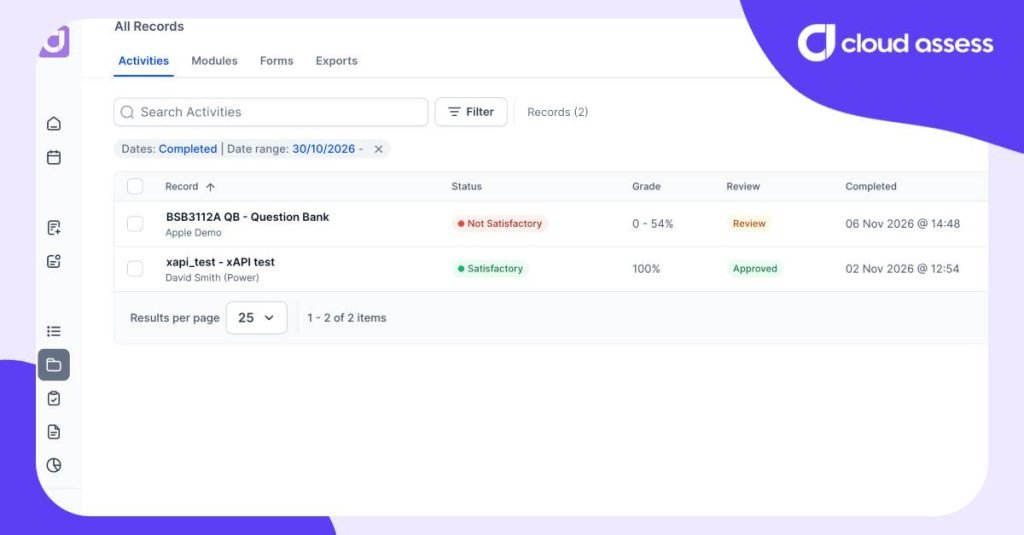
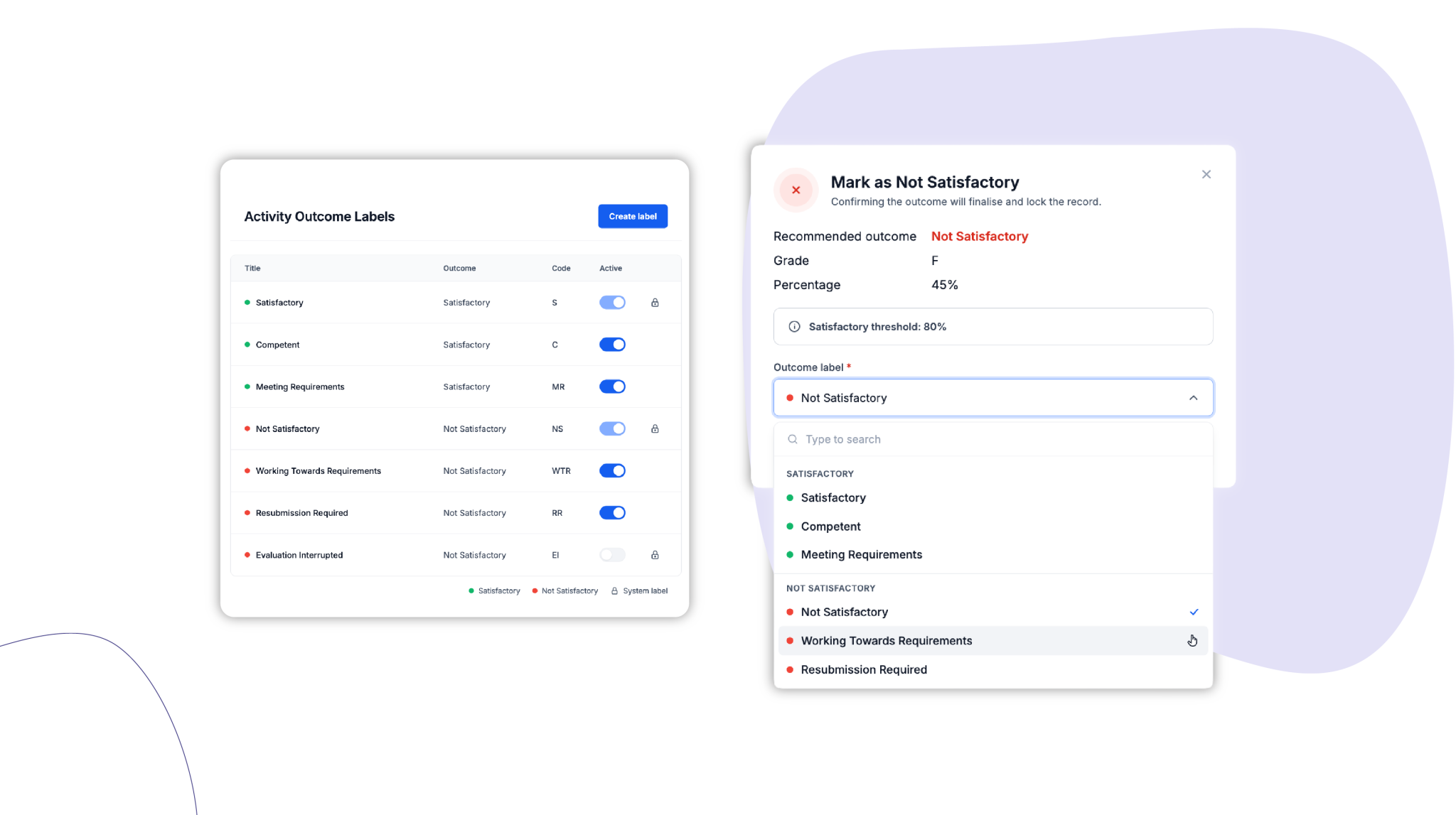
A grading scheme is a scale that sets the outcomes assessors can give a marked activity. Organisations can build schemes to match how they judge performance. RTOs commonly use outcomes like “Satisfactory” and “Not Yet Satisfactory” for individual tasks. Units are then recorded as “Competent” or “Not Yet Competent”. Employers might prefer pass or fail, a percentage score, or levels of proficiency.
Auto-marking applies outcomes to fixed-response questions, like multiple choice or true or false. Assessors set the correct answers when building the assessment. Auto-resulting then records an overall outcome based on the pass criteria. These results are available instantly, as there isn’t a judgement required for them.
Assessors spend less time marking simple questions. They can focus on practical tasks and written answers that need their judgement.
14. AI Marking Suggestions
AI marking suggestions are recommended outcomes for written learner responses. Assessors use AI marking to check each response against the marking criteria. They then review the suggested outcome before accepting or changing it. The assessor always makes the final decision. AI suggestions support their judgement but don’t replace it.
Suggestions suit open-ended questions that auto-marking can’t handle, like short responses and written explanations. RTOs with large student cohorts can mark faster without lowering quality. Employers assessing workers across many sites can keep marking consistent between assessors.
15. VET Compliance Reporting
VET compliance reporting turns assessment outcomes into the data RTOs must report to the regulators and authorities. Results from marked assessments become the unit outcomes in each student’s record.
RTOs must report this training activity data on a regular basis. The standard is the Australian Vocational Education and Training Management Information Statistical Standard (AVETMISS). The VET Information Standard (VET IS) is replacing AVETMISS in stages. Under VET IS, RTOs report more often, as training events happen.
When assessment results feed directly into reporting, RTOs avoid re-entering data by hand. Fewer manual steps means fewer errors when data is validated and submitted. More frequent reporting under VET IS makes accurate and up-to-date assessment records even more important.
16. Skills and Competency Reporting
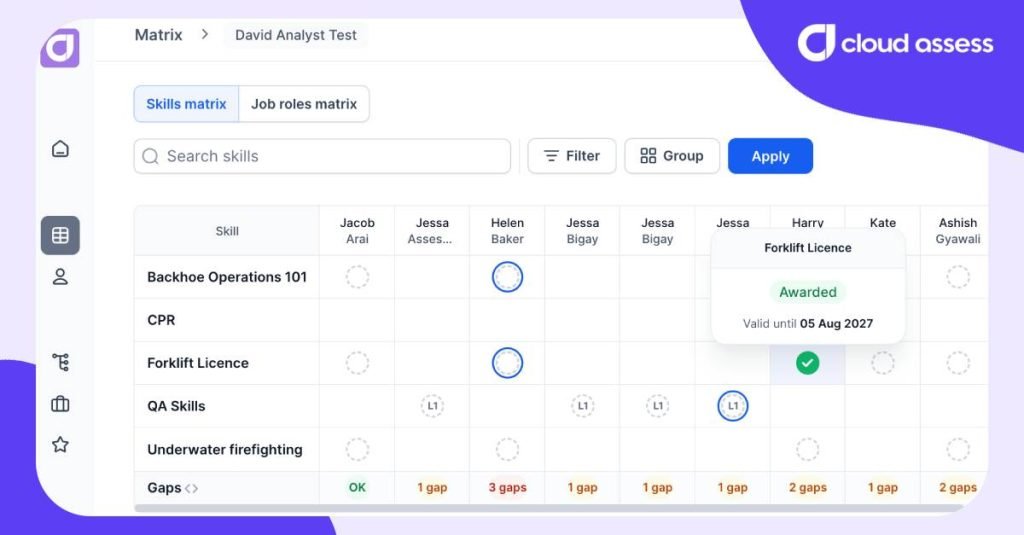
Skills and competency reporting links assessment outcomes to what each job role requires. Recorded results update the organisation’s skills and competency matrix. A skills matrix shows the skills each worker has and at what level. A competency matrix shows whether each worker is competent against role requirements.
Managers can check who’s competent for a task before assigning work. They can also spot gaps across a team, site, or job role. Upcoming expiries and re-assessments, including repeat VoCs, appear in the same view.
Current records help employers prove worker competence to regulators and clients. Those records matter most during audits or after an incident.
Choose the Right Assessment Software for Your Organisation