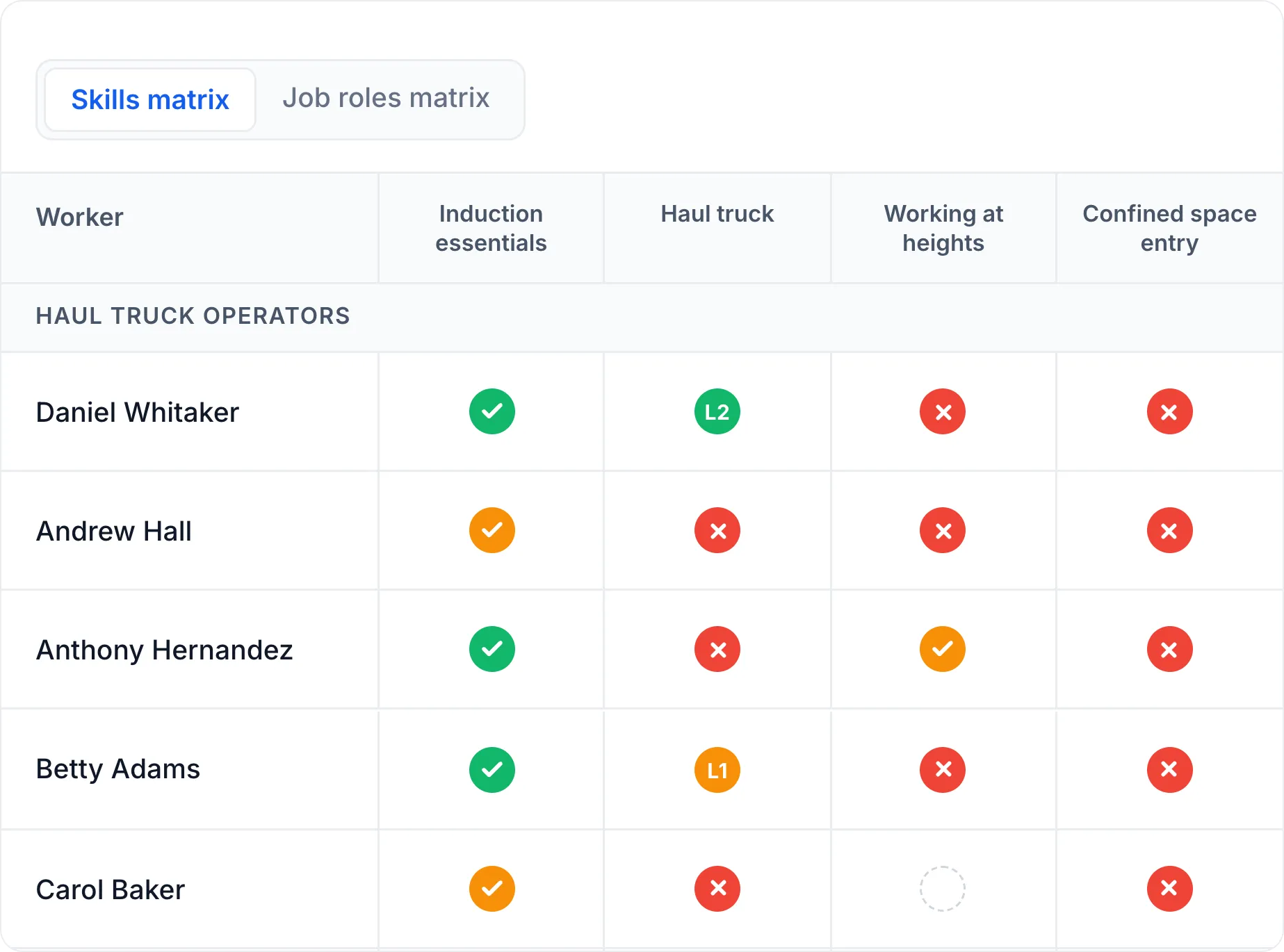
Manufacturing is a high-risk industry where skills, capabilities and competencies are essential for managing risk, supporting operational efficiency, and ensuring compliance. Having a structured method for tracking and developing these skills across your teams is vital.
This is where a skills matrix becomes an essential tool in any manufacturing organisation’s arsenal.
In this article, we explore:
- What a skills matrix is
- Why a skills matrix tool is critical in manufacturing
- Benefits a skills matrix solution offers manufacturing companies
- A step-by-step guide to building your custom skills matrix
- Tools that support skill tracking, development, and compliance
- Examples of manufacturing skills matrices
What is a Skills Matrix for Manufacturing?
A manufacturing skills matrix is a visual grid that maps employee names or roles against required technical, safety, and operational skills and competencies. This allows organisations to determine at a glance where skill gaps may lie and develop targeted employee training programs to address them.
Why is a Skills Matrix Critical in Manufacturing?

- High-Risk Environment. Manufacturing involves high-risk machinery, processes, and materials. A skills matrix helps ensure that only trained and competent employees operate specific equipment, reducing the risk of accidents, and promoting safety and compliance.
- Production Efficiency. With real-time visibility over workforce skills, manufacturers can assign the right people to the right jobs, minimising downtime, reducing rework, and improving output across the production line.
- Operational Resilience. A well-maintained matrix supports multi-skilling and skill mobility, enabling operations to continue smoothly even when key staff are absent or unexpected disruptions occur.
- HSE Compliance. Skills matrices support Health, Safety and Environmental (HSE) compliance by tracking mandatory and statutory training like fire safety, first aid, equipment-specific safety, and emergency response. They help you meet legal obligations, support audit readiness, and ensure consistent application of your standard operating procedures (SOPs).
Benefits of a Skills Matrix for Manufacturing Companies

Improves Employee Management
Every task on the floor goes to someone qualified to perform it. A skills matrix allows manufacturers to map workforce competencies in real time, giving managers a clear view of team capabilities across roles like machine operators, technicians, and supervisors. Through dashboard visualisation and real-time updates, it becomes easier to manage teams across shifts, lines, and sites.
Integrating training records and assessment outcomes into skill management software allows managers to quickly identify which employees are qualified for specific tasks. Skills mapping helps with better role allocation, while up-to-date data ensures smoother shift planning, and reduces the risk of assigning tasks to underqualified staff. This leads to safer, more efficient operations, improves workforce performance, and greater accountability.
Supports Compliance
Audit readiness becomes the default rather than a last-minute scramble. Manufacturing organisations must meet strict compliance requirements, especially when it comes to health, safety, and quality. A skills matrix helps manage compliance training by tracking mandatory HSE training and role-specific requirements.
A well-maintained matrix that aligns with regulatory standards such as ISO 45001 (occupational health and safety) and ISO 9001 (quality management), makes it easier to prepare for audits. Certification tracking and automatic expiry alerts also help with flagging outdated or missing qualifications before they become a risk. This gives organisations ample time to schedule refresher training and address gaps before they impact operations.
A skills matrix can also support Verification of Competency (VOC) by documenting assessments that confirm employees can safely and competently perform high-risk tasks. This ensures qualifications are backed by demonstrated ability, reinforcing workplace safety and compliance.
Identifies Skill Gaps
Production stays on track because skill gaps are caught early. Using structured training needs analysis, you can assess whether your teams meet the required competency standards for their roles, equipment, and responsibilities. Supplementing your matrix with a skills gap analysis tool can make this process even more precise. It can reveal the depth and scale of those gaps across different production areas.
This visibility also helps identify skill stagnation, and career stagnation. These issues are particularly common in fast-evolving production environments, where gaps can emerge due to new technologies, changing safety protocols, or the introduction of complex equipment.
With this insight, you can plan targeted interventions early, whether through upskilling, reskilling, formal assessment, or revised role alignment. Addressing skill gaps proactively improves workforce resilience and ensures your team remains fully equipped to meet current and future operational demands.
Ensures Continuous Professional Development

Workforce skills keep pace with new technology and changing regulations. A skills matrix enables you to track continuous professional development (CPD) progress, schedule training activities, and ensure staff are achieving ongoing development goals.
Rather than treating training as a one-off event, the matrix supports a long-term, structured approach to employee growth. It allows supervisors to assign refresher courses, monitor learning outcomes, and align CPD efforts with broader competency frameworks. It also supports career progression by showing employees how their skills are developing over time and what’s needed to move into more senior roles. Making development an ongoing priority improves performance and compliance while increasing job satisfaction and enhancing employee retention.
Boosts Upskilling and Cross-Training
Critical roles stay covered, even at short notice. Multi-skilling and cross-training are key to building a more flexible, efficient, and resilient workforce in manufacturing. A skills matrix helps identify opportunities for employee upskilling and reskilling, allowing teams to respond quickly to production changes, staff shortages, or the introduction of new machinery.
Tracking skill mobility and highlighting who is ready to learn new tasks or take on additional roles helps expand workforce capabilities. This results in lean operations and reduces training lead times by enabling teams to reassign skilled employees faster. It also strengthens internal recruiting, reduces reliance on a single point of expertise, and promotes a culture of continuous learning and adaptability across the plant.
Supports Risk Management
Staffing decisions for today and future growth rest on real data. A skills matrix provides a clear, centralised view of staff proficiency levels, helping you plan shifts, allocate tasks, and scale teams based on operational priorities.
Making safety-related competencies visible and auditable improves planning around training, supervision, and equipment access. It also supports internal investigations and incident response by providing documented proof of competency for relevant staff involved. s.
Streamlines Operational Processes
Digitising your skills data helps automate many aspects of workforce management and supports broader digital transformation initiatives. Automation features like real-time updates, expiry alerts, and role-based access support efforts to go paperless and streamline manual processes.
These systems free up managers to focus more on production goals and less on admin, while improving visibility across training, compliance, and performance. The result is a more agile, data-driven manufacturing process, where decisions are based on live information and aligned with strategic business outcomes.
Improves Workforce Planning
Strategic workforce planning in manufacturing requires insight into both current capabilities and future staffing needs. A skills matrix supports this by providing a clear, centralised view of staff proficiency levels, helping you plan shifts, allocate tasks, and scale teams based on operational priorities.
For multi-site operations, the matrix offers a standardised approach to skill tracking, allowing HR and operations teams to manage large, distributed workforces more efficiently. It also supports scenario planning by helping you model workforce readiness for new contracts, facility expansions, or technology rollouts. Long-term, it allows you to identify where internal promotions, training investments, or external hiring will be needed to meet business growth or technological change.
Free Skills Matrix Template
Building a skills matrix from scratch can be time-consuming. But we’ve simplified the process! Our downloadable template includes built-in formatting, skill categories, and tracking columns to help you get started immediately.
How to Build a Manufacturing Skills Matrix

1. Define Key Job Roles
Start by listing the critical roles in your facility. These can be broken down into roles within specific teams. However, organisations looking to embrace skill mobility may want to list all positions without teams assigned to them. This will make it easier to track skills across your workforce, regardless of which team a role may currently be assigned to.
It’s also important to include each role’s responsibilities, as it will help you to align roles with required skills in the next step. Examples of roles within a manufacturing context may include:
- Machine Operators who run production equipment and monitor output
- Maintenance Technicians who perform preventative and reactive equipment maintenance
- Supervisors who oversee production lines and ensure compliance and quality
2. List Required Competencies for Each Role
For each role in your manufacturing workforce, map out the mandatory, technical, and role-specific skills employees need to perform their duties safely and effectively. This may include regulatory training (such as HSE compliance), machine operation protocols, problem-solving abilities, and even power skills like communication or supervision.
Using the manufacturing roles outlined above, you may want to track the following competencies and proficiency levels:
- Machine Operators require core competencies such as safe equipment operation, quality control, and start-up/shutdown procedures. These free equipment courses are a good place to start.
- Maintenance Technicians need advanced technical skills such as mechanical fault diagnosis, lockout/tagout procedures, and troubleshooting programmable logic controllers. This accredited electrical safety awareness course could be invaluable for these employees.
- Supervisors should be skilled in leadership, incident reporting, shift coordination, and quality assurance. These free incident prevention courses could come in handy.
3. Evaluate Current Competency Levels
Once you’ve defined the required competencies, the next step is to assess your employees’ current capabilities. This includes evaluating technical proficiency, safety knowledge, and equipment-specific training for each team member.
You can do this using a mix of assessment types, including self-assessments, on-the-job observations, training records, and supervisor feedback. Assigning proficiency levels, like novice, competent, advanced, or expert, can help you quantify and standardise skill levels.
4. Highlight Gaps
With your competencies mapped and current skill levels evaluated, the next step is to identify where gaps exist between what’s required and what’s currently in place. Using a visual rating system with traffic light colours or numerical scales makes it easy to spot areas where training or certification is lacking.
These visual cues can help identify operational risks, production vulnerabilities and training opportunities. Regularly reviewing these gaps before and after training will help you to minimise downtime, reduce safety incidents and avoid the risk of failed inspections.
5. Develop Personalised Training Plans
Once skill gaps have been identified, you can build targeted employee training plans that address each employee’s development needs. Rather than relying on generic training, the matrix allows you to tailor development pathways that support both immediate role requirements and long-term workforce goals.
Plans should also include a mix of on-the-job training, formal instruction, and verification methods such as skills demonstrations, supervisor sign-off, or external assessments. This ensures knowledge transfer and practical application, which are critical in high-risk manufacturing environments.
6. Review and Iterate
A skills matrix should evolve with your workforce. Regularly review it after audits, performance reviews, or training completions to ensure the data remains accurate and relevant. In manufacturing, where compliance requirements and production technologies often shift, this continuous review process helps maintain operational readiness and supports long-term workforce planning.
7. Use Technology to Simplify Management

Digital tools can automate tracking, send expiry alerts, and provide real-time dashboards. For manufacturers managing multiple shifts or sites, this reduces admin, improves visibility, and ensures critical training or compliance gaps don’t slip through the cracks. Some examples include:
- Skills Matrix Software. Provides a centralised platform for multi-site teams to track skills, qualifications, and real-time training progress. Ideal for manufacturers looking to improve visibility and workforce readiness.
- Learning Management System (LMS). These eLearning systems support training delivery and provide customisable dashboards for monitoring CPD, HSE compliance, and mandatory training progress across your workforce.
- HR Systems. These platforms track expiry dates for training and certifications with automatic alerts. HR tools also centralise employee records and link skills with role assignments and performance.
- Employee Management Software. Incorporates tools for scheduling, performance reviews, and training integration, ensuring staff are deployed where their skills are most needed.
- Data Analysis Tools. Turn training and workforce data into actionable insights using visual dashboards, helping managers track key metrics and make evidence-based decisions.
- All-in-One Solutions. Fully integrated platforms like Cloud Assess combine LMS features, HR integrations, certification management, compliance tracking, and skills management in one solution. This makes them perfect for manufacturers seeking to digitise and scale workforce development.
Manufacturing Skills Matrix Examples
Machine Operator Skills Matrix
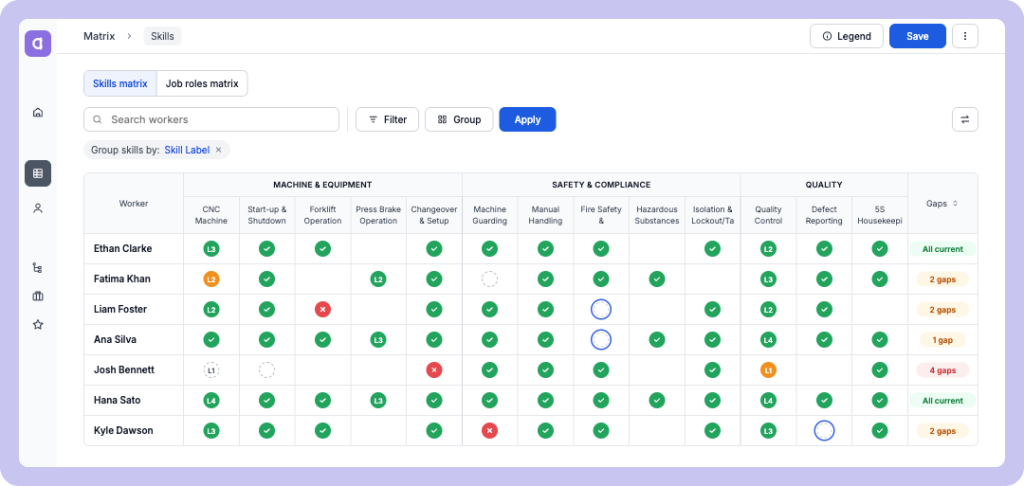
Core skills include computer numerical control (CNC) operation and start-up and shutdown procedures. Machine guarding, manual handling, and fire safety training are usually mandatory. Many manufacturers rate quality checks from novice to expert, rather than pass or fail.
Maintenance Technician Skills Matrix
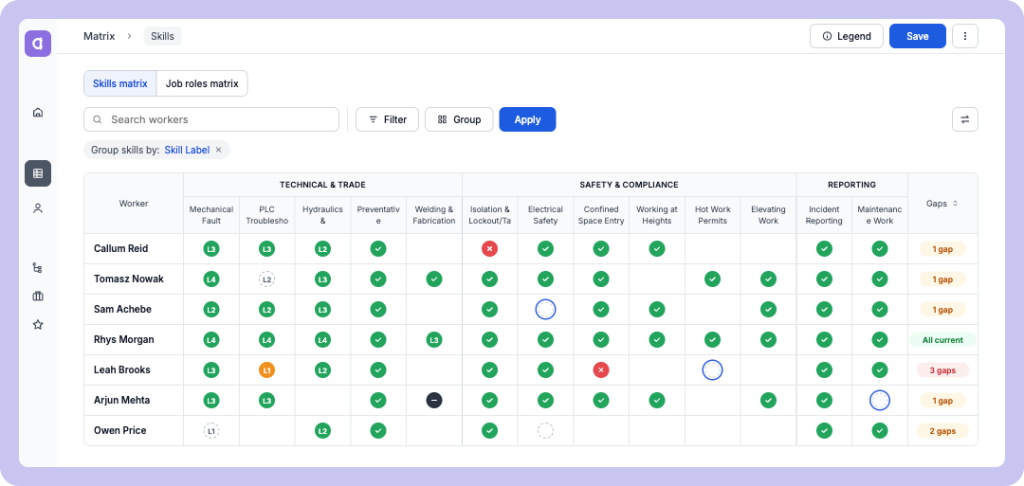
Isolation and lockout/tagout sits at the top of every maintenance technician’s matrix. A lapsed competency puts the technician and their colleagues at serious risk. Other key skills include mechanical fault diagnosis and programmable logic controller (PLC) troubleshooting. Electrical safety and confined space entry often apply too. VOC records confirm technicians can safely perform these high-risk tasks.
Production Supervisor Skills Matrix
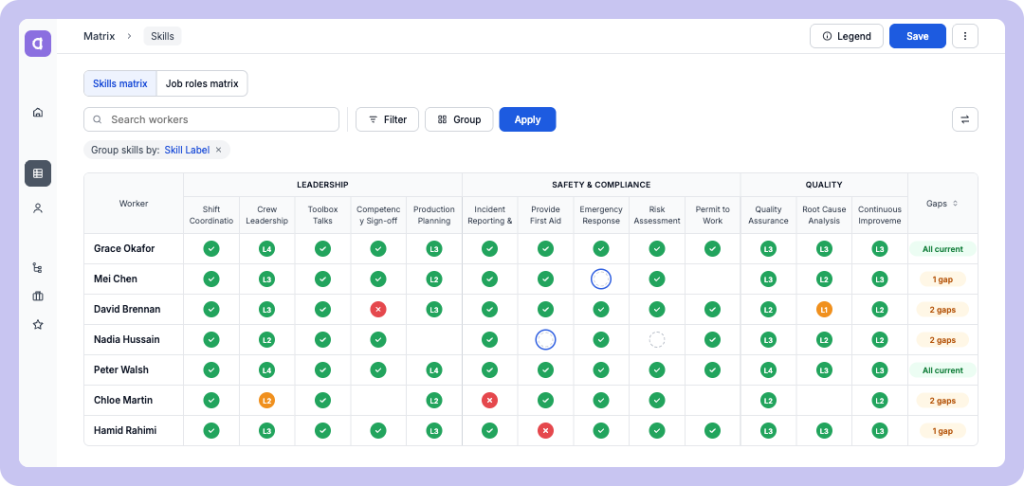
Production supervisors need leadership skills alongside technical knowledge. Shift coordination, incident reporting, and quality assurance belong on their matrix. First aid and emergency response matter too, as supervisors often lead the response. Supervisors who sign off others’ competency should have that authority recorded.
Quality Inspector Skills Matrix
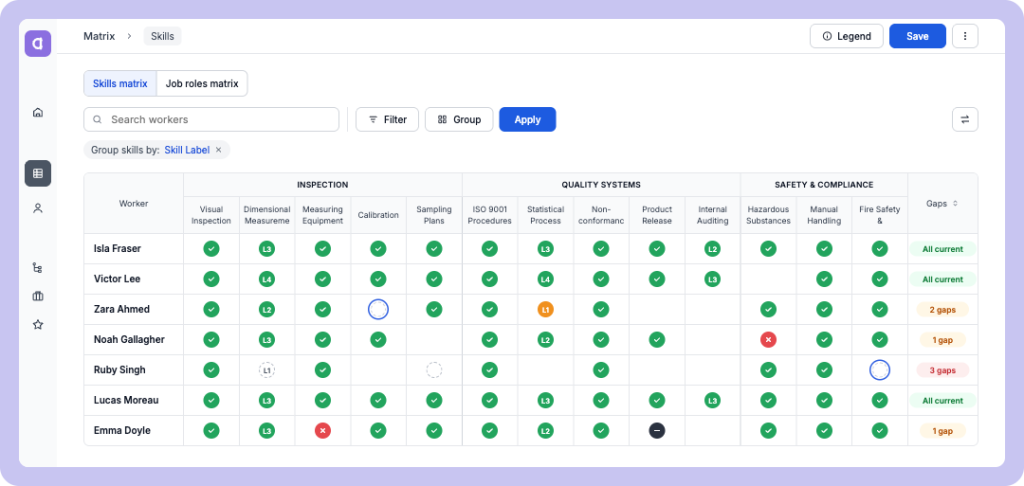
Quality inspectors protect product standards and support ISO 9001 compliance. Their matrix tracks inspection methods, measuring equipment use, and defect reporting. Calibration and statistical process control often apply to senior inspectors. Hazardous substances handling is common in chemical and food manufacturing. Proficiency levels show who can approve product release.
Drive Results with a Smarter Skills Matrix
For manufacturing companies, a skills matrix is more than a training tool. It’s a strategic asset. Skills mapping and tracking support safety, compliance, efficiency, and workforce adaptability in environments where performance and risk must be carefully balanced.
By investing in the right matrix and tools, you’ll empower your teams, reduce operational risks, and future-proof your workforce.
Ready to get started? Download our free skills matrix template to start building a smarter, safer, and more capable workforce. Or book a demo with Cloud Assess to see how our platform can help you digitise and scale workforce development.