Strengthens Compliance and Risk Management
In regulated industries, an employer has to ensure workers are competent for the tasks they perform. That duty sits with the organisation, not the worker, and a certificate on file is not the same as demonstrating competence. Skills management is how an organisation meets that obligation in practice. Before work is assigned, a supervisor can confirm the person holds the required skill and that it is current. Where it is not, the assignment changes or the training happens first.
It also gives risk management something concrete to work with. A competence gap is a risk the organisation can identify, rate, and treat like any other, rather than one that only becomes visible after an incident. The same record answers the regulator afterwards, showing who was assessed, against what standard, and when.
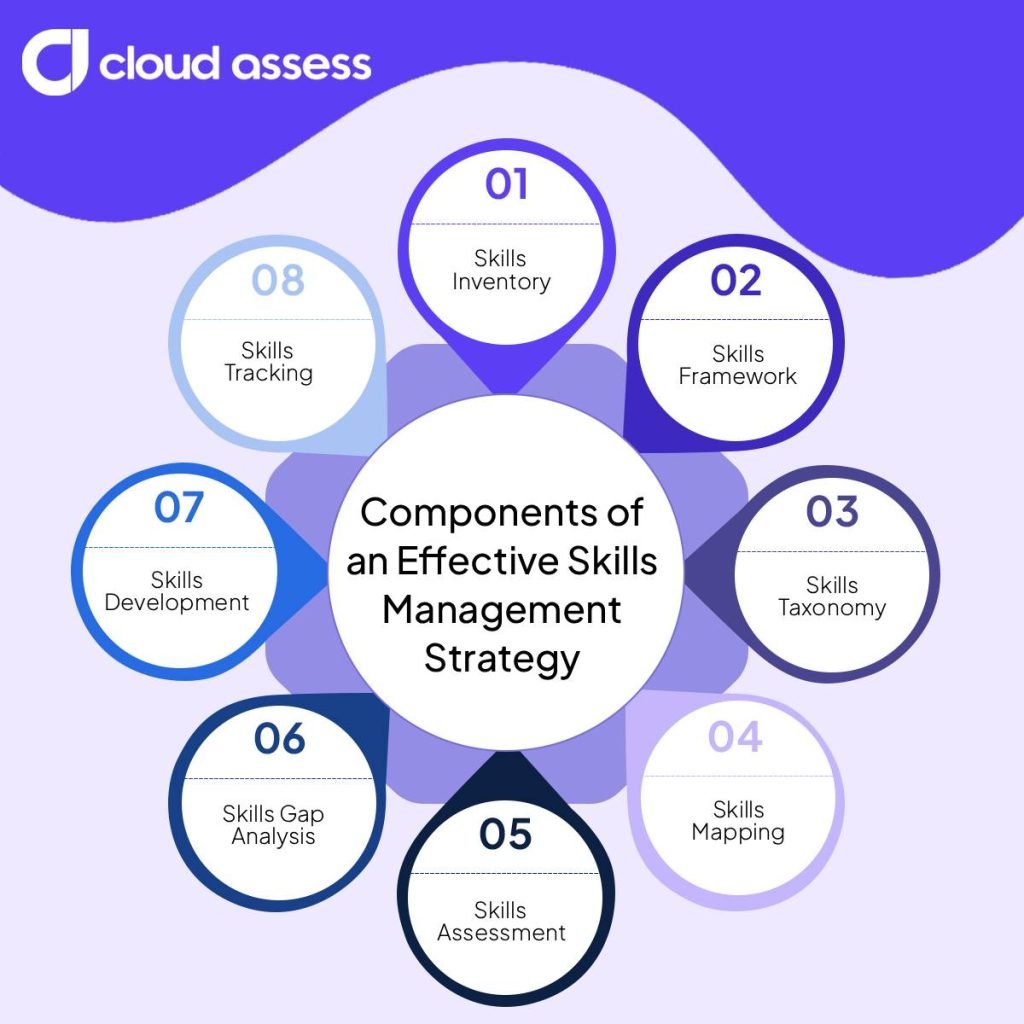
Components of an Effective Skills Management Strategy
Skills Inventory
A skills inventory is a detailed database that lists employees’ skills across the organisation. It helps companies see what competencies are available in different departments, enabling better workforce planning and quick talent allocation to various projects. This is crucial for identifying untapped skills and ensuring resources are used effectively.
Example: A mining operation uses a skills inventory to confirm which employees hold a current high-risk work licence for dogging and rigging, so it can staff a shutdown without hiring contractors.
Skills Framework
A skills framework sets out the skills each role requires and the standard an employee must reach at each level. It gives managers and employees a shared reference for what competence looks like in a given role.
Example: A healthcare provider builds a framework for enrolled nurses. Level 1 covers core clinical observations, Level 2 adds medication administration, and Level 3 requires supervision of junior staff.
Skills Taxonomy
A skills taxonomy organises and groups skills into a structured system. It creates a common language for teams to discuss organisational skills and competencies.
Example: A construction company organises its taxonomy into plant operation, high-risk work, site safety, and supervision. Each group holds the individual skills that sit beneath it.
Skills Mapping
Skills mapping helps which employees hold which skills, and how that maps against the roles those skills support. This process makes sure the right people are matched with the right jobs or projects.
Example: Skills mapping shows that one employee holds the confined space entry qualification a job requires, while another holds the gas testing competency needed alongside it.
Skills Assessment
A skills assessment measures how an employee’s current skills compare against what their role requires. Organisations use self-assessment, supervisor verification, practical observation on the job, and formal testing against a defined standard.
Example: A supervisor observes a technician completing an isolation procedure, then records whether each step met the required standard.
Skills Gap Analysis
Skills gap analysis compares the skills employees currently have with those needed for specific roles or projects. It helps pinpoint important gaps that need to be filled through hiring, training, or upskilling.
Example: A transport operator runs a gap analysis and finds that only three of its twelve drivers hold the dangerous goods licence an upcoming contract requires.
Skills Development
Once gaps are identified, skills development focuses on closing those gaps through targeted training programs, upskilling, and reskilling initiatives. A solid skills development strategy aligns with the company’s goals, ensuring employees improve in ways that benefit their growth and the organisation.
Example: If a gap analysis shows most supervisors lack formal safety leadership training, the organisation enrols them in a targeted program rather than running generic management training.
Skills Tracking
Skills tracking follows how skills across the workforce change over time, including progress against development plans and certifications approaching expiry. Where an inventory shows what the workforce holds now, tracking shows what is improving and what is lapsing.
Example: A manufacturer reviews its skills data each quarter to see which competencies are improving across the workforce, and which certifications are approaching expiry.
How to Implement a Skills Management Program
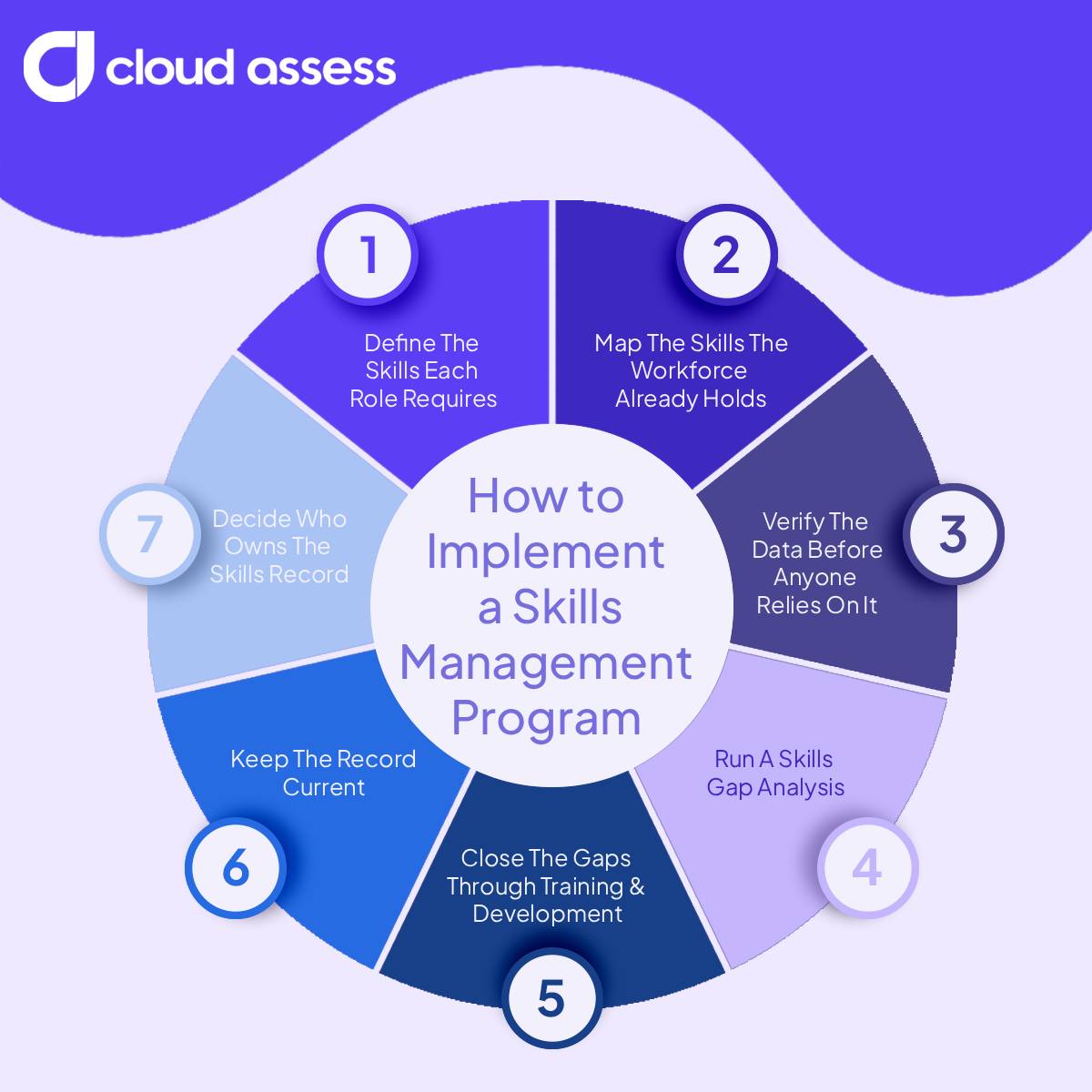
1. Define the Skills Each Role Requires
Start with the work, not the people. For each role, list the skills someone needs to perform it safely and competently, and the standard they need to reach. That list becomes your skills framework. Keep the first version narrow. Twelve to twenty skills per role covering the tasks that matter is enough to start. A framework with 300 skills looks thorough, but never gets used.
Build it with supervisors. HR knows what the position description says. The supervisor knows the job requires a skill nobody wrote down. Where licences or statutory training already set a standard, anchor the framework to those rather than inventing parallel ones.
2. Map the Skills Your Workforce Already Holds
Record what each employee holds against the framework. Pull existing sources first. Training records, licence registers, and qualification copies will cover part of the workforce before anyone fills in a form. Collect the rest through self-assessment, which is the fastest method at scale. Explain the purpose before you launch it. Where employees expect the ratings to affect their standing, the data becomes unreliable.
Expect the first map to be incomplete. Getting partial data that shows where the gaps are beats waiting for a full picture.
3. Verify the Data Before Anyone Relies On It

Self-reported skills are claims, not evidence. Before the record informs rostering, promotion, or audit responses, someone needs to confirm the claims hold up. Verification takes three forms.
- Supervisor sign-off covers skills a manager has observed.
- Practical observation covers tasks with a defined standard, where an assessor watches the work and records the result.
- Documentary evidence covers licences, where the certificate is the proof.
Match the method to the risk, and record who verified each skill and when.
4. Run a Skills Gap Analysis
Compare what the workforce holds against what the framework requires. Gaps fall into three types.
- Individual gaps are where one person lacks a skill their role needs. These become training assignments.
- Coverage gaps are where too few people hold a skill the work depends on. A team with one qualified person for a critical task has a coverage gap, even though that person is competent.
- Emerging gaps are where a skill will be required but is not yet, usually through new equipment, a new contract, or a regulatory change.
Run the analysis at team level first. Organisation-wide numbers hide the concentrations that matter.
5. Close the Gaps Through Training and Development
Tie every training assignment to a specific gap. Generic programs are easier to get buy-in for and harder to justify, because nobody can say afterwards which gap closed. Sequence by risk, not by volume. Coverage gaps on high-risk tasks come first, since those are the ones that stop work or create exposure. Individual gaps on lower-risk skills can wait for the next cycle.
Match the method to the skill. Practical skills need supervised time on the task. Knowledge-based skills suit self-paced courses or eLearning. Judgement-based skills develop through coaching and exposure, not a module. Assess afterwards and update the record. Training that closes a gap has to be verified like any other skill, or the gap stays open on paper.
6. Keep the Record Current
A skills record decays from the day it is built. People change roles, licences expire, and requirements move. Set two cadences.
- A rolling one for expiries, checked monthly, so renewals are scheduled before anything lapses.
- A periodic one for the framework itself, reviewed annually, to add skills the work now requires and remove those it doesn’t.
Define the triggers that force an update outside both cycles. These could include new roles, new equipment, regulatory changes, or completed assessments.
7. Decide Who Owns the Skills Record
Without a named owner, the record is accurate for a quarter and then quietly goes stale. Split it deliberately. One function owns the system, usually HR or L&D, covering the framework, the reporting, and the review cycles. Supervisors own accuracy for their own teams, because they are the only people who see whether the work is performed to standard.
Programs fail when one function owns both. HR cannot verify how work is actually performed, and supervisors cannot maintain a framework across the organisation. Make the split explicit, and give supervisors a defined task with a deadline rather than a general responsibility.
Tools for Managing Workforce Skills
Skills Management Software
Workplace skills management software gives an organisation one place to hold its skills framework and record who holds which skills at what level. These platforms typically include a skills matrix tool, which teams use to view current skills by role, team, or site and identify where the gaps sit.
What these platforms do varies across the market. Some record what employees and managers enter, which makes them useful for visibility but leaves the data as a set of claims. Others let organisations assess employees against a defined standard, capture supervisor sign-off, and attach evidence to each skill, so a skill level can be substantiated. Those platforms also track licence and refresher expiry, and push verified skills data into the HRIS, payroll, and safety systems an organisation already runs.
Learning Management Systems
A learning management system (LMS) delivers and records training. Organisations use it to assign courses, track completion, and hold certificates in one place, which covers the delivery side of closing a skills gap. Most also include a skills matrix tool built from training records.
An LMS records that training was completed. It does not confirm whether the employee can perform the task to standard, which is why organisations in regulated industries generally run both an LMS and a skills platform.
How Cloud Assess Supports Skills Management for Frontline Teams
Cloud Assess is a flexible all-in-one LMS and skills platform built for frontline workers and high-risk industries. Its Workforce Skills solution supports organisations in their efforts to effectively manage team skills.
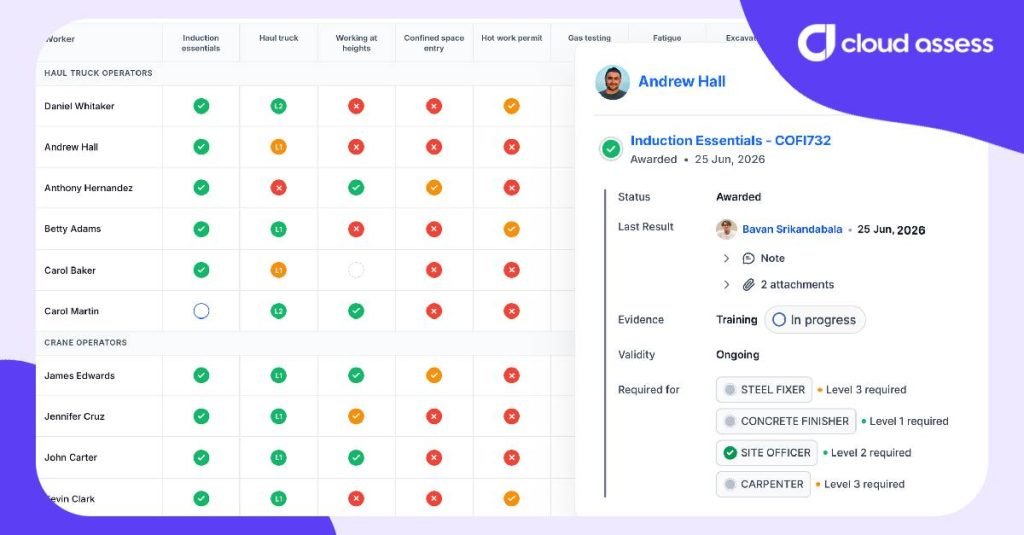
The platform offers features like:
- Skills and job role mapping. With Cloud Assess, companies can define what competence looks like for each role, then map every worker against it.
- Live skills matrix. The platform offers a real-time view of who holds which skills, at what level, filtered by site, business unit, or job role. Multi-level skills show progress rather than pass or fail.
- Verification of competency. With Cloud Assess, assessors can verify skills where the work happens, capturing photo, video, and location-stamped evidence. This works offline, so teams can assess and sign off on remote sites, then sync once back in range.
- Gap analysis. With Cloud Assess, organisations can see which workers are not cleared for a role, and exactly which training closes the gap.
- HR system integration. Companies can sync competency, currency, and expiry data with the HR, rostering, and safety platforms they already run.
Find out how your organisation can verify skills, close gaps, and prove competence across every site. Request a demo today to see Workforce Skills in action!