

The way people learn at work has changed a lot in recent years. In the past, formal training and university education were seen as essential in the workplace. But more companies have come to value practical skills and real-world experiences over academic qualifications. This change has made employers focus more on skills and learning while working.
This change started in the 1980s, when the 70:20:10 model of learning was first introduced.
In this article, we explore:
- What the 70:20:10 model means
- The components that make up 70%, 20% and 10% of learning
- How the model can be applied in different learning environments
- Benefits and challenges of using the 70:20:10 model in learning and development (L&D)
- Technologies that support implementation

What is the 70:20:10 Model in L&D?
The 70:20:10 model shows that people learn best through experience, talking to others, and formal training. It’s expressed as a ratio broken down into three parts: 70% of experiential learning, 20% social learning, and 10% formal learning.
Morgan McCall, Michael Lombardo and Robert Eichinger introduced the learning framework in the 1980s. They surveyed leaders and executives, asking what had the biggest impact on their management styles.
The results showed that the vast majority of learning came from their experiences and assignments on the job and from discussions with colleagues and mentors.
But the 70:20:10 model is not just about how people gain knowledge. It shows why it’s important to balance formal and informal learning. This helps employees remember what they learn and build workforce skills. Today, many companies incorporate the model into their employee training strategies by shifting focus away from theory and towards practical, hands-on training methods.
70:20:10 Model vs Other Learning Models
70:20:10 Framework vs Learning Pyramid
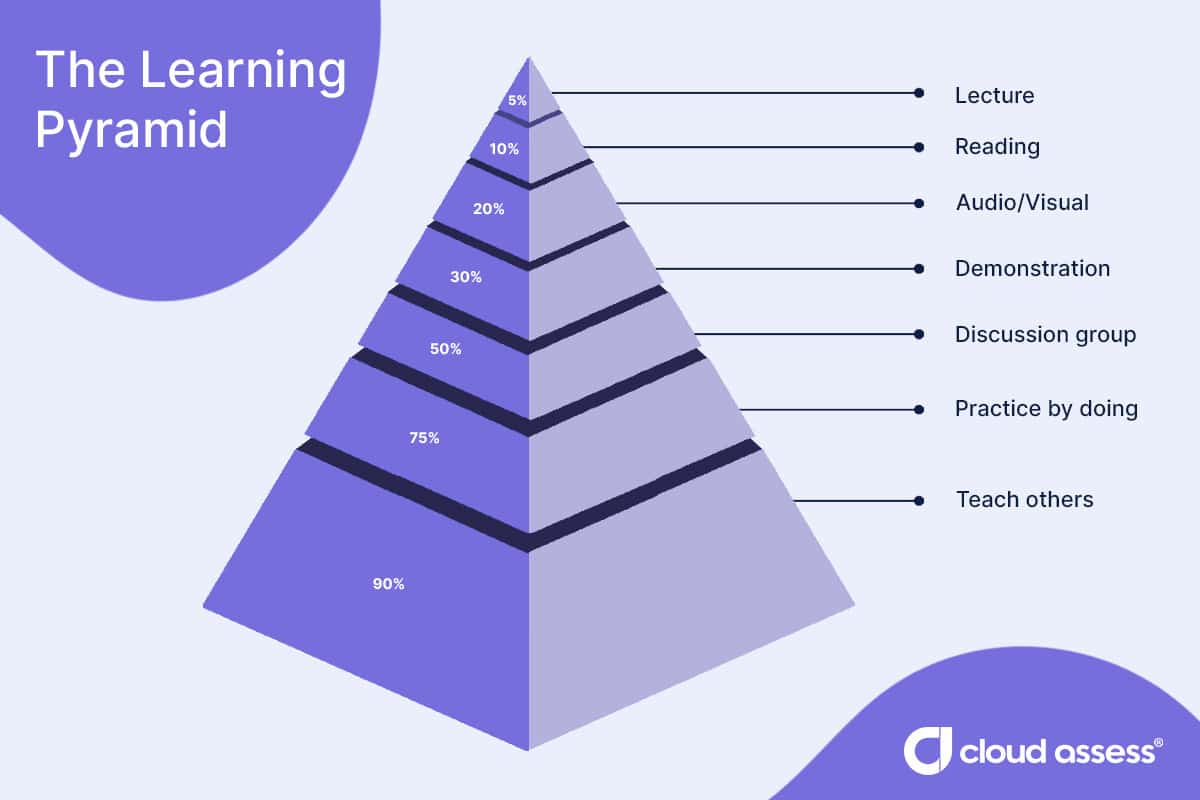
The Learning Pyramid, also called the Cone of Learning or Retention Pyramid, shows how well people remember information depending on how they learn. It proves that active methods, like hands-on experience and teaching others, help people remember more than passive ones like reading or listening.
This aligns with the 70:20:10 model. It offers a simple way to use high-retention workplace training activities. The model highlights that people learn more through doing and interacting than just by sitting in a classroom.
70:20:10 Model vs 10+ Model

The 10+ model is a term sometimes used to point out companies that say they use the 70:20:10 model but focus too much on formal learning. These organisations rely on structured training courses but don’t connect learning to daily tasks.
This misses the point of the 70:20:10 model, which shows most learning happens through doing the job and learning from others—not just through formal training.
Components of the 70:20:10 Approach

70% Experience
70% of learning comes from doing the job. It includes the daily tasks employees complete, the tools they use, and the challenges they solve. This type of learning helps them get better at their roles and build real skills.
This learning often happens informally, but it can also be planned. For example, employers can offer new recruits structured induction training with job shadowing, guided practice, and hands-on demos. This lets people learn by doing, while following correct procedures and meeting standards.
Tip: Want to learn more about learning from experience? Discover Kolb’s Experiential Learning Cycle.

20% Exposure
20% of learning comes from other people. Employees learn through mentoring, coaching, feedback, and informal chats with coworkers. These peer interactions help them find new ways to solve problems.
Often, employees take the lead by asking others for help or advice. But companies can support this too—by offering coaching programs, group projects, or 360 feedback reviews. These create more chances to learn from others and grow.
These types of experiences often involve self-directed learning, where employees seek out colleagues to talk to about their work or ask for feedback without prompting. However, companies that develop mentorship and coaching programs can also encourage newer employees to learn from experienced colleagues. Asking teams to collaborate on projects or participate in 360 performance reviews also fosters exposure to new perspectives and ways of working.
Example: A new manager is paired with an experienced mentor who excels at leading team meetings, providing feedback and resolving conflicts. Regular coaching sessions and observing meetings help the manager learn creative leadership techniques for handling challenges they might face in their new role.

10% Education
The 10% in the 70:20:10 model refers to structured education and learning activities. These include formal courses, certifications, and workshops that give employees the theories and processes they need for their roles.
Even though formal learning is only 10%, it’s still important for learning new ideas. It helps employees build a foundation of knowledge that can be expanded on through exposure and experience. Formal learning is also essential for complying with regulatory and industry standards, which require companies to enrol employees in specific in-person, classroom or online training.
However, formal training is most effective when followed by practical application and social reinforcement, turning theory into practice.
Example: A company launches an eLearning course on cybersecurity awareness. Employees complete the course to understand key threats and best practices, and are then encouraged to review real security incidents together by discussing response strategies. This provides them with the education and exposure to apply their learning to everyday work, where experience in cybersecurity protocols will be gained over time.
Use Cases in Learning and Development

Vocational Training
The 70:20:10 model isn’t just for the workplace. It also fits well in Vocational Education and Training (VET). Apprenticeships and internships give learners hands-on experience and exposure to real work settings. This lets them apply what they learn in the classroom. Other options like job shadowing, industry workshops, and demos also help learners build real-world skills for future jobs.
Workplace Training
New hires will often come into your organisation with a foundation of knowledge from their education or life experiences. They build on this with your employee onboarding, induction, and compliance training.
However, the majority of meaningful learning doesn’t happen in structured courses. It comes from interactions with colleagues, observing teams in action, and hands-on experience as employees navigate their current roles. Over time, they develop confidence, refine their approach, and become more efficient and productive, putting on-the-job experiences and social learning into practice.
Benefits of Using the 70:20:10 Model

Connects Training to Practical Applications
In the 70:20:10 approach, formal learning is most valuable when it’s being used to develop new skills, capabilities and competencies. Learning for learning’s sake is fine, but it’s most effective when the knowledge you gain has a practical purpose.
This helps make sure training leads to real results and is worth the cost.
Improves Productivity
It may sound counterintuitive, but mistakes are often the fastest way to learn. When employees apply new skills directly to real tasks, they might make mistakes at first. But these mistakes help them learn and improve over time.
By prioritising informal learning through on-the-job training and practical experience, employees continuously refine their processes, develop problem-solving skills, and contribute more effectively to business outcomes. These types of learners become highly productive team members, turning everyday challenges into opportunities for improvement.
Enhances Collaboration
By supporting collaborative learning, a 70:20:10 approach strengthens communication, builds trust, and encourages knowledge sharing across your organisation. When employees regularly exchange ideas, insights, and feedback, they build a shared understanding of processes, tools, and challenges. This reduces the risk of critical knowledge being siloed with one person, something that could have a real impact on operations if they were to leave unexpectedly.
Encourages a Culture of Continuous Learning
People want to work for companies that support continuous professional development. These are the organisations where employees see long-term career potential, not just temporary roles.
Using the 70:20:10 model in your employee development plans is a good way to keep learning going. The longer employees remain with your organisation, the more experience they gain, helping them improve and making them better candidates for internal recruiting opportunities. This further improves job satisfaction, engagement and, ultimately, employee retention.
Supports a More Agile Workforce
Employees who keep learning new skills are better able to handle changes at work. They become more adaptable, learning to apply their abilities in changing scenarios. This kind of agile workforce helps organisations pivot quickly as new technologies emerge, industry standards evolve, and market demands shift.
Since they don’t have to wait for formal courses, employees can change how they work faster as business needs change.
Challenges When Implementing 70:20:10 in L&D

Minimises the Importance of Formal Training Methods
The 70:20:10 approach places the least emphasis on formal training. Some companies see this as a reason to ignore structured learning or reduce investment in learning and development. This can lead to knowledge and skill gaps if formal learning is completely deprioritised.
Solution: Treat the 70:20:10 ratio as a guiding framework, not a strict quota. In some situations, particularly when onboarding new employees or supporting skills-first hiring, a formal approach may be necessary to build essential knowledge.
Even then, combining formal instruction with follow-up experiences and social interactions helps reinforce learning and improve knowledge retention. A well-balanced L&D budget should support both structured and informal learning to ensure long-term growth and capability development.


