What is Cognitive Load?
Cognitive load is the amount of thinking the brain does to handle information at once. It describes how much working memory capacity and cognitive resources people use during a task.
Types of Cognitive Load

Intrinsic Cognitive Load
Intrinsic load is the complexity of the information itself. This means that when the material is more difficult or has many parts, the brain needs to work harder to understand it. This is especially true during the early stages of cognitive skill acquisition. In these early stages, people build core mental abilities like thinking, reasoning, and problem‑solving.
Extraneous Cognitive Load
Extraneous load happens when materials present information poorly. When the presentation is unclear or full of distractions, learners have to use extra mental effort to handle them. This effort takes away from actual learning.
Germane Cognitive Load
Germane load is the mental effort used to make sense of information. This effort helps learners organise what they know and build deeper understanding.
How Cognitive Load Impacts Learning

Overload Leads To:
- Confusion: Learners experience cognitive overload when they face too much information at once. This makes it hard to process complex ideas clearly. As a result, their ability to build knowledge suffers.
- Frustration: High mental demands often cause learners to feel stressed and lose motivation. This drop in engagement can slow down the learning process.
- Poor retention: When cognitive load is too high, the brain struggles to store information effectively. This leads to weaker knowledge retention and makes recall more difficult.
Optimal Load Supports:
- Deep learning: When teachers balance cognitive load, learners can concentrate better. They understand ideas more deeply. This supports power skills such as critical thinking, problem-solving and overall, meaningful learning.
- Transfer to real-world tasks: When teachers manage cognitive effort well, learners can apply what they’ve learned. They use their knowledge in practical situations. This improves skill transfer and prepares them for real-life challenges.
What is Cognitive Load Theory?
Cognitive load theory (CLT) describes how the brain handles information when learning. It’s a framework rooted in cognitive science, focusing on the amount of information processed at any one time.
John Sweller developed the theory in the late 1980s. He aimed to understand how the human brain processes and retains information during learning. Sweller’s educational research focused on improving instructional design by aligning it with the brain’s cognitive capacity.
How Cognitive Load Theory Differs from Other Learning Theories
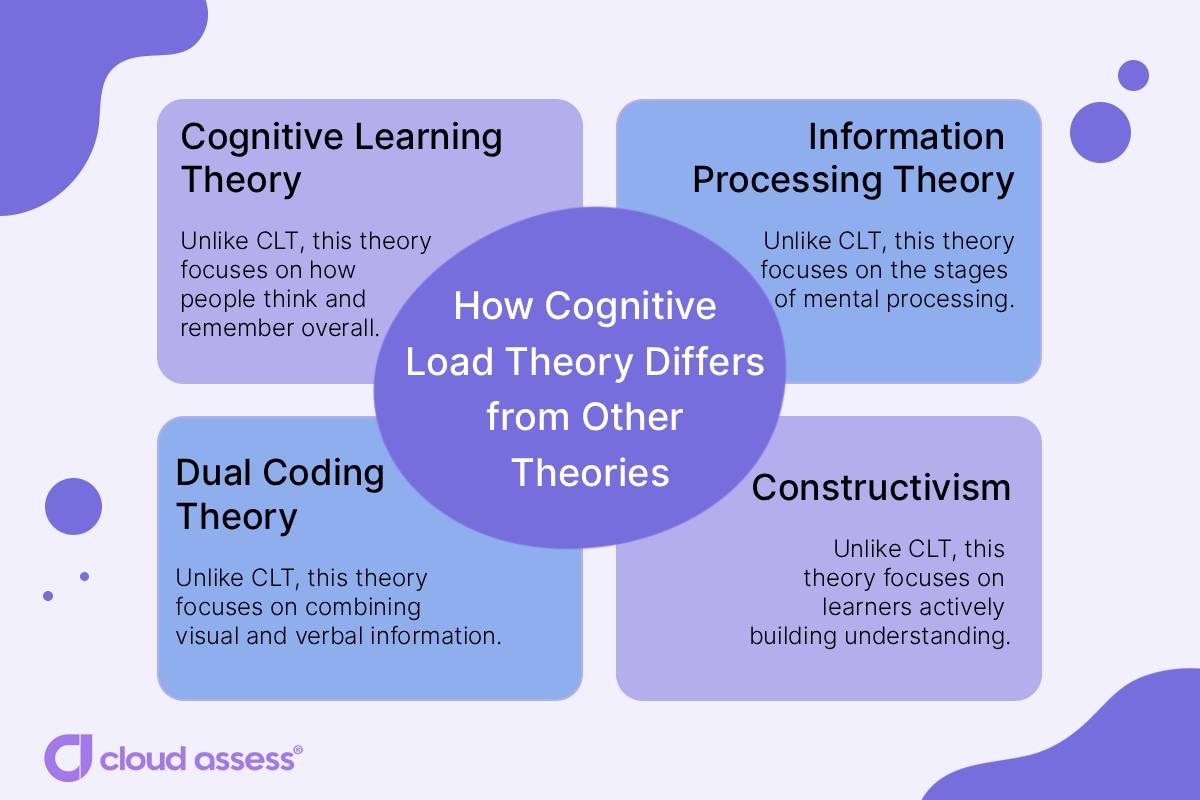
Cognitive Load Theory vs Cognitive Learning Theory
Cognitive learning theory looks at how people think and remember when they learn. It covers things like attention and how we solve problems.
Cognitive load theory focuses on one part of that process, how much information our brain can handle at a time.
Cognitive Load Theory vs Information Processing Theory
Information processing theory explains how the brain takes in, stores, and retrieves information. It views learning as a step-by-step process involving attention, perception, and memory.
Cognitive load theory builds on this by focusing specifically on the limits of working memory during learning. While information processing theory describes the stages of mental processing. Cognitive load theory provides practical strategies to manage the mental effort needed.
Cognitive Load Theory vs Dual Coding Theory
Dual coding theory says the brain learns better when it gets information through two channels. It argues that using pictures and words together helps us understand and remember more.
Cognitive load theory is different. It focuses on how much information to give and how to organise it during learning.
Cognitive Load Theory vs Constructivism
Constructivism says learners build their own understanding. They do this by connecting new information to what they already know. It focuses on active learning and personal experience.
Cognitive load theory highlights the brain’s limits on processing information. Constructivism focuses on the learner’s active role. But cognitive load theory focuses on how to design instruction that fits the brain’s capacity.
Benefits of Applying CLT in Education

Improved Learning Efficiency
The theory helps educators design instruction that matches the brain’s capacity. One key strategy is breaking complex tasks into smaller, manageable chunks. This step-by-step approach prevents learners from feeling overwhelmed. It helps them build skills steadily and confidently.
For example, the instructor avoids teaching all the steps at once. They begin by explaining how to start the machine safely. Once learners master that, the trainer moves on to operating controls. Then, they progress to troubleshooting.
Better Knowledge Retention
CLT encourages removing distractions and organising information clearly. This clarity helps learners store critical information in long-term memory. As a result, it becomes easier to recall in real situations.
For instance, in a health and safety course, trainers avoid cluttered slides or irrelevant images. Instead, they focus on clear bullet points and simple diagrams explaining emergency procedures.
Higher Engagement
When educators apply CLT principles, they create learning experiences that keep learners motivated. For example, breaking content into short modules helps learners focus better. Microlearning units also fit well with their attention spans. Providing immediate feedback during interactive simulations keeps learners interested and reduces frustration. These factors result in higher participation and improved learner engagement.
Inclusive Education
Applying the theory allows educators to adjust the complexity of material. They match it to the learner’s level of expertise. This tailored approach ensures everyone stays challenged without feeling overwhelmed. It supports diverse learning needs.
For example, in a mixed-level vocational class, beginners might first watch detailed demonstrations. Meanwhile, more experienced learners tackle advanced scenarios.
Enhanced Instructional Design
Cognitive load theory guides educators to create effective materials. They integrate text and visuals to reduce split attention. This clear, organised presentation speeds up understanding and skill development.
For example, in technical training, trainers place labels directly on machine diagrams. This approach helps learners connect concepts quickly, rather than using separate text slides.
How to Apply CLT in Vocational Education
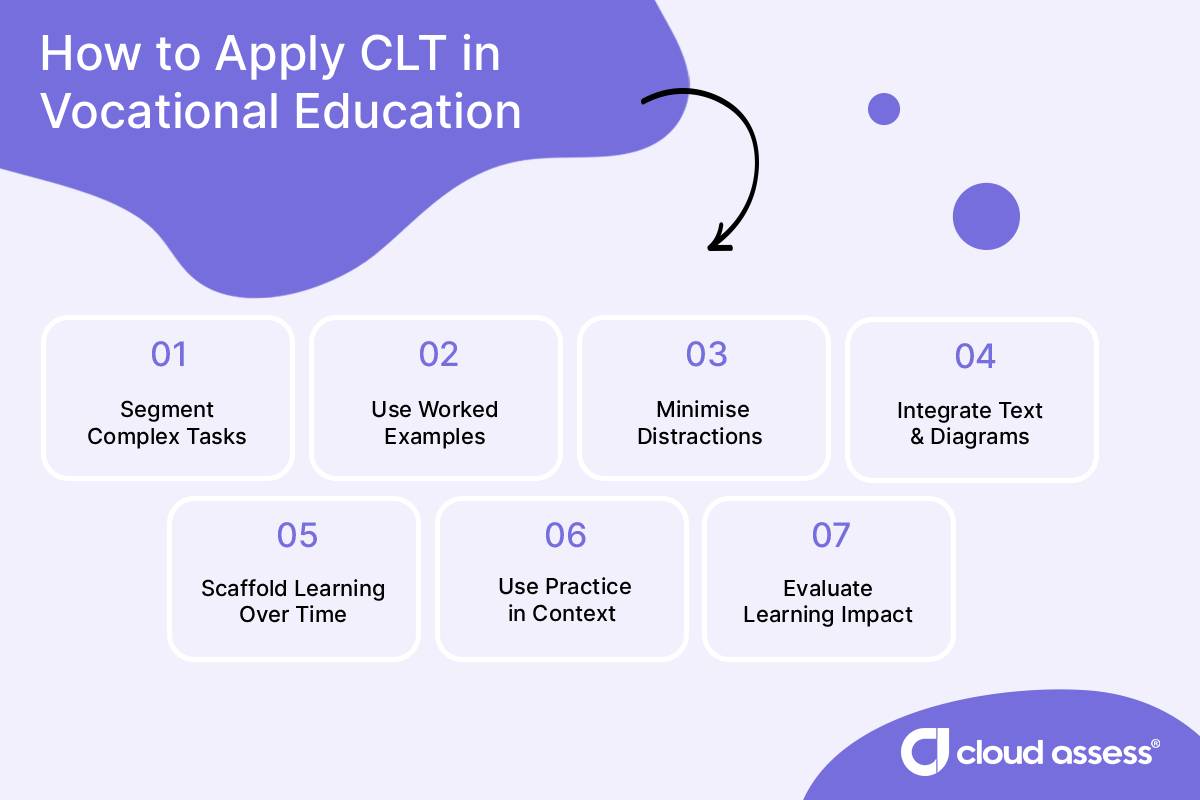
1. Segment Complex Tasks into Smaller Steps
Break complex tasks into clear, manageable steps. For example, when teaching machine operation, first focus on safely starting the machine. Once learners master this, move on to operating controls and troubleshooting. Use flowcharts or numbered lists to guide learners through each stage.
2. Use Worked Examples
Provide full examples of learning tasks before asking learners to perform them. In healthcare training, demonstrate a complete patient check-up first. Follow with partially completed examples that require learners to fill in missing steps.
3. Minimise Distractions in Learning Materials
Remove irrelevant visuals, jargon, and animations from your materials. For instance, in a safety manual, avoid flashy graphics like spinning animations or decorative images. Also, steer clear of complex language and avoid technical jargon. For example, don’t use phrases like “synergistic protocol optimisation.” Avoid long, dense sentences too. Instead, use clear phrases like “working together to improve procedures.” Keep sentences short and straightforward so learners can easily understand.
4. Integrate Text and Diagrams
Place explanatory text close to the relevant part of diagrams or equipment photos. For example, when training learners on electrical wiring, label components directly. Do this on the wiring diagram. This approach helps learners make quick, accurate connections between text and visuals. It reduces unnecessary eye movement and confusion.
5. Scaffold Learning Over Time
Start training sessions with guided practice. Use detailed checklists and prompts to support learners. For example, in culinary training, instructors might provide step-by-step recipes. These include clear instructions at first. As learners gain experience, gradually remove these supports.
6. Use Practice in Context
Create realistic environments where learners can apply their skills. These settings should mimic actual work conditions. For example, automotive trainees should spend time in workshops. There, they work on real vehicles under supervision. This helps them transfer classroom knowledge to practical tasks. Similarly, healthcare students can use simulation labs to rehearse patient care scenarios safely.
7. Evaluate Learning Impact
Implement regular assessments and feedback loops. Use these to monitor how learners cope with task complexity and the pace of instruction. Use surveys, quizzes, or direct observations to identify signs of overload or disengagement. Adjust the training content or speed based on what you learn. This might include simplifying instructions or adding more practice time. It might also involve breaking tasks into smaller segments.
How to Apply CLT in Workplace Training
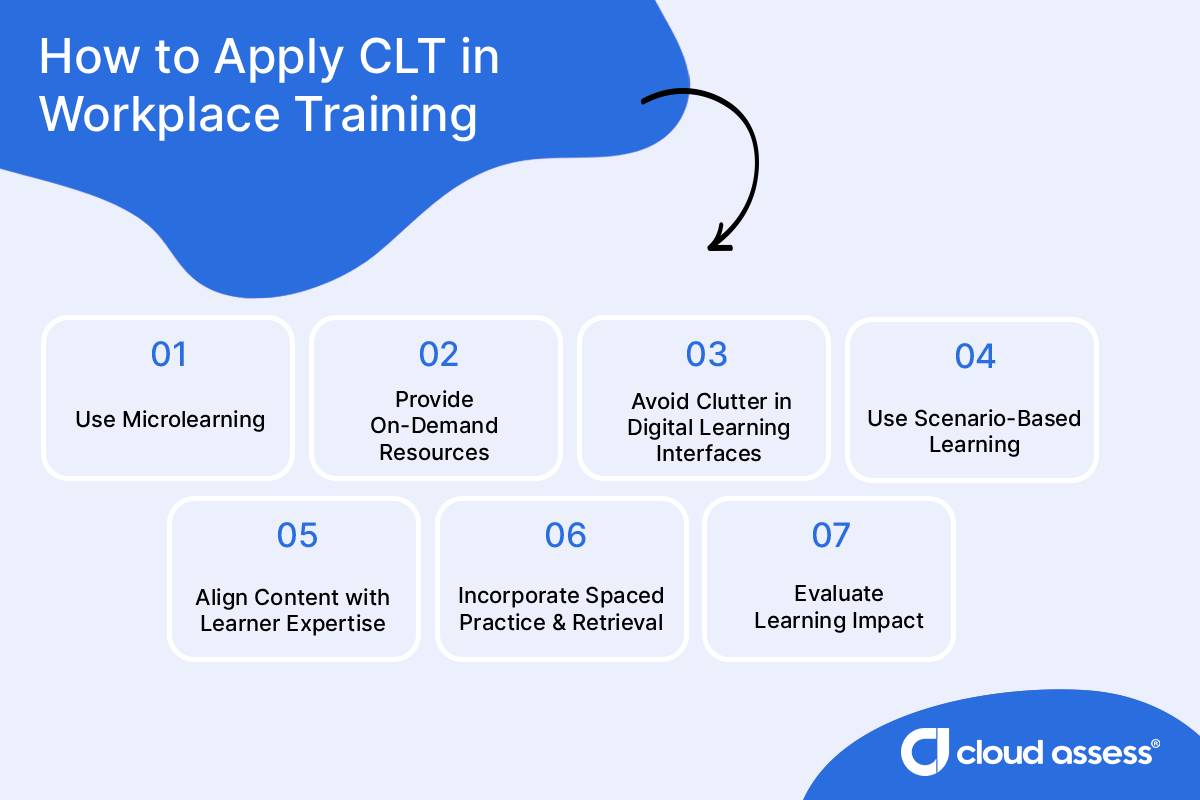
1. Use Microlearning to Limit High Cognitive Load
Create microlearning training units that last around five minutes each to reduce cognitive load. For example, break down a manufacturing safety course into separate videos. A microlearning example would be one video covering wearing protective gear and another focusing on operating a forklift. A third explains emergency procedures. Alternatively, design scenario modules where learners practice one skill at a time. For instance, they might first learn to stack materials correctly. Then, they move on to equipment inspection.
2. Provide Just-in-Time Learning Resources
Provide quick reference tools accessible exactly when needed. For instance, place QR codes on machinery or workstations that link to concise step-by-step guides. Learners can also access these guides through mobile-friendly learning management system (LMS) links. If a warehouse worker forgets how to perform a pallet inspection, they can scan the code or open the LMS. Both options let them watch a brief refresher video or review a checklist right on the floor.
3. Avoid Clutter in Digital Learning Interfaces
Keep digital learning platforms simple and focused. For example, design dashboards carefully. Show only the current training module and essential navigation. Avoid unrelated alerts or advertisements. These can distract employees during shift breaks.
4. Use Scenario-Based Learning and Decision Paths
Create branching scenarios based on real frontline tasks using scenario-based learning. For example, a healthcare worker might decide how to respond to a patient showing symptoms of infection. Different choices lead to varied outcomes with immediate feedback on each decision’s impact.
5. Align Content with Learner Expertise
Offer different learning paths for new and experienced workers. For example, new retail staff might follow a structured program on store policies and customer service basics. Experienced employees can access optional modules on inventory management or leadership skills. They can choose the order in which they complete these modules.
6. Incorporate Spaced Practice and Retrieval
Schedule follow-up quizzes and activities after initial training. For instance, after a logistics safety course, send monthly quizzes covering key procedures. These can include topics like safe loading practices. This helps reinforce learning over time.
7. Evaluate Learning Impact
Collect training feedback and track performance regularly. For example, if many employees struggle with a training module on machinery maintenance, take a closer look at the content. Analyse it for complexity. You might break it down into smaller steps or add clearer visuals and examples.
Challenges in Applying Cognitive Load Theory
Balancing Load Across Diverse Learners
Learners in any learning environment come with different backgrounds, experience levels, and abilities. Designing instruction that suits everyone can be challenging. Some learners may find the material too basic while others struggle with complexity.
Solution: Use adaptive learning strategies or tiered content. For example, offer foundational modules for beginners. Then provide optional advanced material for more experienced learners.
Time Constraints and Content Pressure
Educators and trainers often face limited time and extensive curricula or training requirements. This can lead to overloading sessions with too much information. This increases unnecessary cognitive load risk.
Solution: Prioritise key content and break learning into shorter, focused segments. Microlearning and spaced practice can help learners absorb material gradually.
Measuring Load Accurately
It’s hard to tell if learners are getting too much or too little information without clear feedback. You also need ways to measure cognitive load, mental effort, and working memory use. Getting this wrong can make learning less effective.
Solution: Implement regular formative assessments, surveys, and learner feedback mechanisms. Monitor signs of overload, such as confusion or disengagement, and adjust accordingly.
Misaligned Stakeholder Expectations
Different stakeholders may have conflicting expectations about training pace, depth, and methods. This can hinder effective cognitive load management.
Solution: Foster open communication and collaboration among stakeholders. Clarify the goals of applying cognitive load principles and involve all parties in planning and evaluation.
Technology Overuse or Poor User Experience
Excessive or poorly designed digital tools can distract learners, adding unnecessary cognitive load. This applies across educational contexts from classrooms to LMS for corporate training platforms.
Solution: Choose intuitive, streamlined technology solutions. Regularly review digital materials for clarity and simplicity. Provide adequate user support and training.
Other Learning Theories
Cognitive Load Theory is one of many learning theories within educational psychology. These theories help explain how people learn and provide strategies to improve education and training.
Cloud Assess has explored several of these theories, each offering different insights and practical approaches. These include:
- Cognitive Apprenticeship
- Transformative Learning Theory
- Gestalt Theory of Learning
- Self-Directed Learning Theory
- Self-Determination Theory
- Situated Learning Theory
- Connectivism